
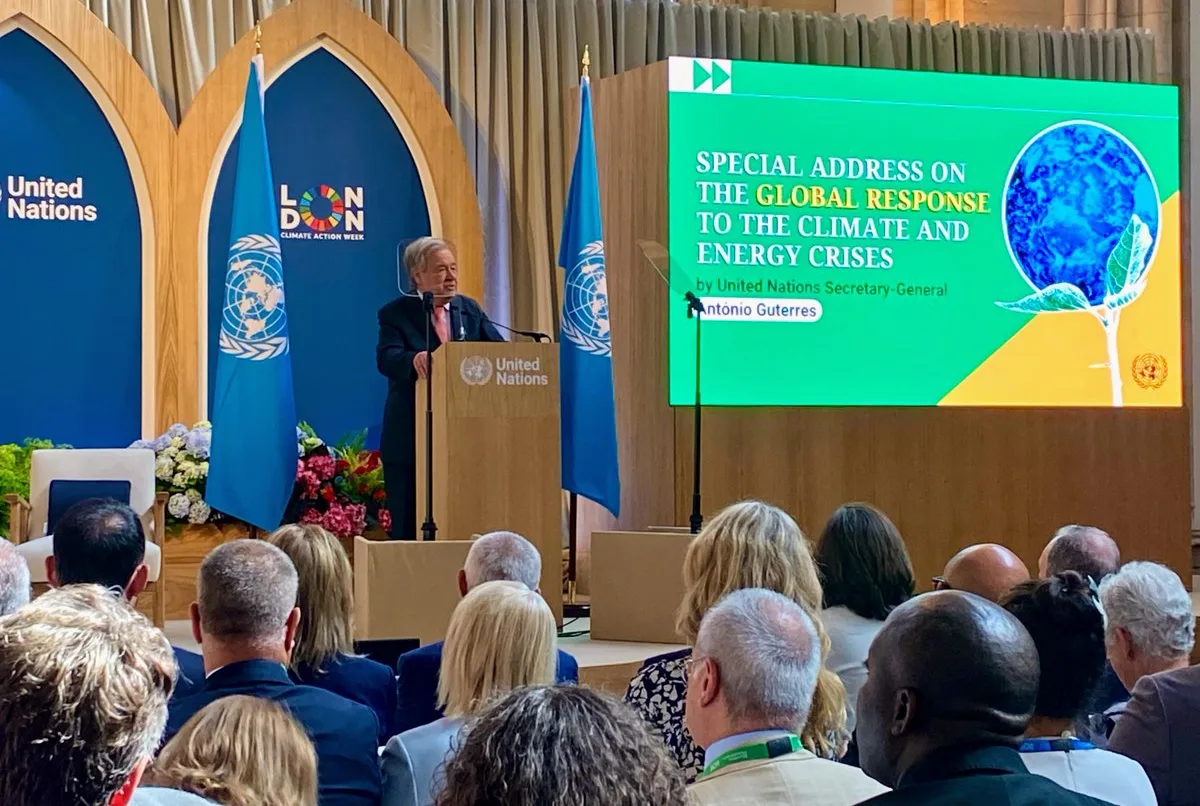
ASIATODAY.ID, LONDON – The Secretary-General of the United Nations Antonio Guterres has issued a stark warning that the world is facing “a tale of two crises” — an accelerating climate emergency and a deepening global energy shock driven by fossil fuel dependence.
Speaking at London Climate Action Week, on June 23, 2026, he said both crises share a common root cause: fossil fuels, and require a shared solution — a fast, fair transition to clean energy, alongside stronger adaptation, resilience, and climate justice for vulnerable populations.
Record Heat and Rising Climate Risks
The UN chief warned that the world has just experienced the eleven hottest years on record, with climate-related disasters becoming more frequent, more destructive, and more costly.
He cited warnings from the World Meteorological Organization that extreme El Niño conditions could further intensify global disruption, threatening food and water systems and hitting the poorest countries hardest.
He also warned that global temperatures are likely to exceed the 1.5°C threshold set under the Paris Agreement in the coming years, increasing the risk of triggering irreversible “tipping points” in the Earth system, including:
– Collapse of coral reef ecosystems
– Accelerated ice loss in Greenland and West Antarctica
– Rising sea levels threatening coastal and island nations
– Disruption of major ocean circulation systems
– Amazon rainforest degradation toward savanna-like conditions
“Every fraction of a degree matters,” he said, stressing that even temporary overshoot must be minimized and reversed as quickly as possible.
Energy Shock Deepens Global Instability
Alongside the climate crisis, the world is facing a new energy shock triggered by conflict in the Middle East. The International Energy Agency (IEA) has described the disruption as comparable to the oil shocks of the 1970s and the fallout from the Russia–Ukraine war.
For many developing countries, the Secretary-General warned, the crisis is not only about energy prices but also about rising debt, food insecurity, and stalled development.
He argued that the current fossil fuel–based economic model has exposed its structural weaknesses, making global systems vulnerable to geopolitical shocks and price volatility.
Fossil Fuel Era Under Scrutiny
The UN chief said the existing development model — heavily reliant on coal, oil, and gas — is increasingly unsustainable. He warned that continued dependence on fossil fuels risks locking in inequality, instability, and environmental breakdown.
“The world cannot go back,” he said, urging full implementation of the Sustainable Development Goals as a pathway toward aligning growth with sustainability and justice.
Renewables Surge as Costs Collapse
He highlighted the rapid expansion of renewable energy as a clear alternative, noting dramatic cost declines over the past decade:
– Solar power costs down nearly 90% since 2010
– Onshore wind costs down over 70%
– Battery storage costs down about 95%
He added that most new renewable energy capacity is now cheaper than fossil fuel alternatives, and that global investment in clean energy is nearly twice that of fossil fuels.
According to the International Renewable Energy Agency (IRENA), renewable energy saved the global economy hundreds of billions of dollars in avoided fuel costs in 2025 alone.
“There are no embargoes on sunlight and no blockades on wind,” he said, describing renewables as the foundation of true energy security.
Methane Crackdown and Clean Energy Push
The Secretary-General announced a global Call to Action on Methane, targeting emissions from waste, agriculture, and fossil fuel production.
He noted that methane is about 80 times more potent than carbon dioxide over the short term, but can be rapidly reduced using existing technologies — many at low or no cost.
He also called for near-zero methane emissions across the oil and gas value chain, arguing that voluntary measures are no longer sufficient.
AI, Energy Demand, and Transparency
The speech also addressed the rising energy footprint of artificial intelligence infrastructure. The UN chief proposed a new AI Environmental Transparency Initiative, requiring major tech companies to disclose their carbon, water, and land impacts and transition data centres to renewable energy by 2030.
Financing the Transition
A major theme of the address was climate finance and global inequality. The Secretary-General criticized the current financial system for making clean energy investment too expensive in developing countries, despite vast renewable potential.
He called for:
– Increased lending capacity of multilateral development banks
– Delivery of pledged climate finance commitments
– Expansion of guarantees, blended finance, and risk-sharing tools
– Stronger alignment of global finance with the Paris Agreement
He emphasized that Africa, despite holding vast solar and mineral resources, receives only a small fraction of global clean energy investment.
A “Just Transition” for All
The UN chief stressed that the energy transition must be fair, warning that unmanaged transitions risk deepening inequality and social instability.
He proposed a structured global dialogue bringing together governments, industry, workers, and civil society to manage the shift away from fossil fuels while protecting jobs and economies.
Protecting Science and Information Integrity
Finally, he warned of rising disinformation targeting climate science and public trust. He called for stronger protection of scientific independence, journalists, and environmental defenders, and welcomed UN efforts to improve information integrity on climate change.
“Best of Times and Worst of Times”
Concluding his remarks, the Secretary-General invoked Charles Dickens to describe the moment as both the most dangerous and most promising in modern history.
“This is the best of times and the worst of times,” he said, noting that while climate risks are accelerating, the clean energy transition is already underway and accelerating rapidly.
He said the world now faces a defining choice: whether to remain locked into fossil fuel dependence or to build a safer, fairer future powered by renewable energy. (Midwan)
Follow Us at Google News and WA Channel