
ASIATODAY.ID, BEIJING – China has renewed its push to expand its economic footprint across South Asia by proposing a China–Myanmar–Bangladesh Economic Corridor, a strategic connectivity project designed to strengthen regional trade links and reinforce Beijing’s Belt and Road Initiative (BRI).
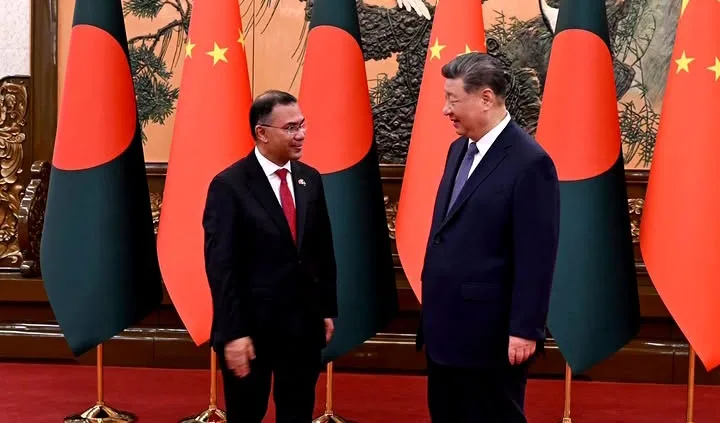
The proposal emerged as one of the key outcomes of Chinese President Xi Jinping’s meeting with Bangladeshi Prime Minister Tarique Rahman during the latter’s first official visit to Beijing on Friday.
According to a statement released by China’s Foreign Ministry, Beijing is prepared to deepen high-quality Belt and Road cooperation with Bangladesh while advancing the development of the China–Myanmar–Bangladesh Economic Corridor to enhance regional connectivity.
The proposed corridor would link China’s southwestern Yunnan Province with Myanmar and Bangladesh through an integrated network of transport infrastructure, logistics hubs, industrial zones, and trade facilities, creating a new economic gateway between China and the Bay of Bengal.
Mahdi Amin, spokesperson for the Bangladeshi Prime Minister’s Office, confirmed that regional connectivity featured prominently in the leaders’ discussions.
“President Xi Jinping and Prime Minister Tarique Rahman discussed connectivity in detail. A proposal was made on how an economic corridor could be developed linking Bangladesh, Myanmar, and China,” Amin said.
A New Chapter for the Belt and Road Initiative
Launched by President Xi in 2013, the Belt and Road Initiative is China’s flagship global infrastructure and investment strategy aimed at improving trade connectivity across Asia, Africa, Europe, and beyond through investments in railways, ports, highways, energy projects, and industrial development.
Bangladesh joined the initiative in 2016 and has since become one of Beijing’s most important strategic partners in South Asia.
In a joint communiqué issued following the summit, both governments pledged to deepen high-quality cooperation and accelerate their respective modernization agendas.
Xi and Rahman also agreed to elevate bilateral ties by building a China–Bangladesh Community, signaling a new phase in their strategic partnership.
Mongla Port Emerges as a Key Investment Hub
Beyond the proposed economic corridor, China and Bangladesh also signed an agreement to develop the China–Bangladesh Mongla Port Economic Zone during the Invest Bangladesh seminar in Beijing.
The project is expected to strengthen Bangladesh’s role as a regional manufacturing, logistics, and maritime trade hub while expanding access to the Bay of Bengal and broader Indo-Pacific markets.
Reviving an Ambition Without India
The latest proposal effectively revives an earlier vision that China introduced in 2015 under the Bangladesh–China–India–Myanmar (BCIM) Economic Corridor, another flagship component of the Belt and Road Initiative.
That initiative failed to gain traction after India declined to participate, prompting Beijing to quietly shelve the project in 2019.
By reshaping the concept around Bangladesh and Myanmar while excluding India, China appears to be pursuing a more pragmatic strategy to establish a regional trade corridor that could be implemented more rapidly.
For Bangladesh, the initiative offers the prospect of attracting new investment, expanding port infrastructure, and strengthening its position as a regional trade hub.
For China, it represents another strategic route to the Indian Ocean, reinforcing supply chain resilience and deepening Beijing’s economic influence across South Asia and the wider Indo-Pacific. (RT)
Follow Us at Google News, WA Channel, and LinkedIn