
ASIATODAY.ID, TOKYO — Fifteen years after the Fukushima nuclear disaster reshaped global perceptions of nuclear safety, Japan and the International Atomic Energy Agency (IAEA) are entering a new phase of recovery that could redefine international standards for nuclear transparency and environmental remediation.
While Tokyo continues the long-term discharge of Advanced Liquid Processing System (ALPS)-treated water from the Fukushima Daiichi Nuclear Power Station, it has also expanded international participation by allowing independent experts to verify every stage of the monitoring process.
During his visit to Japan this week, IAEA Director General Rafael Mariano Grossi led a series of high-level initiatives spanning marine radioactivity monitoring, environmental remediation, next-generation nuclear energy cooperation, and the expansion of nuclear technology for healthcare.
The visit underscored Japan’s determination, together with the IAEA, to strengthen transparency, reinforce scientific credibility, and build international confidence in one of the world’s most closely scrutinized nuclear recovery programs.
International Oversight of Fukushima Water Intensifies
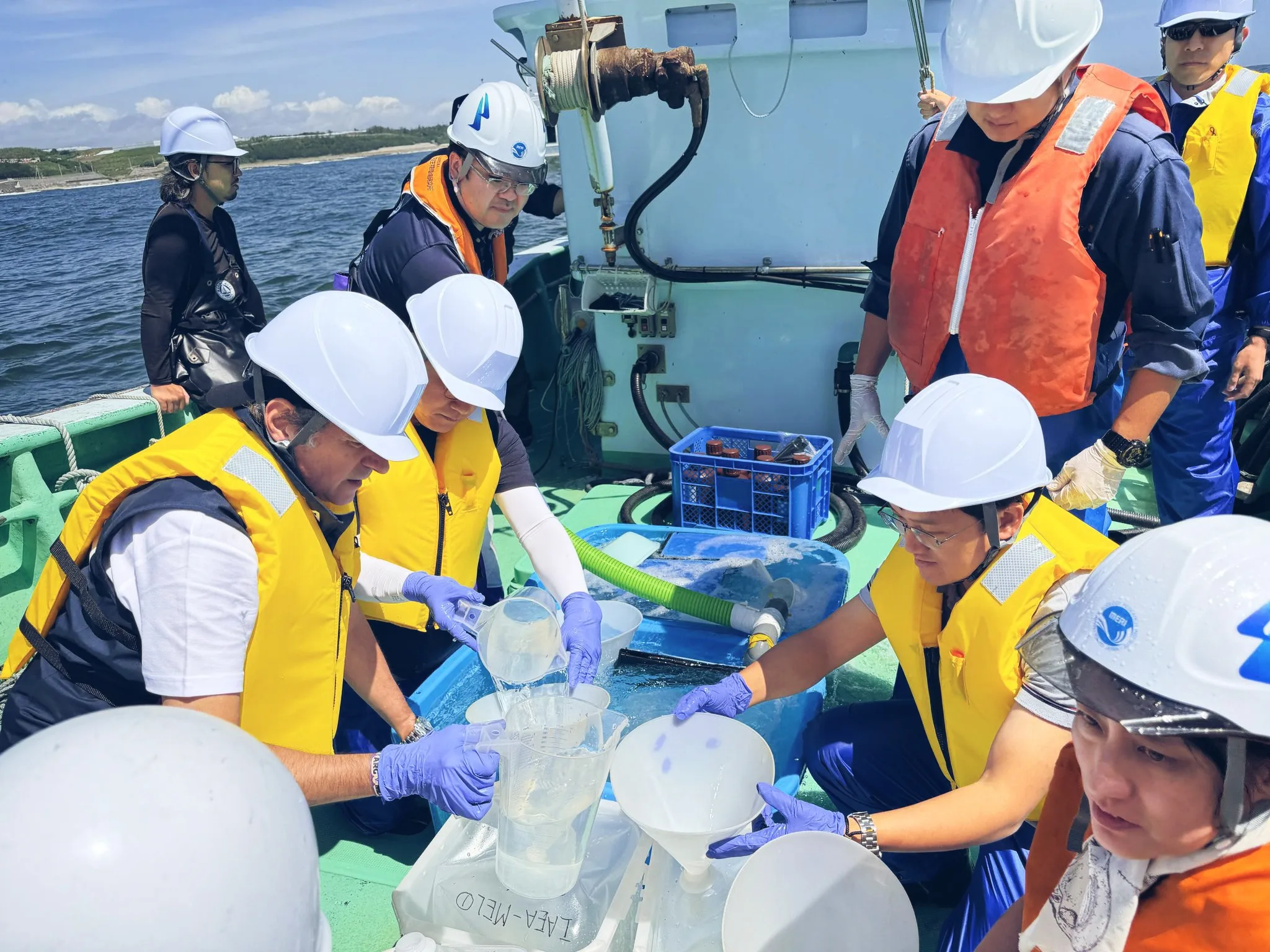
One of the most significant events of the visit was the collection of seawater samples near the Fukushima Daiichi Nuclear Power Station by Director General Grossi alongside independent experts from China, South Korea, and Switzerland.
The sampling mission forms part of the Additional Measures agreed between Japan and the IAEA in 2024 to broaden international participation in monitoring the discharge of ALPS-treated water into the Pacific Ocean.
The initiative allows participating countries not only to observe the monitoring process but also to independently collect samples and conduct their own laboratory analyses.
According to Grossi, the expanded framework demonstrates that Japan’s water discharge program can be independently verified through internationally accepted scientific methods.
“By welcoming countries to collect and analyse samples directly, Japan is helping to increase transparency, shared understanding and confidence, particularly among its neighbours,” Grossi said quoted on June 28.
The seawater samples will be analysed by the IAEA Marine Environment Laboratories in Monaco, laboratories in Japan, China’s Third Institute of Oceanography, the Korea Institute of Nuclear Safety, and Switzerland’s Spiez Laboratory.
The multinational collaboration provides an additional layer of independent scientific validation for the monitoring data published by Japan.
More Than 156,000 Cubic Metres of Treated Water Already Released
Plant operator Tokyo Electric Power Company Holdings (TEPCO) began discharging ALPS-treated water in August 2023.
As of June 2026, more than 156,000 cubic metres of treated water have been released into the Pacific Ocean through 20 discharge batches.
According to IAEA monitoring results, tritium concentrations in every batch released so far remain well below Japan’s operational limits and fully comply with international safety standards.
The discharge process is expected to continue in carefully controlled stages over the coming decades as part of the long-term decommissioning of the Fukushima Daiichi Nuclear Power Station.
Throughout this period, the IAEA will maintain a continuous on-site presence, independently verify monitoring data, conduct inter-laboratory comparisons, and provide live online monitoring to ensure ongoing transparency.
Japan and the IAEA Strengthen Cooperation on Managing 14 Million Cubic Metres of Contaminated Soil
Beyond seawater monitoring, Japan and the IAEA have expanded cooperation on environmental restoration across Fukushima Prefecture.
Director General Grossi and Japan’s Environment Minister Hirotaka Ishihara signed a Memorandum of Cooperation covering the managed recycling and final disposal of soil and waste generated during decontamination activities following the 2011 Fukushima accident.
Over the past decade, Japan has removed approximately 14 million cubic metres of contaminated soil and waste from affected areas.
If spread evenly across an area measuring 10 by 10 kilometres, the material would form a layer approximately 14 centimetres thick.
Around 75 percent of the material, which contains low levels of radioactivity, is expected to be safely recycled for land development, embankments, landfill engineering, and other infrastructure projects.
The remaining material continues to be securely managed at interim storage facilities in Fukushima Prefecture.
Under Japanese law, the final disposal of all removed soil and waste outside Fukushima Prefecture must be completed by March 2045 following further volume reduction and treatment.
Grossi said the agreement reflects the IAEA’s long-term commitment to ensuring Japan’s environmental recovery continues in full accordance with international nuclear safety standards.
Japan Accelerates the Next Generation of Nuclear Energy
Grossi’s visit also resulted in a new cooperation agreement between the IAEA and Japan’s Ministry of Economy, Trade and Industry (METI) to expand collaboration on nuclear energy development.
The agreement focuses on capacity building, nuclear safety, and the advancement of Small Modular Reactors (SMRs).
SMRs are increasingly viewed as one of the most promising next-generation nuclear technologies, offering flexible, low-carbon electricity generation that can complement renewable energy while strengthening long-term energy security.
Growing global interest in SMRs reflects the increasing role of nuclear power in achieving decarbonization goals and supporting reliable electricity systems.
The partnership also complements the IAEA’s broader cooperation with international financial institutions—including the Asian Development Bank, the World Bank Group, the European Bank for Reconstruction and Development, and the OPEC Fund—as momentum grows for financing nuclear energy projects worldwide.
Long-Term Independent Monitoring Extended for Decades
During the visit, Japan and the IAEA also agreed to extend their cooperation on the Agency’s independent monitoring and assessment of ALPS-treated water discharges.
The agreement ensures that the IAEA will continue providing impartial, science-based oversight throughout the decades-long discharge programme.
The extension is expected to strengthen international confidence, particularly among neighbouring countries that have closely monitored the environmental implications of the water release.
From Fukushima to the Future of Global Nuclear Governance
Beyond Fukushima, Grossi met with Japanese Prime Minister Sanae Takaichi to discuss the growing role of nuclear energy in energy security, advances in fusion technology, and broader international nuclear developments.
The IAEA also expanded partnerships with Japan’s private sector, including Fujifilm through its Rays of Hope initiative to strengthen cancer diagnosis and treatment, while deepening cooperation with The Nippon Foundation and Sumitomo Corporation on marine environmental management and technological innovation.
The visit highlighted how Fukushima is evolving from a symbol of one of history’s worst nuclear disasters into a global laboratory for transparency, environmental restoration, technological innovation, and international nuclear governance.
With scientists from multiple countries participating in independent verification, continuous IAEA oversight, and Japan’s commitment to unprecedented transparency, Fukushima is increasingly emerging as one of the world’s most comprehensive examples of how international cooperation can rebuild public trust in safe, responsible, and sustainable nuclear energy. (AT Network)
Follow Us at Google News, WA Channel, and LinkedIn