
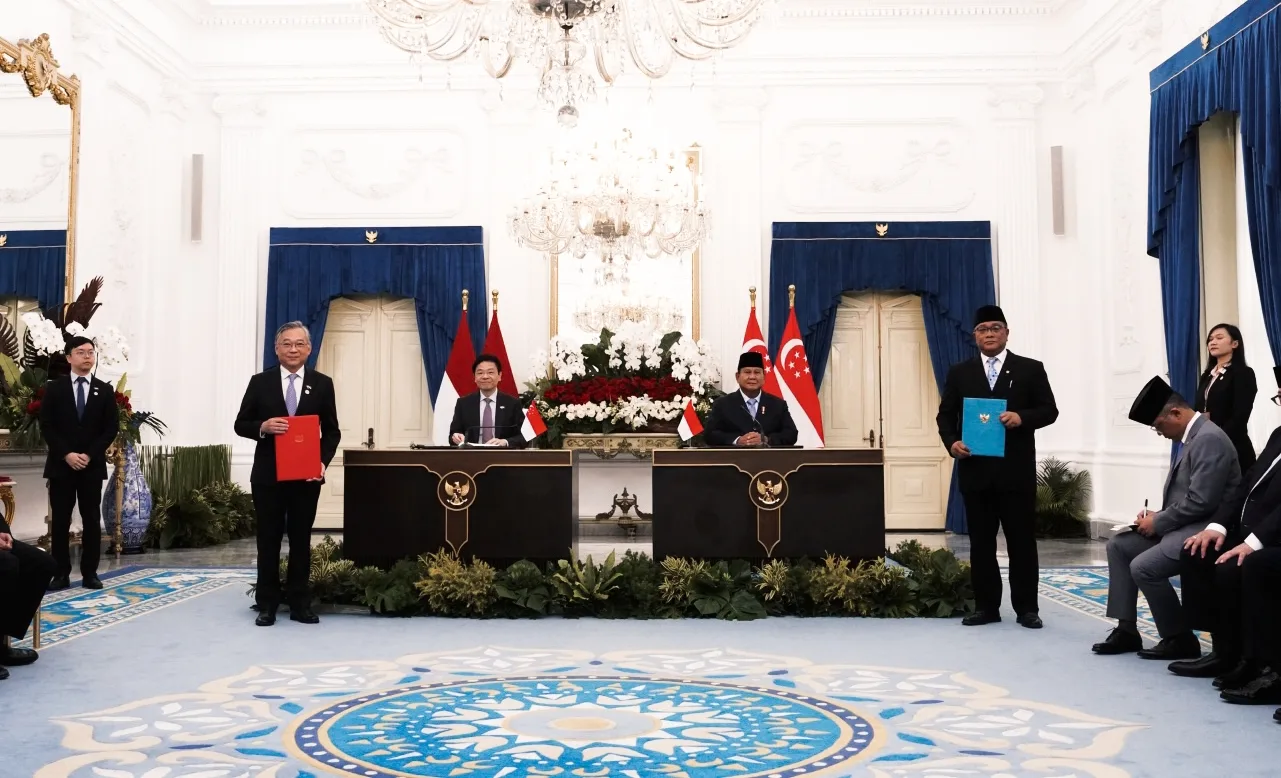
ASIATODAY.ID, JAKARTA — Indonesia and Singapore have signed two landmark agreements on environmental protection and carbon market cooperation, marking a major step in bilateral climate diplomacy and reinforcing their shared commitment to sustainable development under the Paris Agreement.
The agreements were signed during the annual Leaders’ Retreat between Indonesian President Prabowo Subianto and Singaporean Prime Minister Lawrence Wong at Merdeka Palace in Jakarta, where environmental cooperation was elevated as a strategic pillar of bilateral relations.
The two Memoranda of Understanding (MoUs) establish a framework for cooperation on environmental protection and carbon credit trading under Article 6 of the Paris Agreement, paving the way for closer collaboration on emissions reduction, climate finance, and sustainable economic development.
The agreements were signed by Indonesia’s Minister of Environment and Head of the Environmental Control Agency, Moh Jumhur Hidayat, together with Singapore’s Minister for Sustainability and the Environment Grace Fu, and Deputy Prime Minister and Minister for Trade and Industry Gan Kim Yong.
“These MoUs provide an umbrella framework for broader operational cooperation covering climate change mitigation, waste management, air pollution control, the circular economy, and carbon governance,” Jumhur said. “We expect this partnership to deliver tangible benefits for both countries while strengthening our collective response to global environmental challenges.”
The partnership supports Indonesia’s strategy to accelerate its green economic transition while enhancing regional environmental resilience. Both governments plan to expand cooperation through capacity building, joint research, technical exchanges, and pilot projects aimed at promoting sustainable development across Southeast Asia.
A central component of the partnership is the development of a high-integrity international carbon market under Article 6 of the Paris Agreement. The mechanism is intended to facilitate cross-border carbon credit transactions while ensuring transparency, environmental integrity, and accountability.
Gan Kim Yong said Singapore is committed to becoming a trusted partner in mobilizing climate finance for projects that generate measurable environmental, economic, and social benefits.
“Singapore is committed to building a carbon market that is credible, transparent, and mutually beneficial. This partnership will help channel climate finance into high-integrity projects, including forest conservation, coastal ecosystem restoration, and clean technology solutions that reduce emissions while creating new economic opportunities.”
He added that the projects are expected to provide direct benefits to local communities and Indigenous peoples, who are among those most vulnerable to the impacts of climate change.
As the next phase of implementation, Indonesia and Singapore will negotiate an Implementation Agreement governing authorization procedures, verification standards, transfers of Internationally Transferred Mitigation Outcomes (ITMOs), and corresponding adjustment mechanisms to prevent the double counting of emissions reductions in accordance with Article 6 rules.
For Indonesia, the agreements reinforce the implementation of its Carbon Economic Value framework while strengthening the country’s position in the emerging global carbon market. Officials said the objective is to ensure that carbon trading contributes not only to emissions reductions but also to sustainable economic growth, climate justice, and inclusive development by delivering tangible benefits to local communities.
The agreements also reflect growing international momentum to operationalize Article 6 of the Paris Agreement, as countries seek to establish credible cross-border carbon markets capable of mobilizing climate finance while supporting emissions reductions and long-term sustainable growth.
As Southeast Asia accelerates its low-carbon transition, the Indonesia–Singapore partnership highlights the increasing role of regional cooperation in advancing climate action, strengthening environmental governance, and unlocking new opportunities in the global green economy. (Midwan)
Follow Us at Google News, WA Channel, and LinkedIn