
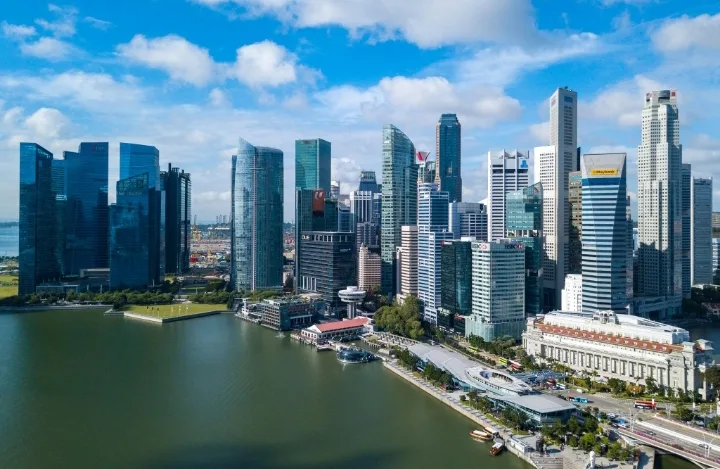
ASIATODAY.ID, SINGAPORE — Singapore is strengthening its position as one of the world’s most resilient economies as artificial intelligence (AI) growth, semiconductor demand, and robust financial foundations help the city-state navigate a period of heightened global uncertainty.
The International Monetary Fund (IMF) said Singapore entered 2026 with strong economic fundamentals, supported by prudent policies, substantial financial buffers, and its ability to adapt to rapid technological change.
In its 2026 Article IV Consultation released on July 20, the IMF highlighted Singapore’s resilience amid multiple challenges, including geopolitical tensions, trade fragmentation, and energy market disruptions.
Singapore’s economy expanded 5.0 percent in 2025, driven by strong semiconductor production and exports linked to the global AI technology cycle. Private consumption and investment also remained solid, supported by healthy wage growth.
Economic momentum continued into the first quarter of 2026, with GDP expanding at an annualized quarter-on-quarter rate of 5.3 percent, reflecting continued AI-related semiconductor demand and ongoing infrastructure projects.
AI Growth Strengthens Singapore’s Global Technology Position
The rapid expansion of AI-related industries has further strengthened Singapore’s role in the global technology supply chain.
With advanced infrastructure, a highly skilled workforce, world-class connectivity, and a trusted business environment, Singapore has become a strategic destination for companies investing in artificial intelligence, semiconductor manufacturing, and digital innovation.
The IMF expects Singapore’s growth to moderate to 3.5 percent in 2026 and 2.7 percent in 2027 as global risks remain elevated. However, the institution emphasized that Singapore’s strong fundamentals provide important protection against external pressures.
Energy Shock and Inflation Risks Remain Key Challenges
Despite its economic strength, Singapore continues to face challenges from global developments.
The IMF noted that the escalation of conflict in the Middle East has triggered an energy shock, contributing to higher inflation risks worldwide.
Singapore’s headline inflation increased to 1.8 percent in April 2026, although inflation expectations remain well anchored.
The IMF said Singapore’s monetary policy stance remains appropriate, while the Monetary Authority of Singapore (MAS) should continue monitoring inflation developments and remain ready to respond to emerging risks.
Strong Financial System Supports Economic Stability
Singapore’s financial sector remains a major pillar of economic resilience.
The banking system is well-capitalized, with a capital adequacy ratio of 18.5 percent in the second quarter of 2025. Asset quality also remains strong, with the non-performing loan ratio at 1.1 percent.
Singapore recorded a current account surplus of 16.7 percent of GDP in 2025, reflecting its continued external strength.
The IMF projects Singapore’s official reserves will increase to approximately US$478.7 billion in 2026 and US$542.2 billion in 2027, providing additional protection against future shocks.
Singapore’s Next Growth Chapter
With a nominal GDP of US$604.3 billion in 2025 and GDP per capita approaching US$98,878, Singapore remains among Asia’s most competitive and advanced economies.
The IMF encouraged Singapore to continue expanding AI adoption, strengthening infrastructure investment, improving workforce capabilities, and supporting more inclusive economic growth.
As the global economy enters a new era shaped by technology, supply chain transformation, and geopolitical shifts, Singapore’s ability to combine innovation with economic discipline will determine its next phase of growth.
From a global technology hub to a financial powerhouse, Singapore continues to demonstrate why resilience and strategic adaptation remain its greatest economic advantages. (AT Network)
Follow Us at Google News, Instagram and LinkedIn