
ASIATODAY.ID, JAKARTA — A new wave of geopolitical tension is emerging across the Indo-Pacific as a sharp increase in Chinese government vessel activity around Taiwan raises concerns that Beijing may be testing the limits of regional security and maritime resilience.
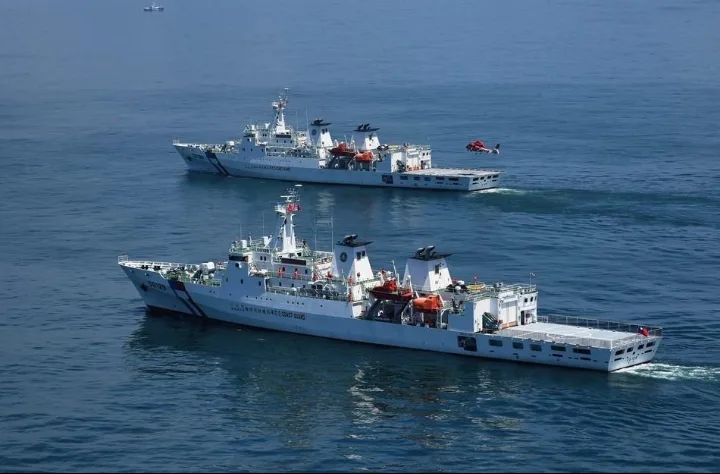
Taiwan’s Coast Guard data showed that at least 55 Chinese government vessels, including coast guard ships and research vessels, were detected operating around Taiwan in June 2026. The figure represents a significant increase from 30 vessels in May 2026 and 25 vessels during the same period last year.
Taipei views the surge as more than routine maritime activity, describing it as part of a growing gray-zone strategy aimed at expanding pressure without triggering an open military confrontation.
“If the situation escalates into a blockade or something equivalent to a quasi-war situation, we have plans to work with the navy to jointly protect Taiwan’s vital maritime routes,” a senior Taiwan Coast Guard official said.
The development has placed the waters surrounding Taiwan at the center of global attention, as the area remains one of the world’s most important strategic corridors for trade, technology supply chains, and energy flows.
Beijing’s Maritime Pressure Strategy Enters a New Phase
Taiwan has warned that China is increasingly relying on coast guard operations as a tool to strengthen its territorial claims while avoiding direct military escalation.
The Taiwanese government described the approach as a form of lawfare — using legal narratives, administrative actions, and maritime enforcement activities to gradually establish a new reality on the ground.
According to Taiwan officials, several Chinese coast guard vessels operating in the area are former naval ships that have been modified and transferred into maritime enforcement roles.
These vessels are significantly larger, have greater endurance, and possess capabilities far beyond conventional coast guard fleets, creating additional pressure on Taiwan’s maritime surveillance capacity.
Taiwanese officials said Chinese coast guard vessels have increasingly operated in pairs outside Taiwan’s exclusive economic zone in the Pacific Ocean.
“They create substantial pressure on Taiwan’s coast guard capabilities,” one official said.
Taipei also reported that Chinese vessels have begun broadcasting requests for information from commercial ships regarding port activities and maritime movements.
Although no commercial vessels have changed their routes so far, Taiwan has warned that such actions could challenge freedom of navigation and create uncertainty for international shipping.
Taiwan has responded by broadcasting messages to commercial vessels urging them to maintain normal routes and disregard instructions from authorities it considers to have no jurisdiction over the waters.
South China Sea Becomes Another Flashpoint
The rising tensions around Taiwan coincide with renewed attention on the South China Sea, another critical maritime region connecting major economic centers across Asia.
Taiwan’s Ministry of Foreign Affairs (MOFA) has reaffirmed that its position regarding its interests and sovereignty claims in the South China Sea remains unchanged.
Taipei emphasized four principles: inclusion in multilateral dispute mechanisms, peaceful resolution based on international law including the United Nations Convention on the Law of the Sea (UNCLOS), protection of freedom of navigation and overflight, and cooperation for shared development.
Taiwan also rejected unilateral expansionism, gray-zone coercion, militarization, and other actions that could undermine regional peace and stability.
Using Itu Aba (Taiping Island) as a platform, Taiwan said it seeks to promote maritime cooperation, environmental protection, scientific research, humanitarian assistance, and sustainable development.
Indonesia-Australia Strengthen Security Partnership
As strategic competition intensifies across the Indo-Pacific, Indonesia and Australia are expanding defense and intelligence cooperation to address emerging security challenges.
Indonesia’s Deputy Defense Minister Donny Ermawan Taufanto received Kathy Klugman, Director-General of Australia’s Office of National Intelligence, at the Ministry of Defense in Jakarta on Monday, July 20, 2026.
The meeting focused on strengthening intelligence cooperation, defense relations, cybersecurity capabilities, and regional security coordination.
Donny welcomed the continued strengthening of Indonesia-Australia ties and congratulated Klugman on becoming the first woman to lead Australia’s intelligence agency.
Both sides exchanged views on strategic developments, including geopolitical dynamics in the Middle East and the Indo-Pacific, while reaffirming their commitment to improving intelligence capacity and human resource development.
The Indo-Pacific’s Strategic Test
The latest developments around Taiwan highlight the increasingly complex competition among major powers in the Indo-Pacific.
For Southeast Asian nations, stability in the Taiwan Strait and the South China Sea is not only a geopolitical issue but also a critical factor affecting global trade, technology supply chains, energy security, and economic growth.
As major powers expand their maritime presence across Asia’s strategic waterways, the central challenge for the region is preventing competition from escalating into confrontation while preserving an open, stable, and rules-based Indo-Pacific order. (AT Network)
Follow Us at Google News, Instagram and LinkedIn