
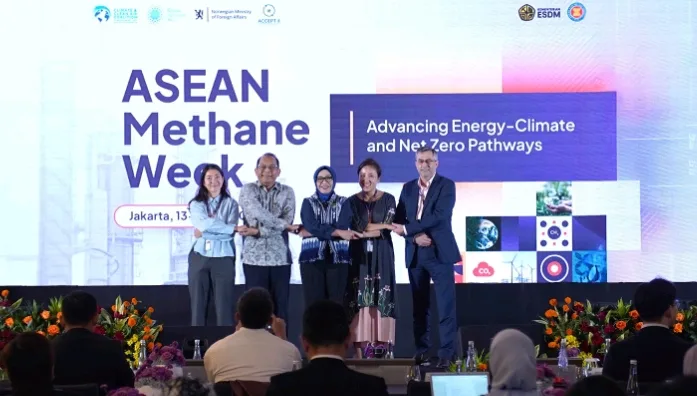
ASIATODAY.ID, JAKARTA – ASEAN is intensifying efforts to reduce methane emissions, placing the powerful greenhouse gas at the centre of its regional energy transition strategy as Southeast Asia seeks to balance energy security, economic growth and climate commitments.
The renewed focus emerged during ASEAN Methane Week, held in Jakarta from 13–16 July 2026, which brought together nearly 300 policymakers, energy leaders, financial institutions, development partners and international organisations to accelerate cooperation on methane mitigation across the region.
Organised by the ASEAN Centre for Energy (ACE) in collaboration with the Global Methane Hub (GMH), the Climate and Clean Air Coalition (CCAC) and the ASEAN Climate Change and Energy Project (ACCEPT), the forum highlighted methane reduction as one of the most practical and immediate pathways to support ASEAN’s transition toward a lower-carbon energy future.
ASEAN faces a complex energy challenge. While renewable energy development continues to expand, fossil fuels still account for around 84% of the region’s total energy supply, making the transition toward cleaner energy a gradual process that must maintain reliability and affordability.
Methane has become a strategic priority due to its significant climate impact. With a global warming potential 82.5 times greater than carbon dioxide over a 20-year period, reducing methane emissions from oil, gas and coal operations offers one of the fastest opportunities to deliver near-term climate benefits.
The regional push is supported by the ASEAN Plan of Action for Energy Cooperation (APAEC) 2026–2030, the bloc’s latest energy framework, which includes dedicated action plans to reduce methane emissions from fossil fuel activities. The move reflects ASEAN’s broader shift toward integrating climate considerations into energy security planning.
During the four-day programme, government representatives, industry stakeholders and international partners discussed the need to accelerate implementation through stronger methane policies, improved emissions monitoring, deployment of abatement technologies and innovative financing mechanisms.
Indonesia’s Director General of New, Renewable Energy and Energy Conservation, Prof. Eniya Listiani Dewi, emphasised the importance of regional collaboration in achieving shared climate and energy objectives.
“What we need to do in the Asia region is to strengthen cooperation, regional dialogue and close collaboration, as these are essential to achieving our shared goals,” she said.
ACE Executive Director Dato’ Ir. Ts. Razib Dawood said methane mitigation has evolved beyond an environmental issue and has become a key element of energy, economic and regional cooperation strategies.
“Methane is no longer seen as simply an environmental issue. It is an energy issue. An economic issue. A security issue. And ultimately, a regional cooperation issue,” he said.
The event also advanced preparations for the ASEAN Coal Methane Program (A-CH4MP), a regional platform aimed at strengthening technical capacity, improving methane data and supporting policymakers and industry in addressing emissions from coal mining activities.
Supported by the Norwegian Ministry of Foreign Affairs and co-hosted by Indonesia’s Ministry of Energy and Mineral Resources, ASEAN Methane Week is expected to strengthen regional coordination and accelerate implementation of APAEC 2026–2030, supporting ASEAN’s goal of building a more secure, competitive and sustainable energy future. (AT Network)
Follow Us at Google News, Instagram and LinkedIn