
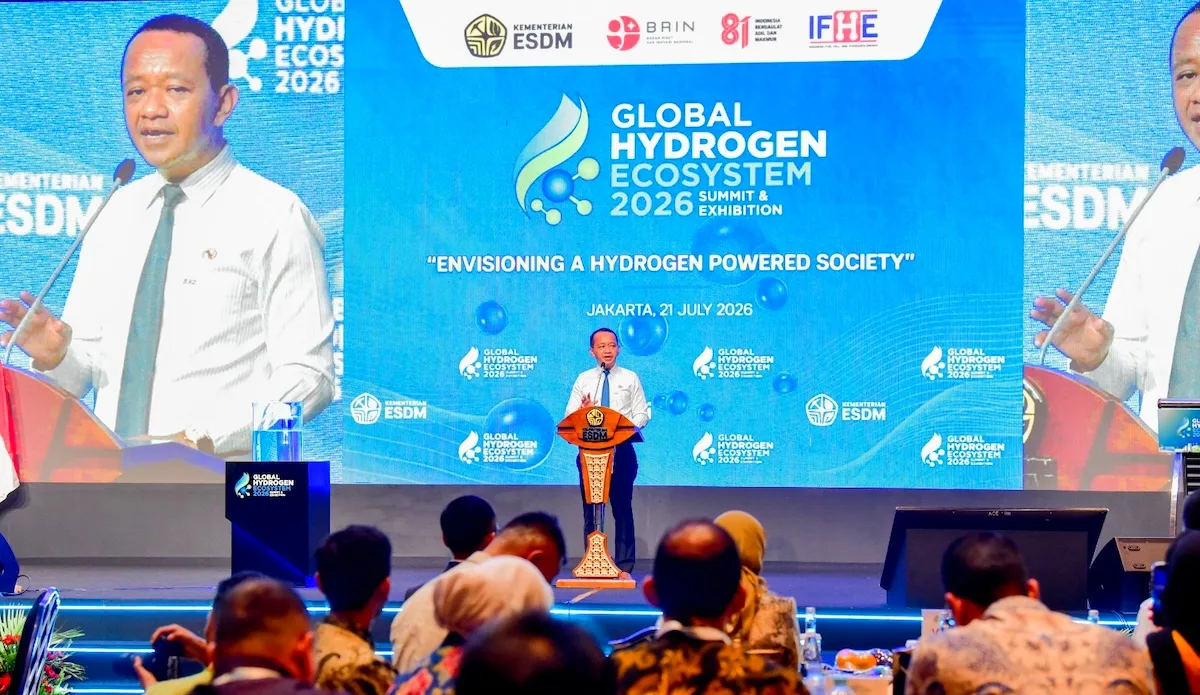
ASIATODAY.ID, JAKARTA — Indonesia has unveiled a IDR32 trillion (approximately US$2 billion) investment pipeline for 93 hydrogen projects, marking the country’s most significant push yet to develop a domestic hydrogen economy as it seeks to strengthen energy security and accelerate its transition to low-carbon energy.
The projects were announced at the Global Hydrogen Ecosystem Summit & Exhibition (GHES) 2026 in Jakarta, where the government also introduced Indonesia’s first Hydrogen Diesel Dual Fuel (H2 DDF) bus and unveiled plans for a 194-kilometer Green Hydrogen Corridor linking Jakarta, Karawang, and Patimban.
The initiatives are designed to expand hydrogen production and utilization across the power, transport, and industrial sectors while reducing dependence on imported fossil fuels.
“We currently have 93 hydrogen ecosystem initiatives across Indonesia, representing investments worth Rp32 trillion,” Director General of New, Renewable Energy and Energy Conservation (EBTKE) Eniya Listiani Dewi said during the summit.
The investment program includes hydrogen-based power projects for remote islands where diesel generation remains the primary electricity source. A flagship project in Sumba is expected to begin commercial operations in 2028, while another on Rote Island combines solar generation with hydrogen energy storage to improve the reliability of renewable electricity.
State-owned energy company Pertamina has also initiated hydrogen production using geothermal energy at its Ulubelu geothermal field, reflecting Indonesia’s strategy of leveraging its abundant renewable resources to produce low-carbon hydrogen.
Eniya said broader hydrogen adoption would strengthen Indonesia’s energy resilience by diversifying domestic energy sources and reducing reliance on imported fuels.
Energy Security and Industrial Growth
Energy and Mineral Resources Minister Bahlil Lahadalia described hydrogen as a strategic resource that could help Indonesia navigate an increasingly uncertain global energy landscape.
He said the government’s hydrogen strategy supports President Prabowo Subianto’s agenda to enhance energy self-sufficiency, accelerate downstream industrialization, attract investment, and create higher-value employment.
Although hydrogen remains more expensive than conventional fuels, Bahlil said advances in technology and changing global energy markets are expected to improve its competitiveness over time.
Hydrogen Moves Beyond the Pilot Stage
The summit also marked the launch of Indonesia’s first Hydrogen Diesel Dual Fuel (H2 DDF) bus, developed jointly by the Ministry of Energy and Mineral Resources, PLN, DAMRI, and SUCOFINDO.
Instead of replacing existing diesel fleets, the pilot retrofits conventional buses to operate on a blend of diesel and hydrogen, providing a lower-cost pathway toward cleaner public transport.
According to SUCOFINDO’s testing, the system reduced smoke opacity by 57.66%, carbon monoxide by 45.45%, carbon dioxide by 39.37%, and nitrogen oxide emissions by 21.16%.
The government also announced the Green Hydrogen Corridor, which will connect Jakarta, Karawang, and Patimban as a demonstration route for hydrogen production, distribution, and mobility applications.
Officials said building a competitive hydrogen industry will require collaboration among government agencies, state-owned enterprises, private companies, research institutions, and international partners.
With 93 projects worth US$2 billion already in development, Indonesia is laying the groundwork for a national hydrogen ecosystem that complements its ambitions in renewable energy, critical minerals, and downstream industrialization. If delivered as planned, the program could strengthen the country’s position as one of Asia’s emerging hydrogen economies. (AT Network)
Follow Us at Google News, Instagram and LinkedIn