
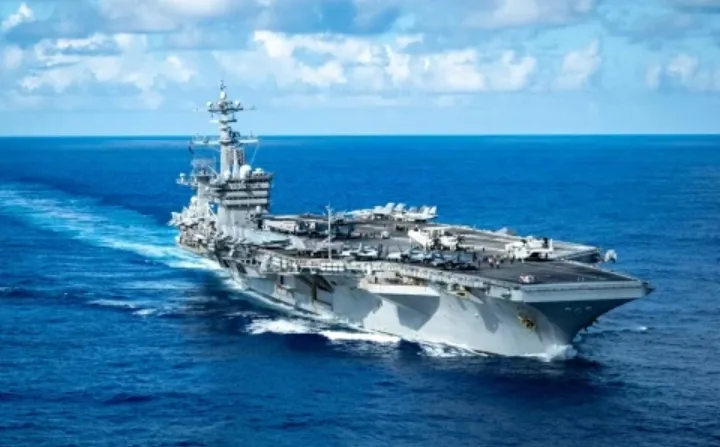
ASIATODAY.ID, JAKARTA — Tensions in the South China Sea are drawing renewed international attention after the United States Navy’s nuclear-powered aircraft carrier USS George Washington (CVN-73) entered the disputed waters as part of Washington’s latest Indo-Pacific deployment.
The carrier strike group moved into the South China Sea after transiting the Luzon Strait, the strategic maritime passage between the Philippines and Taiwan that connects the Philippine Sea with one of the world’s most contested waterways.
The US Navy confirmed the movement of the carrier group but did not disclose specific operational details. Such deployments are typically conducted to support freedom of navigation, maritime security operations, and joint readiness with allies and regional partners.
The arrival of USS George Washington comes as geopolitical competition in the Indo-Pacific continues to intensify, with the South China Sea remaining at the center of overlapping territorial claims involving China, the Philippines, Vietnam, Malaysia, Brunei, and Taiwan.
Beyond its military importance, the South China Sea is a vital global trade route, carrying major flows of commercial shipping, energy supplies, and strategic resources between Asia and the wider world.
From Valiant Shield 2026 to Strategic Waters
The latest movement follows several weeks of operations by USS George Washington across the Western Pacific, including its participation in Valiant Shield 2026, a major multinational military exercise led by the United States.
The exercise involved naval, air, and ground forces from the US and partner countries, focusing on integrated air defense, anti-submarine warfare, maritime strike capabilities, and multi-domain operational coordination.
Following the exercise, the carrier strike group conducted a logistics stop in Guam for replenishment and operational support before continuing its deployment toward the South China Sea.
The Luzon Strait has become an increasingly important maritime corridor for military forces operating across the Indo-Pacific due to its strategic position between the Philippine Sea and the South China Sea.
A New Signal in the US-China Strategic Competition
The deployment of USS George Washington represents a significant demonstration of US naval capability and reinforces Washington’s commitment to maintaining a persistent presence in the Indo-Pacific.
In recent months, US carrier strike groups and other naval forces have expanded activities across the region through multinational exercises, patrol missions, and security cooperation programs with allies and partners.
Washington has repeatedly stated that its military operations are aimed at protecting freedom of navigation and maintaining open access to international waters under established maritime principles.
China has consistently opposed US military activities in the South China Sea, arguing that foreign naval operations increase regional tensions. Beijing has yet to issue an official response regarding the latest deployment of the USS George Washington carrier strike group.
The development comes amid continued maritime friction between China and the Philippines, following several confrontations involving coast guard vessels in disputed areas.
For Southeast Asia, the growing rivalry between major powers presents a complex strategic challenge — maintaining regional stability, safeguarding economic interests, and ensuring that one of the world’s most important maritime corridors remains peaceful and open. (AT Network)
Follow Us at Google News, Instagram and LinkedIn