
ASIATODAY.ID, JAKARTA — The death of a young Bajau girl on Indonesia’s Kabaena Island, Southeast Sulawesi, has drawn international attention after being cited in a Joint Communication by United Nations Special Rapporteurs (AL IDN 8/2025).
The case highlights what UN experts describe as a deepening environmental and human rights crisis linked to nickel mining on small islands.
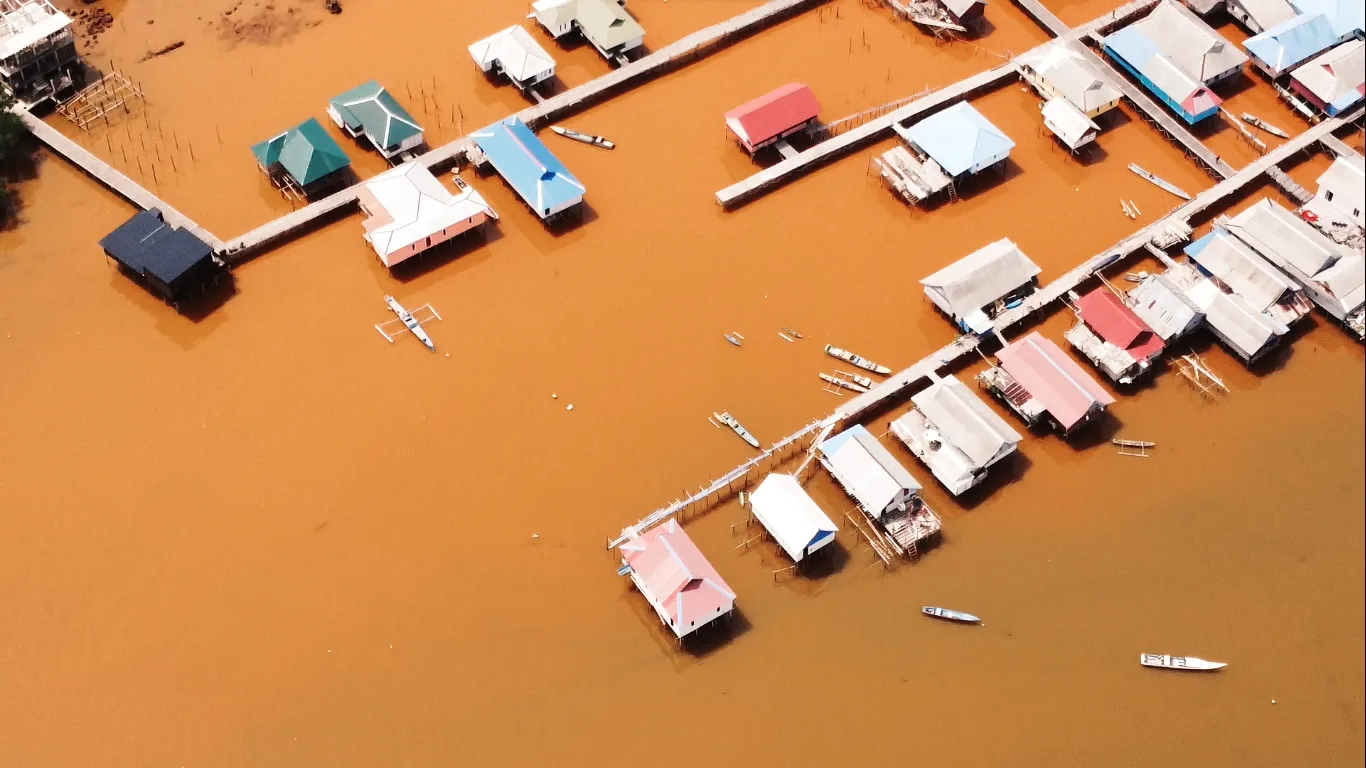
The child, identified locally as Masra, drowned in March 2025 after falling into coastal waters heavily polluted by mining sediment. Following heavy rainfall, the wooden jetty near her home became slick and indistinguishable from the surrounding sea, which had turned murky brown due to nickel mining runoff. Residents struggled to locate her until her body was found floating just meters from her house.
Although Masra’s name is not explicitly mentioned in the UN document, the timing and circumstances confirm that the communication refers to her death.
A Small Island Overwhelmed by Mining
Kabaena Island spans approximately 891 square kilometers, yet more than 70 percent of its land area has been allocated to mining concessions, the majority for nickel extraction. The rapid expansion of extractive activities has triggered severe sedimentation along the coastline, directly impacting the Bajau Indigenous People, whose lives and culture are inseparable from the sea.
According to the UN communication, mining operations have devastated local livelihoods. Fish and octopus catches have dropped by up to 80 percent, while seaweed prices have collapsed by as much as 90 percent.
These findings align with reports from civil society coalitions documenting widespread marine pollution, coastal ecosystem degradation, and the erosion of the economic and cultural foundations of the Bajau community.
Toxic Metals Far Above Safe Limits
Beyond economic losses and safety concerns, the UN also raised alarms over worsening public health conditions on Kabaena. Respiratory illnesses and skin diseases are reportedly on the rise.
More alarmingly, testing has detected toxic heavy metals—including nickel, cadmium, and lead—at concentrations up to 1,000 times higher than World Health Organization (WHO) safety thresholds.
UN experts stressed that the deaths of Bajau children in waters transformed into sludge by mining sediment represent a failure of state protection that cannot be tolerated.
State Failure to Protect Indigenous Rights
Over the past two years, Satya Bumi and Walhi Southeast Sulawesi have conducted intensive monitoring of extractive activities on Kabaena, uncovering serious governance and law enforcement failures.
The UN communication corroborates these findings, including the absence of Free, Prior, and Informed Consent (FPIC), land dispossession without compensation, and criminalization of residents who oppose mining operations. Such practices, the UN noted, violate international human rights standards and Indonesia’s legal obligations.
“This UN communication is a strong signal that the Indonesian government and mining companies can no longer evade responsibility for environmental restoration and the protection of Indigenous Bajau rights on Kabaena,” said Andi Muttaqien, Executive Director of Satya Bumi, in a press statement, quoted on Wednesday, December 24, 2025.
Echoing this view, Andi Rahman, Director of Walhi Southeast Sulawesi, described the UN’s intervention as international recognition of a long-standing ecological and humanitarian crisis on the island.
“The state has failed to fulfill its duty to protect small islands, including the rights of the Bajau Indigenous People who are directly affected by nickel mining expansion,” he said.
Calls to Revoke Mining Permits and Halt Nickel Supply
Civil society groups are urging the Indonesian government to respond urgently to the UN warning by revoking all 16 active nickel mining permits on Kabaena Island, ensuring environmental rehabilitation, and restoring the rights of the Bajau community.
They are also calling on global automotive and battery manufacturers sourcing nickel from Indonesia to conduct rigorous human rights and environmental due diligence throughout their supply chains, immediately halt sourcing from Kabaena, and assume responsibility for the damage caused.
“A just and sustainable energy transition must not be built on the suffering of Indigenous peoples and the destruction of small island ecosystems,” Andi Rahman emphasized.
In addition to Kabaena, the UN Joint Communication documents other alleged human rights violations across Indonesia, including in Papua, national strategic projects, transmigration policies, discrimination against Indigenous peoples, and protracted land conflicts. (AT Network)
Follow Us at Google News and WA Channel