
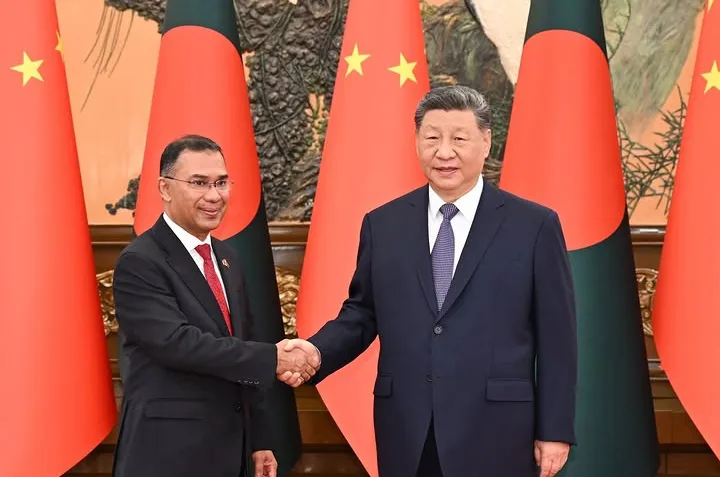
ASIATODAY.ID, BEIJING – Bangladesh and China have dramatically expanded their strategic partnership by signing 13 new cooperation agreements during Prime Minister Tarique Rahman’s first official visit to Beijing, signaling Dhaka’s determination to deepen ties with China despite growing pressure from the United States.
The agreements, signed after bilateral talks between Prime Minister Rahman and Chinese Premier Li Qiang, cover trade, investment, infrastructure, industrial development, and economic cooperation, reinforcing Beijing’s role as one of Bangladesh’s most important strategic partners.
Among the biggest announcements was a US$220 million investment by Chinese textile giant Handa Industries to establish a manufacturing facility in the Keraniganj Economic Zone.
The two countries also signed an agreement to accelerate development of the China–Bangladesh Mongla Port Economic Zone, an industrial hub expected to strengthen Bangladesh’s export capacity and attract additional foreign investment.
The leaders agreed to expand collaboration across multiple sectors, including industrial development, logistics, and bilateral trade, as China continues to dominate Bangladesh’s import market with machinery, electronics, and textile raw materials.
Although speculation had mounted ahead of the visit that Dhaka could finalize a deal to purchase 24 Chinese J-10CE multirole fighter jets, no defense agreement was announced.
The visit comes at a politically sensitive moment. Earlier this year, Bangladesh signed a reciprocal trade agreement with the United States shortly before its national election.
According to Bangladeshi media reports, the deal contains provisions allowing Washington to impose reciprocal tariffs or terminate the agreement if Dhaka enters trade arrangements with countries the US classifies as “non-market economies,” including China.
Critics argue the agreement could significantly constrain Bangladesh’s economic sovereignty by forcing the country to align with US sanctions and trade policies, potentially limiting its ability to maintain a balanced foreign policy between major global powers.
Against that backdrop, Rahman’s decision to finalize a broad package of economic agreements with Beijing is widely viewed as a clear indication that Bangladesh intends to pursue a more diversified strategic and economic agenda.
China remains Bangladesh’s largest trading partner, with Bangladeshi imports from China reaching US$18.56 billion in fiscal year 2025, while exports to China totaled approximately US$694 million. Meanwhile, the United States continues to be Bangladesh’s largest export destination, accounting for between US$8.5 billion and US$10 billion in annual exports.
The latest agreements underscore Bangladesh’s effort to strengthen economic cooperation with both East and West while safeguarding its long-term development interests amid intensifying competition between the world’s two largest economies. (RT)
Follow Us at Google News, WA Channel, and LinkedIn