
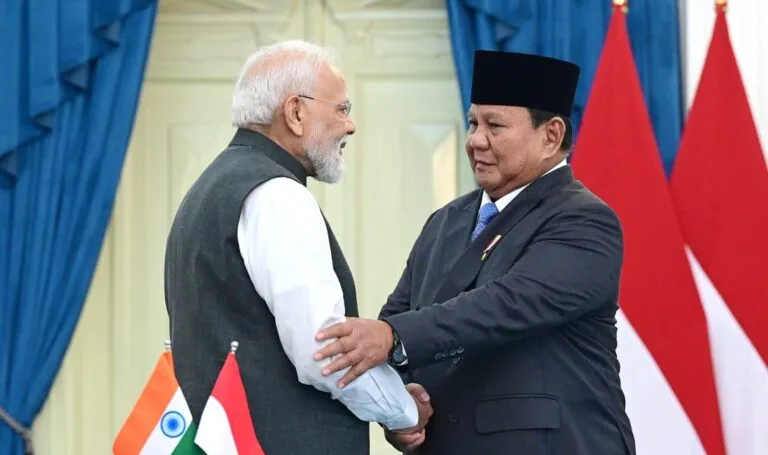
ASIATODAY.ID, JAKARTA — India and Indonesia have significantly strengthened their strategic partnership after signing a landmark defense agreement that includes the export of India’s BrahMos supersonic cruise missile system, alongside a broad package of cooperation spanning defense, critical minerals, maritime infrastructure, advanced manufacturing, and emerging technologies.
The agreements were concluded during Indian Prime Minister Narendra Modi’s official visit to Indonesia, where he held bilateral talks with Indonesian President Prabowo Subianto. During the visit, Indonesia also conferred its highest civilian honor, the Bintang Adipurna of the Republic of Indonesia, on Modi, underscoring the growing importance of bilateral ties between the two leading Asian economies and fellow BRICS partners.
The defense package represents one of the most significant milestones in Indonesia–India relations since the two countries elevated their relationship to a Comprehensive Strategic Partnership. At its center is Indonesia’s acquisition of additional BrahMos supersonic cruise missile batteries, one of the world’s fastest operational cruise missile systems, jointly developed by India and Russia.
India will also supply Astra, an indigenous beyond-visual-range air-to-air missile developed by India’s Defence Research and Development Organisation (DRDO), further expanding defense cooperation between the two nations.
The BrahMos missile has attracted growing international attention following its successful export to the Philippines and its operational deployment by the Indian Armed Forces. The latest agreement with Indonesia further strengthens India’s ambition to become a major global defense exporter while enhancing Jakarta’s military modernization efforts.
Beyond defense, both leaders agreed to deepen cooperation in critical minerals and industrial development. India plans to expand investments in Indonesia’s steel sector, nickel processing, and rare-earth magnet production as New Delhi seeks to diversify and secure supply chains for strategic minerals essential to electric vehicles, renewable energy technologies, and advanced manufacturing.
The two countries also agreed to jointly develop Sabang Port, Indonesia’s northernmost deep-sea port located near the strategically vital Strait of Malacca—one of the world’s busiest maritime trade corridors. The project is expected to strengthen maritime connectivity, regional logistics, and Indo-Pacific security cooperation.
Additional agreements cover maritime security, digital transformation, artificial intelligence, healthcare, education, and broader economic collaboration, reflecting the increasingly comprehensive nature of Indonesia–India relations.
Analysts view the wide-ranging agreements as a significant step toward expanding cooperation between two of Asia’s fastest-growing major economies. As fellow BRICS members, Indonesia and India are seeking to strengthen strategic autonomy, diversify supply chains, deepen defense cooperation, and expand economic resilience amid an increasingly competitive geopolitical landscape.
The landmark agreements signal that Jakarta and New Delhi are moving beyond traditional diplomatic engagement toward a broader strategic partnership that integrates security, industrial development, technology, and sustainable economic growth, reinforcing their shared role in shaping the future of the Indo-Pacific. (AT Network)
Follow Us at Google News, WA Channel, and LinkedIn