
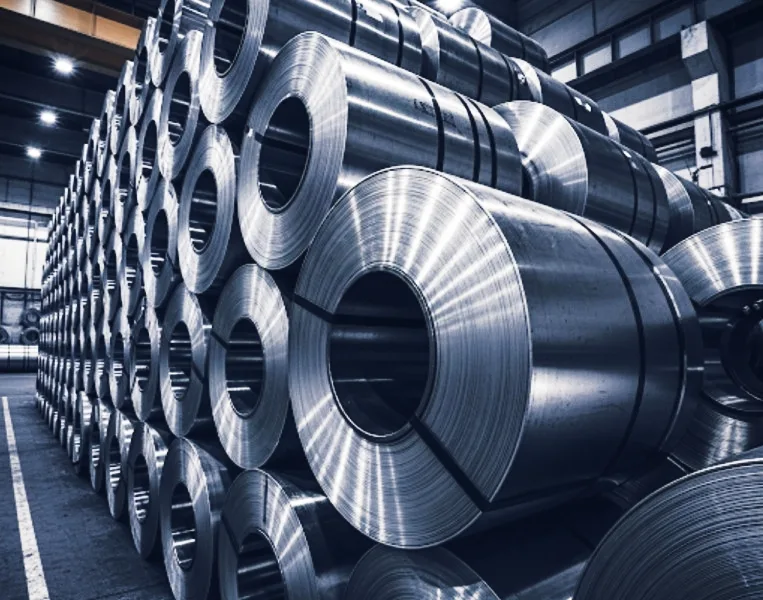
ASIATODAY.ID, JAKARTA – Indonesia’s steel construction industry is under siege. A relentless flood of cheap steel imports from China and Vietnam is devastating local producers, undermining competitiveness, and threatening the nation’s industrial backbone amid volatile global prices and weak import supervision.
The Chairman of the Indonesian Society of Steel Construction (ISSC), Budi Harta Winata, warned that the massive influx of imported steel has caused severe market distortion and driven down the viability of local manufacturers.
“Imported steel products are being sold at prices far below normal production costs — this is clearly predatory pricing,” Budi said in an official statement quoted on Friday, October 31, 2025.
“It’s destroying fair competition, lowering domestic factory utilization, disrupting the national value chain, and threatening our strategic industrial capacity.”
China and Vietnam Flood Indonesia’s Market
According to data from Statistics Indonesia (BPS), imports of iron and steel from China reached US$2.39 billion with a volume of 3.81 million tons between January and August 2025 — up sharply from US$2.16 billion (2.85 million tons) in the same period last year.
The surge has been consistent since 2023, when China’s export volume to Indonesia was 2.31 million tons valued at US$2 billion.
Meanwhile, imports from Vietnam amounted to US$246.75 million or 404,340 tons in the same period, maintaining Vietnam’s position as the second-largest supplier of construction steel to Indonesia, despite a slight decline in value.
Budi stressed that the issue is not Indonesia’s production capacity but rather weak import supervision, regulatory loopholes, and dumping practices by exporting countries.
“If this continues, Indonesia will no longer be an industrial nation — it will merely become a dumping ground for other countries’ steel surpluses,” he said.
“The steel industry is the backbone of national construction sovereignty. A country that loses its industry, loses control over its future.”
Five Demands from Indonesia’s Steel Industry
To prevent further damage, the ISSC has submitted five key policy demands to the government:
1. A temporary moratorium on construction steel imports from China and Vietnam for tariff lines proven to distort the market.
2. Implementation of anti-dumping and safeguard measures in accordance with Government Regulation No. 34/2011 and WTO rules.
3. Stricter import licensing (Pertek, PI, SNI, LS) to prevent abuse.
4. Prioritization of domestic steel products for national strategic projects.
5. Protection of Indonesia’s market from becoming a dumping ground for surplus foreign steel.
Budi emphasized that these measures are not a form of protectionism but a legitimate act of industrial defense.
“Without corrective policies, Indonesia will only have a steel market, not a steel industry. And markets don’t have sovereignty,” he said firmly.
Steel Workers Protest at Customs Office
Frustrated by the government’s slow response, steel industry players took to the streets. On Tuesday, October 28, 2025, hundreds of ISSC members held a peaceful demonstration at the Customs Office in East Jakarta.
Wearing orange vests and construction helmets, the protesters demanded that the Directorate General of Customs and Excise (DJBC) immediately restrict and regulate steel imports that are harming domestic businesses.
“We told Customs that these steel imports are destroying our profession as contractors and manufacturers. The government must act to strictly monitor all incoming steel products,” Budi told.
ISSC’s data shows that imported construction steel from China and Vietnam has been entering Indonesia since 2017, reaching 600,000 tons annually — even though domestic capacity stands at 1 million tons per year.
Due to ultra-low prices, local products can’t compete, leading to widespread project losses and mass layoffs in industrial hubs like Karawang, Cikarang, Subang, and Batang.
“In the past, malls, factories, and warehouses were built with Indonesian steel. Now, they’re all using imported steel,” Budi lamented.
Losing the Nation’s Industrial Sovereignty
The ISSC warns that without immediate government intervention, Indonesia risks losing its strategic industrial base and becoming dependent on foreign suppliers.
“If local steel dies, national construction independence dies with it. This isn’t just about business — it’s about economic sovereignty,” Budi concluded. (AT Network)
Follow Us at Google News and WA Channel