
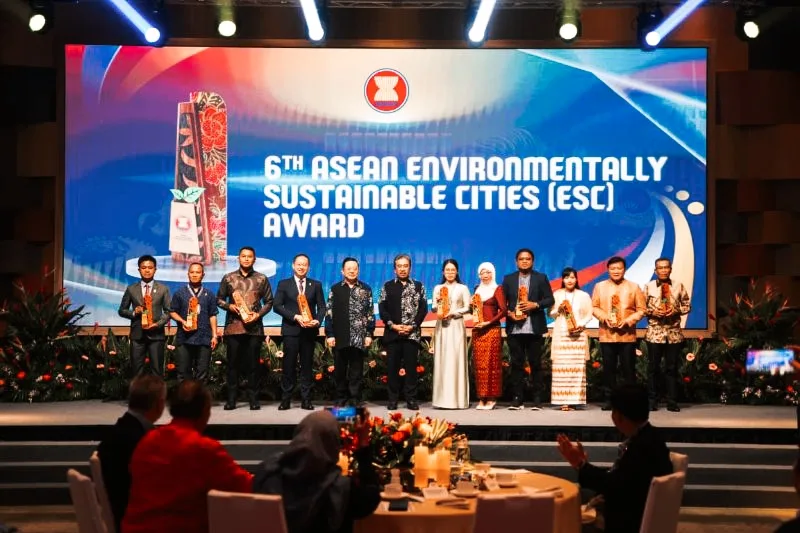
ASIATODAY.ID, LANGKAWI – Indonesia once again marked a proud achievement on the regional stage by securing five honors at the prestigious 6th ASEAN Environmentally Sustainable Cities (ESC) Award and 5th Certificate of Recognition.
This milestone demonstrates Indonesia’s strong commitment to advancing sustainable regional development while strengthening its leadership in ASEAN environmental cooperation.
The awards are presented to cities and districts across ASEAN recognized for their success in promoting sustainable environmental governance. Evaluation is based on key indicators such as clean air, clean water, and clean land, along with new criteria that include urban biodiversity, green open spaces, and the adoption of a circular economy.
“Indonesia highly appreciates the ASEAN Environmentally Sustainable Cities (ESC) Award and the 5th Certificate of Recognition. We hope more ASEAN cities will meet the criteria set by these awards,” said Ary Soedijanto, Deputy for Climate Change Control and Carbon Economic Value Governance, who led the Indonesian delegation, September 9, 2025.
This year, five Indonesian regions received awards: Banyumas Regency, Malang City, Bandung City, Padang City, and Ciamis Regency.
Banyumas Regency won the ASEAN ESC Award for its innovative and inclusive community-based waste management. With 67 active waste banks, the application of 3R principles, and the production of Refuse Derived Fuel (RDF), Banyumas successfully manages 77% of its waste.
Innovations such as TPS3R facilities, maggot cultivation, composting, and eco-friendly procurement have positioned Banyumas as a model for waste management in Southeast Asia and a regional learning hub.
Malang City received a Certificate of Recognition in the Clean Air category for Large Cities, thanks to its success in maintaining high air quality. The city government conducts regular vehicle emission tests, plants more than 518 trees, and has reduced pollutant concentrations to meet international standards.
Malang’s Air Quality Index now stands at 88.36, positively impacting public health, economic productivity, and education quality.
Bandung City was honored in the Clean Water category for Large Cities, recognizing its progress in expanding access to safe drinking water and sanitation. Currently, 91.68% of households have access to clean drinking water, while 82.55% of households and industries are connected to the national wastewater system. Bandung has also innovated by reclaiming springs as multifunctional public spaces.
These efforts have significantly reduced cases of diarrhea, making Bandung a leading city for water management in ASEAN.
Padang City earned recognition in the Circular Economy category for Large Cities, driving waste-to-resource transformation. Through waste banks, maggot farming, and eco-friendly procurement programs, Padang produces widely marketed recycled products.
Its Integrated Waste Management Facility (TPST) at the Aie Dingin landfill, with a capacity of 200 tons/day, generates co-firing fuel for the cement industry. Additional TPST facilities based on composting, bioconversion, and pyrolysis are also under development.
Ciamis Regency received recognition in the Clean Land category for Small Cities, having reduced landfill waste from 45 truckloads per day in 2019 to just 9 in 2024. The local government supports 298 TPS3R facilities and community-driven waste banks, including a central waste bank. Innovative programs such as “Waste Donation,” bans on plastic use during religious festivities, and motorcycle rewards for top waste bank contributors have boosted community participation. Ciamis also developed methane gas-to-energy projects at the Banjaranyar and Ciminyak landfills.
These five awards showcase Indonesia’s unwavering commitment to sustainable development. From Banyumas’ community-driven waste management, Malang’s clean air initiatives, Bandung’s water governance, Padang’s circular economy model, to Ciamis’ land management innovations, Indonesia provides concrete examples that can inspire other ASEAN cities.
“We will continue to align the Adipura Program with ASEAN ESC criteria to encourage more Indonesian cities to compete and gain international recognition, ultimately creating a better environment for all Indonesians,” Ary emphasized.
Through these achievements, Indonesia not only enhances the quality of life in award-winning regions but also inspires other ASEAN cities to replicate best practices in building greener, more sustainable, and inclusive urban development. (AT Network)
Follow Us at Google News and WA Channel