
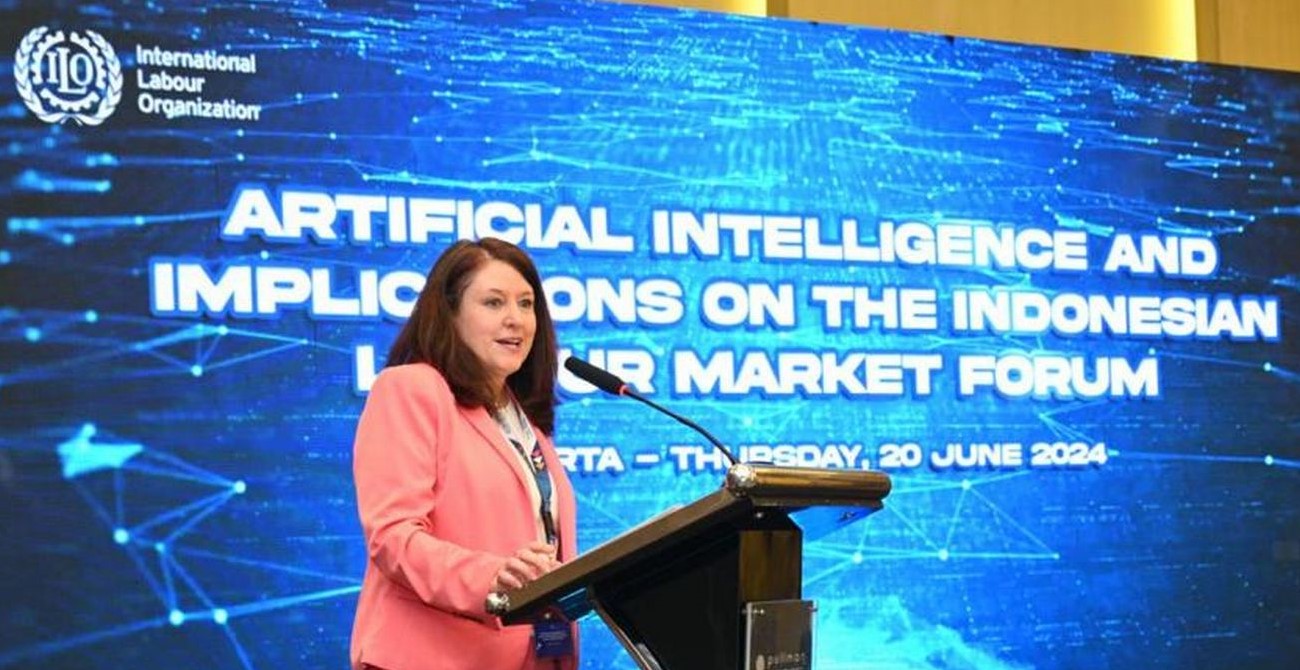
ASIATODAY.ID, JAKARTA – The emergence of artificial intelligence (AI) represents a transformative force, offering exciting opportunities as well as major challenges in the labour market. While artificial intelligence has the potential to increase worker productivity and drive economic growth, it also raises concerns about job displacement and exacerbating existing inequalities.
To further discuss the impact of artificial intelligence on the world of work, the International Labour Organization (ILO) held a High Level Forum entitled “Artificial Intelligence (AI) and its Implications for the Indonesian Labor Market”, on June 26 in Jakarta. The forum began with a keynote speech by Airlangga Hartarto, Coordinating Minister for the Indonesian Economy regarding employment opportunities in the Indonesian labour market and an opening speech by Celeste Drake, Deputy Director General of the ILO, who highlighted several key issues and global challenges.
By strategically bringing together diverse experts for the first dialogue on artificial intelligence in the context of needs, readiness and governance of the Indonesian labour market, this ILO Forum serves to stimulate timely reflection on Indonesia’s current situation and next steps in workforce planning and investment . This forum provides initial guidance on what goals to take, and how best to achieve them in order to capitalize on the benefits of the labour market, leaving no one behind.
Indonesia is the largest potential market in the region for investment in artificial intelligence development, with significant potential to spur and realize a fairer labour market that can benefit from artificial intelligence, while mitigating any risks.
Airlangga Hartarto underlined the Indonesian Government’s commitment to preparing for the future of artificial intelligence in the Indonesian economy.
“We have launched the National Strategy for Indonesia’s Digital Economic Development 2030 as a country that implements digital transformation that helps improve the economic landscape, protect digital talent, create jobs and ensure our steps towards achieving the Sustainable Development Goals (SDGs),” he stated.
The ILO global study, Generative Artificial Intelligence and Jobs: A global analysis of the potential impact on the quantity and quality of work, reveals that artificial intelligence is more likely to add to rather than destroy jobs by automating some tasks rather than taking over a role entirely. Therefore, the biggest impact of this technology is not the loss of jobs, but the potential changes to the quality of work, including work intensity and autonomy.
The study found that the potential impact of generative artificial intelligence is likely to differ significantly for men and women, with more than double the number of female workers potentially impacted by automation. This is due to the overrepresentation of women in administrative jobs, especially in high and middle income countries.
“The ILO is making significant investments in expanding our leading research into artificial intelligence. To increase the visibility of our work and engage constituents and others, we will launch a new Observatory on Artificial Intelligence and Jobs in the Digital Economy in early September,” said Celeste Drake, Deputy Director-General of the ILO.
“The 2025-2026 ILO standard-setting discussion on decent work in a transitional economy is also an opportunity to discuss the potential role of international labor standards in addressing the challenges and opportunities posed by technological progress,” he added.
Shinta Widjaja Kamdani, Chair of the Indonesian Employers’ Association (Apindo) and Rekso Silaban, Chair of the International Advisor to the All-Indonesian Trade Union Confederation (KSBSI), gave their responses on how employers and workers can make the best use of technological changes, such as artificial intelligence, to overcome challenges labour market and take advantage of opportunities to be more productive.
“Social dialogue is key to implementing the national strategy on artificial intelligence and to ensuring proper employee engagement,” concludes Rekson; while Shinta emphasized the importance of equality and inclusiveness. “Artificial intelligence infrastructure plays a big role because artificial intelligence must be accessible to everyone, including women and marginalized groups. Encouraging inclusivity and equality can be one effort to narrow the gap.”
This forum also heard the views of key speakers representing the government and the private sector. Prof. Warsito, Deputy for Coordination of Education Quality Improvement and Religious Moderation at the Coordinating Ministry for Human Development and Culture, highlighted the importance of improving Indonesia’s human resources with relevant skills that are compatible with the rapidly changing world of work and technological advances that are here to stay, such as artificial intelligence.
Prof. Anwar Sanusi, Secretary General of the Ministry of Manpower, emphasized the importance of labour market governance in line with the development of employment policies which are an important formula for ensuring the sustainability of the business world and labour force participation in decent work.
From a business perspective, Ajar Edi, Director of Government Affairs for Microsoft Indonesia and Brunei, explained Microsoft’s priorities as an investor and development partner in Indonesia, and its contribution to Indonesia’s national development. Kurnia Sofia Rosyada, Head of Bank Mandiri’s Data Analysis Business Group, underlined the need to utilize digitalization to strengthen the competitiveness of small and medium businesses which are the backbone of the Indonesian economy. (AT Network)
Follow Us at Google News and WA Channel