
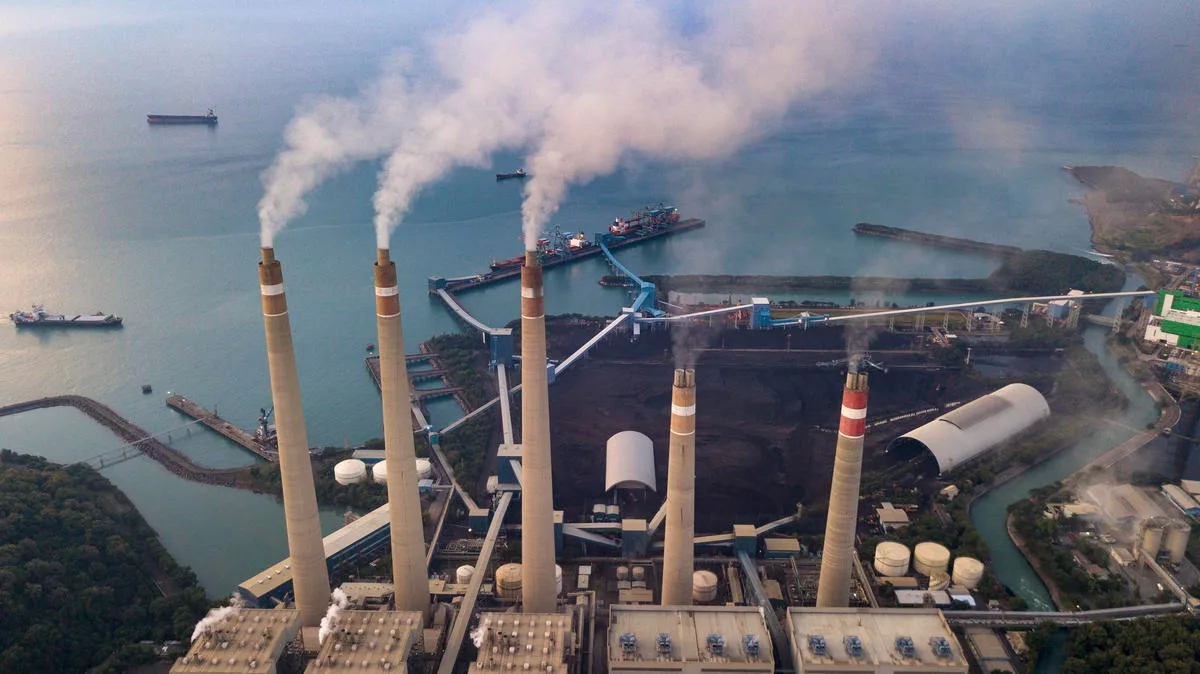
ASIATODAY.ID, JAKARTA — A coalition of civil society organizations under the Just Coalition for Our Planet (JustCOP) is calling on the Indonesian government to reaffirm its commitment to reducing global carbon dioxide–equivalent emissions that are heating the planet. Under current energy policies, Indonesia’s peak carbon emissions—originally targeted for 2030—are now projected to be delayed until 2037.
Every country should ideally reach its peak emissions before they begin to decline, in order to prevent global warming from reaching catastrophic levels for human civilization. Yet Indonesia’s current commitment shows the opposite trend.
“Indonesia’s energy sector emissions peak has been postponed by seven years from what was projected in the Long-Term Strategy for Low Carbon and Climate Resilience (LTS-LCCR) 2050,” said Syaharani, Head of Climate and Decarbonization Division at the Indonesian Center for Environmental Law (ICEL), during an online discussion held in Jakarta, October 14, 2025.
The discussion also featured Tri Purnajaya, Director of Economic and Environmental Development at the Ministry of Foreign Affairs, and Torry Kuswardono, Coordinator of the Secretariat of the People’s Alliance for Climate Justice.
Syaharani’s statement refers to the latest National Electricity Development Plan (RUKN 2024–2060), which projects that power generation from coal-fired power plants (CFPPs) will continue to rise, reaching its peak in 2037. She also cited the National Energy Policy (KEN), which indicates that by 2030, 79% of Indonesia’s energy mix will still come from fossil fuels.
“Under the current Business-as-Usual (BAU) scenario, Indonesia’s 2030 carbon emission reduction target still reflects a 148% increase compared to 2010 levels,” Syaharani explained.
“Moreover, the existing Enhanced Nationally Determined Contribution (ENDC) document does not specifically outline a target for early retirement of coal-fired power plants, which continue to dominate electricity supply across industrial sectors.”
With this delay, Syaharani added, the energy sector—Indonesia’s largest emitter—will continue to release substantial emissions, pushing the global temperature increase beyond the 1.5°C threshold above pre-industrial levels.
“Even if Indonesia fulfills its 2022 ENDC targets, the country would still produce significant emissions,” she emphasized.
This continued emission rise will further intensify global warming and worsen the climate crisis. Therefore, JustCOP urges the government to strengthen its climate ambition through the Second Nationally Determined Contribution (SNDC).
Indonesia Misses the Deadline for Submitting the SNDC Document
Ahead of the upcoming Conference of the Parties (COP 30) on climate change scheduled for mid-November 2025, Indonesia has yet to submit its SNDC document—despite the September 2025 deadline having passed.
However, Tri Purnajaya, Director of Economic and Environmental Development at the Ministry of Foreign Affairs, expressed optimism that Indonesia will soon finalize and submit the document.
“The public must remain realistic, as Indonesia continues to prioritize economic growth,” he said. “Our climate commitment must align with the national development target of 8% growth. Indonesia is not alone—only about half of the countries under the Paris Agreement have submitted their SNDCs.”
During the discussion, Torry Kuswardono stressed that climate policies must prioritize people’s welfare. Government-led mitigation efforts, he said, should not weaken communities’ ability to cope with climate change.
“The state must protect land rights through recognition of customary lands and agrarian reform as the foundation for community climate resilience,” Torry said.
“Adaptive social protection must also be provided for vulnerable groups, such as persons with disabilities, laborers, and informal workers. Over the past decade, we’ve seen a weakening of grassroots adaptation capacity.”
Torry, who also serves as Executive Director of the PIKUL Foundation, cited the example of nickel downstreaming projects in North Maluku and Central Sulawesi, which have led to land grabbing, agrarian conflicts, and pollution affecting local communities.
“Protection for vulnerable groups remains absent in Indonesia’s climate policies,” he noted.
He also criticized the lack of public participation in policy-making processes.
“There are mechanisms that are far from transparent. Even when participation is invited, it often amounts to tokenism. We’re told there will be public consultation, but the very next day, the policy is already signed into law,” he said.
Torry further urged the government to focus on climate change mitigation and adaptation policies that support smaller-scale but widespread and inclusive projects, rather than large, centralized ones.
“Local communities know best what they need. It should not involve clearing forests for so-called food security projects—these forests must be preserved for their rich biodiversity,” Torry concluded. (AT Network)
Follow Us at Google News and WA Channel