
ASIATODAY.ID, NEW YORK – As nationwide protests in Iran show tentative signs of easing after nearly three weeks of bloodshed and unrest, the United Nations has issued a stark warning: without restraint, the crisis risks spiraling into far wider violence—both inside Iran and across the region.
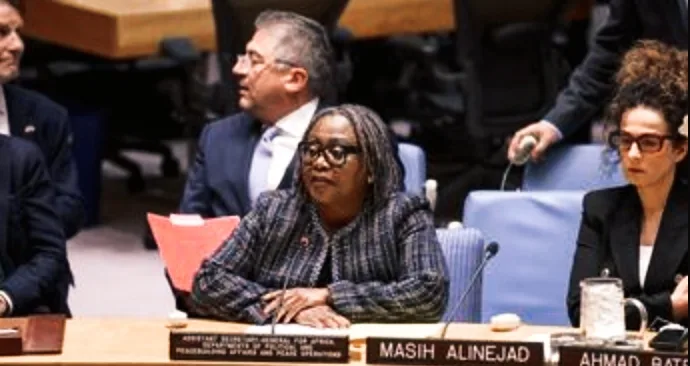
Briefing an emergency session of the UN Security Council in New York on Thursday, Martha Ama Akyaa Pobee, Assistant Secretary-General for Political Affairs, described the situation as “fluid and deeply concerning,” even as protest activity reportedly declined compared to previous weeks.
“The protests continue, albeit at a smaller scale,” Pobee told the Council, which convened at the request of the United States amid mounting international alarm.
UN Rejects Military Options as ‘Volatile and Dangerous’
Pobee voiced serious concern over public rhetoric hinting at possible military strikes against Iran, warning that such statements could dangerously inflame an already unstable crisis.
“This external dimension adds volatility to an already combustible situation,” she said. “All efforts must be undertaken to prevent any further deterioration.”
UN Secretary-General António Guterres, she added, remains convinced that Iran’s challenges—ranging from nuclear tensions to mass protests—can only be resolved through diplomacy and dialogue, not force.
He has urged “maximum restraint”, calling on all parties to refrain from actions that could trigger further loss of life or ignite a wider regional escalation.
Iran’s Largest Protests Since 2022
The unrest erupted on 28 December, sparked by shopkeepers in Tehran protesting the collapse of Iran’s currency, runaway inflation, and worsening living conditions.
What began as economic dissent rapidly evolved into nationwide anti-government demonstrations, the largest since protests following the 2022 death in custody of Jina Amini, a Kurdish woman detained for allegedly violating hijab laws.
Authorities responded by imposing a near-total communications blackout, much of which remains in effect.
Human rights groups report that hundreds—possibly thousands—of protesters and bystanders have been killed, with more than 18,000 people detained. The UN says it has been unable to independently verify these figures due to access restrictions.
Tehran Blames ‘Terrorists’ and ‘Rioters’
According to Pobee, the Iranian government insists it was forced to act after what it described as “organized terrorists” and “rioters” infiltrated the protests, opened fire on security forces, and sought to provoke foreign military intervention.
Iranian authorities have blamed these groups for the deaths of both civilians and members of the security forces.
However, the UN Secretary-General has expressed deep concern over the reported excessive use of force by state authorities, while reaffirming Iranians’ rights to freedom of expression, association, and peaceful assembly.
Dissidents Demand Accountability
Two prominent civil society voices briefed the Council, including Masih Alinejad, an Iranian journalist and outspoken critic of the regime.
“What is needed now is real and concrete action to bring justice to those who order massacres in Iran,” she said.
Also addressing the Council was Ahmad Batebi, an Iranian-American human rights activist who recounted his arrest as a student protester, subsequent death sentence, and years of torture and solitary confinement.
“I was forced to confess that I was a paid American spy,” Batebi told delegates.
US: Iran’s Repression Threatens Global Security
US Ambassador Mike Waltz warned that Tehran’s crackdown carries consequences beyond its borders.
“The level of violence and repression unleashed by the Iranian regime on its own citizens has repercussions for international peace and security,” he said.
Waltz stated that Iranians are demanding freedom “like never before in the Islamic Republic’s brutal history,” adding that President Donald Trump and the United States “stand by the brave people of Iran.”
Iran Accuses US of Engineering Chaos
Iran’s Deputy Permanent Representative Gholamhossein Darzi fired back, denouncing the civil society briefers as agents of US and Israeli political agendas.
Speaking on behalf of what he described as a “nation in mourning,” Darzi accused Washington of deliberately fueling violence inside Iran.
“It is deeply regrettable that the representative of the United States has resorted to lies, distortions of facts, and deliberate disinformation to conceal his country’s direct involvement in steering unrest toward violence,” he said.
A Crisis Far From Over
Despite signs of reduced street protests, the UN’s message was unmistakable: Iran remains at a tipping point, where internal repression, international pressure, and military rhetoric could combine into a far deadlier confrontation—unless restraint prevails. (AT Network)
Follow Us at Google News and WA Channel