
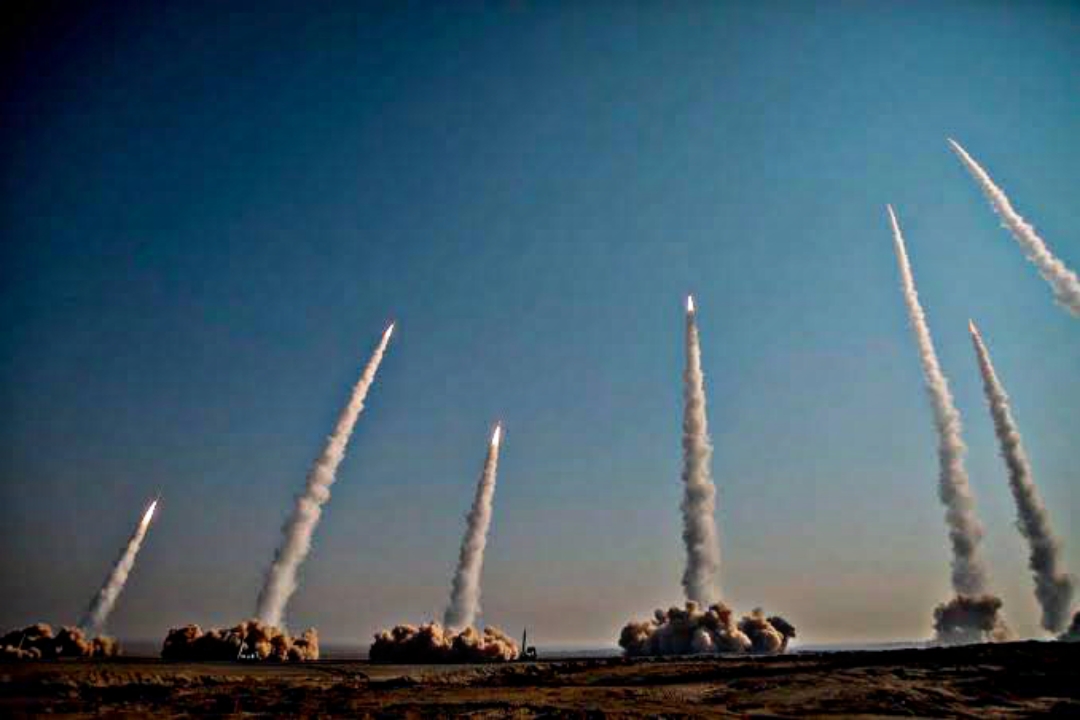
ASIATODAY.ID, TEHRAN – Iran used two-stage super-heavy ballistic missiles Sejjil in an attack on Israel on Wednesday evening, the Islamic Revolutionary Guard Corps (IRGC) said.
“The 12th wave of Operation True Promise 3 began with the launch of two-stage super-heavy long-range missiles Sejjil,” the IRGC said in a statement.
The IRGC “managed to disrupt Israeli air defense systems” and gain full control of Israeli airspace, the statement added.
The targets of the Iranian strikes were Israeli intelligence sites and air bases.
“The missile attacks will be prolonged and effective. Like yesterday, we hit Mossad sites, military intelligence directorates, and army fighter air bases throughout the occupied territories,” the IRGC said in a statement.
Weizmann Institute labs, ‘irreplaceable’ samples destroyed
A number of laboratories at Rehovot’s Weizmann Institute of Science were seriously damaged and even destroyed by the barrage of Iranian ballistic missiles on Sunday morning.
One laboratory led by Prof. Eldad Tzahor – a world leader in the field of cardiac regeneration and director of the cellular and molecular biology laboratory working in the field of regenerative medicine – was totally destroyed.
Another lab that was wiped out was that of senior scientist Dr. Leeat Yankielowicz-Keren, a cancer researcher in the Faculty of Biology, whose lab team consisted of 12 scientists.
Her research focuses on studying tumor-immune interactions using multiplexed imaging and developing computational tools to infer design principles in tumor immunology.
‘Nothing was left to save’ at Weizmann Institute
The institute said that several buildings on campus were damaged, but no one was hurt. “The institute is in contact with the relevant security and emergency agencies and is taking all necessary steps to ensure the safety of employees and the campus,” the spokeswoman said.
The distraught Tzahor released a post saying that “this is hard and sad, as nothing was left to save. We study regenerative medicine – so we will regenerate, regrow, and rebuild. One of my students said the one thing that wasn’t gone is our motivation.”
He thanked friends around the world who offered their support, help, and room for his research. Tzahor received a bachelor’s degree in biology from the Hebrew University and a doctorate in molecular biology at Weizmann.
After completing his postdoctoral training at Harvard Medical School, he returned to Rehovot to do research on novel mechanisms for cardiac regeneration following injury in mammals, which is a major challenge in current biomedical research.
Tzahor and his team dream of developing treatments for perfectly healthy young hearts that would allow them to recover from an otherwise devastating injury decades later. Heart diseases are a leading cause of death worldwide, but are not regarded as a condition one could prepare for with preventive treatment.
However, Tzahor’s team has shown that this could be accomplished through the use of a cellular mechanism in healthy mouse hearts that makes these mice resilient to future heart attacks.
Tzahor grew up on a kibbutz, where he was fascinated as a child by the cycles of life. His childhood experiences and early interest in veterinary biology help explain why a successful scientist changed career paths to pursue embryonic development research.
Scientific samples that ‘cannot be replaced’ destroyed by Iran
Yankielowicz-Keren told The Jerusalem Post that when she learned of the destruction early in the morning, she was “in mourning.”
Scientific devices that cost hundreds of thousands of shekels can be replaced, she added, “but what can’t be are many tumor samples taken and studied over five years from cancer patients, not only in Israel but also in the US, France, Switzerland, and other countries. These cannot be replaced.”
She said their written data was safe, but the loss of the samples in the lab, about the size of a four-room apartment, is a big problem.
“Now we are already rebuilding. Institute heads are working around the clock; they have been wonderful. We are starting to build again, temporarily in other spaces on campus or sharing labs.”
Yankielowicz-Keren earned her BSc degree at Tel Aviv University and her master’s and doctoral degrees in computational biology at the Weizmann Institute.
She then went to Stanford University for her postdoctoral work as a Fulbright, EMBO, and Damon Runyon fellow to spearhead the development of a platform for multiplexed imaging of tissues before joining the faculty of the Department of Molecular Cell Biology in Rehovot five years ago. (Sputnik/The Jerusalem post)
Follow Us at Google News and WA Channel