
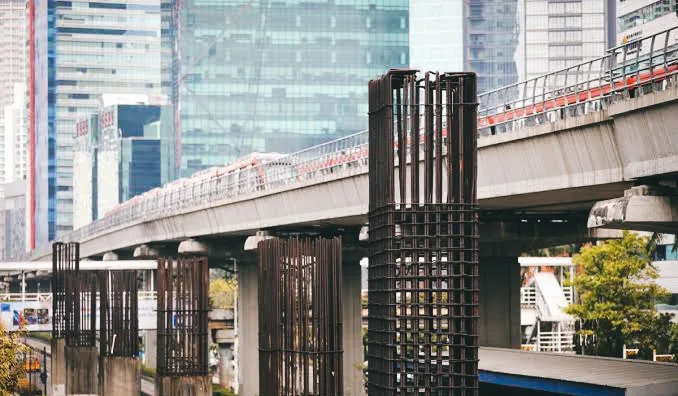
ASIATODAY.ID, JAKARTA — After more than a decade standing as a symbol of abandoned ambition, Jakarta has officially begun dismantling the long-neglected monorail pillars in the Kuningan business district.
The Jakarta Provincial Government says the move marks the definitive end of a failed IDR 58 trillion (USD 3.55 billion) monorail project that has burdened the city’s safety, mobility, and urban image for years.
The concrete pillars, some erected as early as 2007, never carried a single passenger. Instead, they became a daily reminder of a megaproject that promised modern mass transit but collapsed under weak governance, legal uncertainty, and financial instability.
From Grand Vision to Urban Liability
Jakarta’s monorail project was first conceived in the early 2000s as a futuristic solution to chronic traffic congestion. The provincial government partnered with PT Jakarta Monorail, envisioning an elevated rail system connecting key commercial corridors such as Kuningan, Sudirman, and Tanah Abang.
Construction began with great optimism. Pillars rose along major roads, signaling what was meant to be a new era of urban mobility. But the project soon ran into serious trouble—funding shortfalls, design changes, and unresolved legal issues stalled progress before tracks or trains were ever installed.
By September 21, 2011, the cooperation agreement between the Jakarta government and PT Jakarta Monorail formally expired. The project lost its legal foundation, yet the unfinished structures remained in public space, unmanaged and unresolved, for more than a decade.
Over time, the abandoned monorail came to represent a failure of infrastructure planning and execution, creating traffic bottlenecks, visual blight, and safety risks in one of Jakarta’s most strategic districts.
IDR 58 Trillion Revival Claims Resurface
Ironically, the dismantling of the old monorail coincides with renewed claims of reviving the project. In July 2025, PT Jakarta Monorel announced plans for a new monorail system with an estimated investment value of IDR 58 trillion, backed by foreign capital and global technology.
The company is now majority-owned by Ortus Infrastructure Capital Limited, part of the Ortus Group, which acquired roughly 90 percent of the shares in 2013 from PT Indonesia Transit Central and PT Adhi Karya.
The proposed project would use Alstom Monorail technology from France and operate under a 40-year Build–Operate–Transfer (BOT) scheme. Plans include a 30-kilometer Green Line and a 14-kilometer Blue Line, with projected daily ridership of up to 280,000 passengers.
Yet the dismantling of the old structures sends a clear message from city authorities: Jakarta’s transport future cannot be rebuilt on unresolved failures of the past.
Jakarta Government: Failed Projects Must Be Closed, Not Inherited
Governor Pramono Anung and Deputy Governor Rano Karno have emphasized that the dismantling process is being carried out transparently, accountably, and in strict compliance with the law. The city has allocated approximately IDR 100 billion from the 2026 regional budget to remove the structures and reorganize the Kuningan area.
According to Yustinus Prastowo, Deputy Coordinator of the Governor’s Special Staff, the operation goes beyond demolition.
“Kuningan is the face of Jakarta—home to embassies, major businesses, and public transport corridors. Allowing a failed project to remain for years posed risks to safety, mobility, and the city’s international image,” he said on Saturday, January 10, 2026.
Authorities also cited data linking the abandoned pillars to elevated traffic accident risks due to non-compliant safety standards.
122 Pillars Removed, Legal Status Settled
Jakarta’s Assistant Secretary for Development and Environment, Afan Adriansyah, confirmed that 122 monorail pillars stand on land owned by the provincial government. Court rulings established the structures as assets of PT Adhi Karya, though technically unusable for any monorail system.
Moreover, neither Presidential Regulation No. 55/2018 on the Greater Jakarta Transport Master Plan nor Jakarta’s 2024–2044 Spatial Planning Regulation includes monorail development as part of the city’s official transport network.
The Jakarta government has coordinated the dismantling with PT Adhi Karya, under supervision from the Attorney General’s Office and consultations with the Corruption Eradication Commission (KPK). While the city is handling the demolition, the assets will be securely stored to respect legal ownership.
“Failed projects must not continue as urban burdens. Resolution must be firm, lawful, and accountable,” Afan stated.
Closing a Chapter, Testing the Future
The removal of Jakarta’s abandoned monorail pillars formally closes a long chapter of infrastructure failure—one that spanned multiple administrations and left visible scars on the cityscape.
As ambitious new proposals worth tens of trillions of rupiah re-emerge, Jakarta’s decision to dismantle the old monorail serves as a warning and a lesson: mega infrastructure projects demand strong governance, policy consistency, and public accountability—without which even the grandest visions can collapse into concrete relics. (AT Network)
Follow Us at Google News and WA Channel