
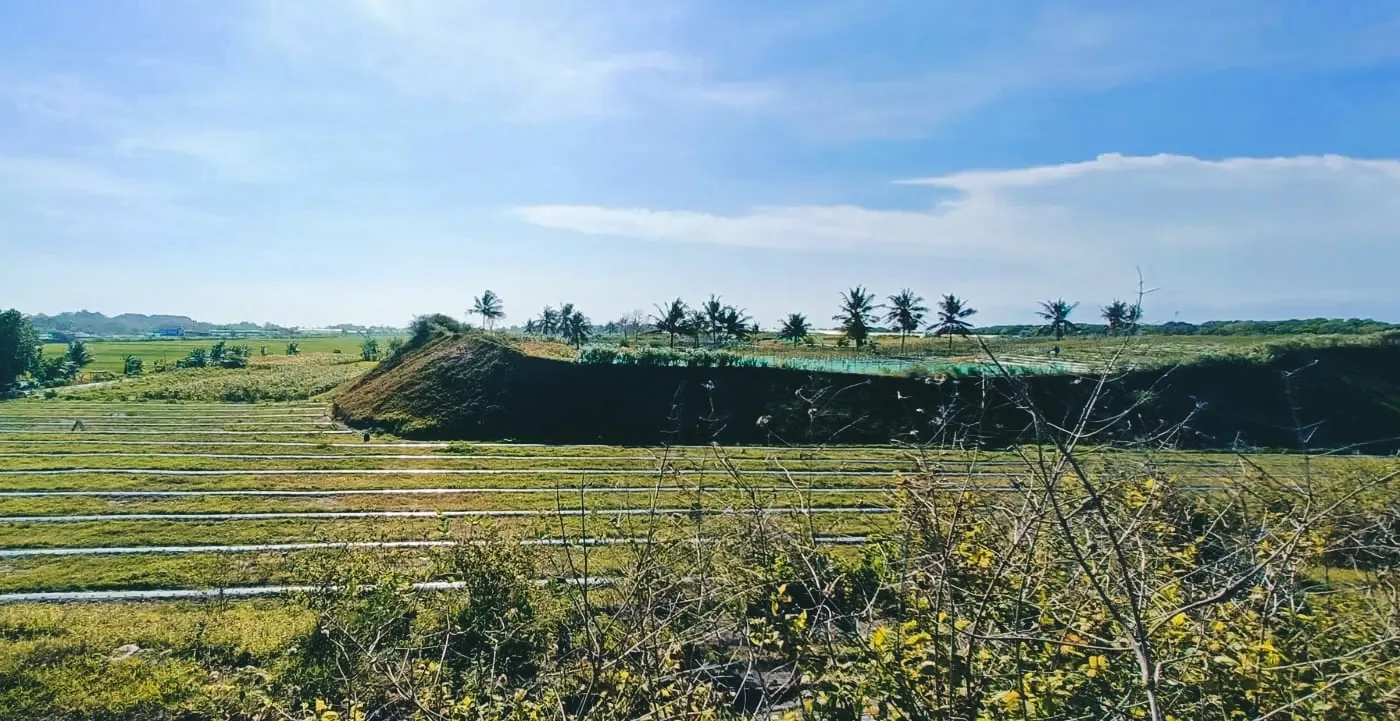
ASIATODAY.ID, BANDUNG — Along the southern coast of Java, stretching from Kebumen to Purworejo, lies an ancient natural fortress formed thousands of years ago. These towering sand ridges behind the shoreline are not ordinary mounds; they are geological walls shaped by nature to shield coastal communities from devastating tsunamis.
Today, however, this natural protection is slowly being eroded by expanding sand mining activities.
Eko Yulianto, a researcher at the Geological Disaster Research Center of Indonesia’s National Research and Innovation Agency (BRIN), emphasized the critical role of these sand ridges.
“These natural barriers were formed through geological processes over thousands of years, and they are vital for the safety of coastal residents. If these ridges are damaged, we lose our most fundamental layer of tsunami protection,” he said In an interview in early November 2025.
Findings from a BRIN research team—part of the 2025 Research and Innovation Funding Program (RIIM)—show that the ridges formed roughly six thousand years ago, when sea levels were three to five meters higher than today. Scientifically, the formation is known as the Holocene Maximum Marine Terrace (TLHM).
These ancient marine deposits now serve as crucial tsunami buffers. The sand ridges extend for about 40 kilometers, standing 6 to 13 meters high on average, located 400 to 500 meters from the shoreline in Kebumen and Purworejo, and up to eight kilometers inland in Cilacap.
Their varying heights and distances from the sea explain the differing tsunami risks across the region. Settlements in Kebumen and Purworejo—positioned atop ridges more than nine meters above sea level—are relatively safer from moderate-scale tsunamis.
“Cilacap, on the other hand, sits at only zero to four meters above sea level and lies directly on the modern coastal plain, making it significantly more vulnerable,” Eko explained.
Morphologically, Cilacap is far more exposed due to its lower elevation and proximity to the ocean.
Geological studies indicate that the megathrust zone south of Java–Nusa Tenggara is capable of generating massive earthquakes of up to magnitude 9.6, with recurrence intervals of roughly 675 years.
“An earthquake of this scale could trigger a major tsunami capable of sweeping several kilometers inland. In such a scenario, the sand ridges act as essential natural barriers, slowing and reducing the force of incoming waves before they reach populated areas,” he said.
Unfortunately, this invaluable natural defense—formed freely by nature—is now at risk of disappearing due to unchecked sand extraction. Replacing it with artificial coastal defenses, like the seawalls built in Japan after the 2011 tsunami, would cost at least 14 trillion rupiah—equivalent to 14 times Indonesia’s 2025 National Disaster Management Agency (BNPB) budget.
Japan constructed seawalls 12 to 15 meters high along nearly 400 kilometers of coastline at a cost of 138 trillion rupiah.
“The irony is that we are destroying a priceless natural protection for short-term gains,” Eko remarked.
“Damaging these sand ridges is equivalent to stripping communities of their last line of defense against a tsunami. This is not merely a geological issue—it is a humanitarian one.”
Nature often provides its own way of protecting human life. The sand ridges of southern Java are a powerful example. Formed slowly over millennia, they could vanish within a few decades if not preserved.
Safeguarding these natural tsunami barriers is not only about environmental conservation—it is about ensuring the safety and future of generations to come. (AT Network)
Follow Us at Google News and WA Channel