
ASIATODAY.ID WASHINGTON – The world is once again on edge. The war in the Middle East is no longer just a regional conflict—it has evolved into a global economic shock, driving up energy prices, disrupting supply chains, and threatening growth across continents.
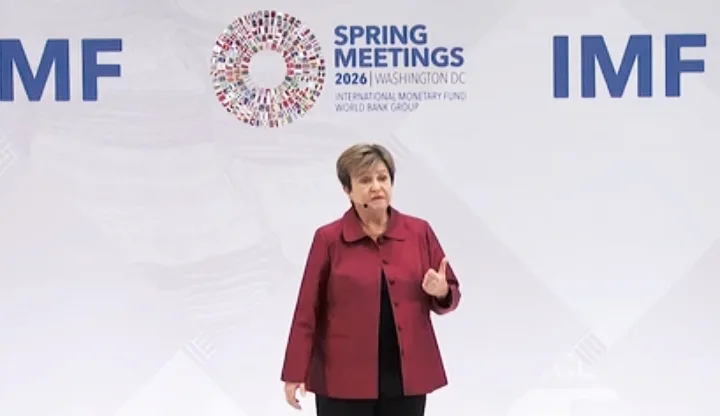
In her address at the 2026 Spring Meetings, Kristalina Georgieva, Managing Director of the International Monetary Fund, warned that the global economy is facing a large, global, and asymmetric energy supply shock.
The scale is staggering. Global oil flows have dropped by around 13 percent, while liquefied natural gas (LNG) supplies have fallen by roughly 20 percent. The immediate consequence: surging energy prices, rising inflation, and mounting pressure on economies worldwide.
Brent crude prices spiked from $72 per barrel to as high as $120 before easing slightly. Yet, for many countries, energy remains significantly more expensive than before the conflict, with some paying steep premiums just to secure supply.
The ripple effects are severe. Fuel shortages—including diesel and jet fuel—are disrupting transportation, trade, and tourism in an increasingly interconnected world. At the same time, food insecurity is worsening, with an additional 45 million people at risk, pushing the global total of those facing hunger beyond 360 million.
Industrial supply chains are also under strain. Key inputs such as sulfur, helium, and naphtha—critical for semiconductors, medical imaging, and plastics—are increasingly difficult to access, compounding global production challenges.
According to the IMF, the shock is spreading through three main channels: rising prices and supply shortages, shifting inflation expectations, and tightening financial conditions. Together, these forces risk suppressing demand and slowing global growth.
Although similar shocks have occurred in the past, including during the 1970s oil crisis, the IMF cautions that this episode will still leave a lasting mark. Even under the most optimistic scenario, global growth is expected to be downgraded.
A stark example is Qatar’s Ras Laffan LNG complex, a critical hub for global energy supply, which has been severely disrupted by the conflict. Full recovery could take between three to five years—posing a prolonged challenge, particularly for energy-dependent regions such as Asia-Pacific.
Meanwhile, uncertainty looms over vital trade routes like the Strait of Hormuz and the Red Sea. Persistent disruptions in these corridors could further destabilize global energy distribution and trade flows.
The impact is highly uneven. Energy-exporting countries are relatively better positioned, while import-dependent economies—especially those with limited fiscal space—face the harshest consequences. Small and vulnerable economies are at greatest risk.
In response, the IMF is urging countries to avoid unilateral measures such as export restrictions or price controls, which could exacerbate global instability.
Instead, policymakers are encouraged to adopt targeted and disciplined responses. Central banks must remain vigilant on inflation, while governments should provide temporary, well-targeted support to the most vulnerable without undermining fiscal sustainability.
The Fund also highlighted a growing concern: limited fiscal space. With public debt levels significantly higher than two decades ago, many countries have reduced capacity to respond effectively to new shocks.
Amid this uncertainty, the IMF estimates that global demand for balance-of-payments support could rise to between $20 billion and $50 billion in the near term.
Yet one message stands above all: strong policies and resilient economic fundamentals are the best defense in times of crisis.
“Countries may not control global shocks, but they do control their policies and institutions,” Georgieva emphasized.
Ultimately, the IMF underscores a fundamental truth—peace matters. Beyond the data and economic projections, war remains the root cause of instability, undermining progress and prosperity worldwide. (AT Network)
Follow Us at Google News and WA Channel