
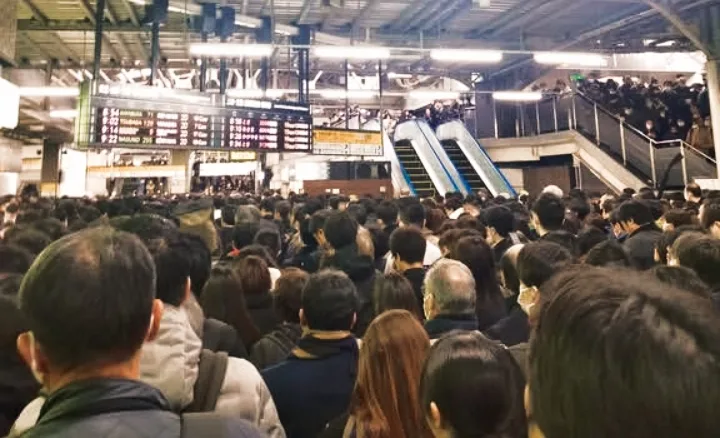
ASIATODAY.ID, TOKYO — One of the world’s most advanced and heavily used urban transport systems was brought to a standstill on Friday morning after a power failure crippled major railway lines across Tokyo, leaving more than 673,000 commuters stranded for up to nine hours.
Two critical lines operated by East Japan Railway Company (JR East)—the Yamanote Line and the Keihin-Tohoku Line—were forced to suspend services during peak morning hours, triggering widespread disruption across the Japanese capital.
JR East said the outage occurred when electricity failed to recover following overnight maintenance work at Tamachi Station, cutting power supply to both lines.
“Smoke was seen coming from an equipment box along the track near the station,” a JR East spokesperson said, as quoted by Japan Times.
Passengers Evacuated, Forced to Walk Along the Tracks
The disruption escalated when several trains came to a halt between stations. Passengers were evacuated from stalled carriages and instructed to walk along the tracks toward nearby stations under the supervision of firefighters and railway staff.
Images and videos circulating on social media showed overcrowded platforms and concourses, with thousands of commuters packed into major stations amid mounting delays.
The Yamanote Line, which loops around central Tokyo, serves some of the busiest stations in the world, including Shinjuku, handling an estimated 3.5 million passengers daily. The Keihin-Tohoku Line connects key urban and commercial hubs, including Tokyo and Yokohama.
A Stark Reminder of Systemic Vulnerability
The incident has sparked renewed scrutiny over the resilience of even the most technologically advanced transportation networks. Within hours, Tokyo—often cited as a global benchmark for efficiency—descended into gridlock.
While services gradually resumed later in the day, the disruption rippled across the city’s economy, work schedules, and public confidence.
Tokyo stood still—proof that in a hyper-connected мегacity, a single power failure can halt millions of lives. (AT Network)
Follow Us at Google News and WA Channel