
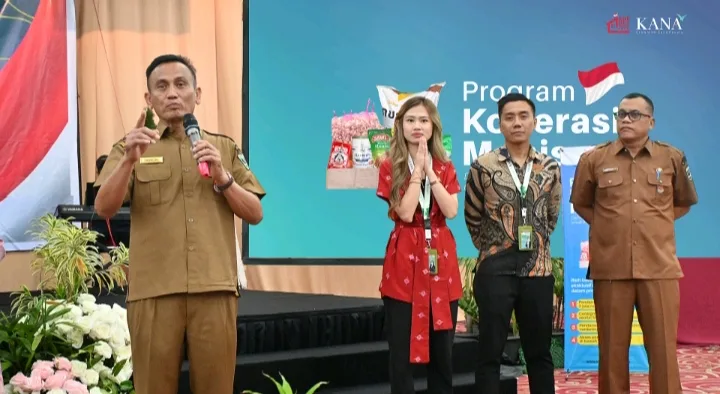
ASIATODAY.ID, PADANG — The Provincial Government of West Sumatra, through the Office of Cooperatives and SMEs, continues to strengthen the role of village cooperatives in the regional economic value chain. One of its key initiatives is the Village Cooperative Mentorship Capacity Building Program, held over five days, from October 17–21, 2025, in Padang City.
The program serves as a systematic effort to enhance the human resource capacity of cooperative managers, enabling them to operate more professionally and with a strong business orientation. Head of the West Sumatra Cooperative and SME Office, Endrizal, described the training as a long-term investment in developing a strong and competitive cooperative ecosystem.
“We want cooperative leaders and mentors to have sound managerial skills, be able to identify business opportunities, and manage local economic potential productively,” said Endrizal, October 21, 2025.
Beyond capacity building, the program also opens space for collaboration with the private sector. On the third day, Kana Cooperative introduced the “Koperasi Manis” (Sweet Cooperative) Program — a business partnership initiative inviting village and urban cooperatives (Kopdes/Kel) to join a distribution network for essential goods, particularly white sugar and basic food commodities.
Tresya Wijaya, Executive Chair of Kana Cooperative, explained that Koperasi Manis is a partnership model designed to expand inter-cooperative business networks and foster local economic self-reliance.
“We’ve created a mutually beneficial partnership system where village cooperatives serve as local distributors and earn direct economic value from their sales activities,” Tresya said.
Under the scheme, Kana Cooperative provides operational support of IDR 2 million (approximately USD 120) per month for each participating Kopdes/Kel Merah Putih. Goods are supplied on a consignment basis, with no upfront payment required, and each cooperative can potentially achieve monthly transactions of up to IDR 200 million (around USD 12,000). This model is expected to strengthen local supply chains for essential goods while reducing capital constraints faced by cooperatives.
Endrizal praised Kana Cooperative’s business approach, saying it addresses key challenges faced by many cooperatives, especially in terms of capital and inventory availability.
“Kana Cooperative offers a concrete solution — products are available, and the financing system allows cooperatives to operate without upfront capital pressure,” he noted.
As a follow-up, Kana Cooperative and the West Sumatra Cooperative Office signed a Memorandum of Understanding (MoU) for the implementation of the Koperasi Manis Program. The agreement was signed by Tresya Wijaya and Muhammad Sophian Tawar, Chair of the Kopediko Syariah Sejahtera Consumer Cooperative of West Sumatra.
This collaboration marks an important milestone in building an efficient, transparent, and sustainable cooperative supply chain partnership model across West Sumatra.
The following day, Kana Cooperative and the provincial cooperative office continued socializing the program among three urban cooperatives in Padang — Kopkel Merah Putih Balai Gadang, Kampung Jawa, and Pasie Nan Tigo. This initiative represents the direct application of the cooperative business model at the grassroots level.
Through this initiative, Kana Cooperative reaffirms its commitment to developing an adaptive, market-oriented cooperative ecosystem — in alignment with the provincial government’s Gerakan Koperasi Merah Putih (Red-and-White Cooperative Movement) and national efforts to strengthen food security through an inclusive and efficient distribution system. (Silvia Andriani)
Follow Us at Google News and WA Channel