
ASIATODAY.ID, JAKARTA – Indonesia has shown the international world as a country committed to mitigating climate change through mangrove conservation.
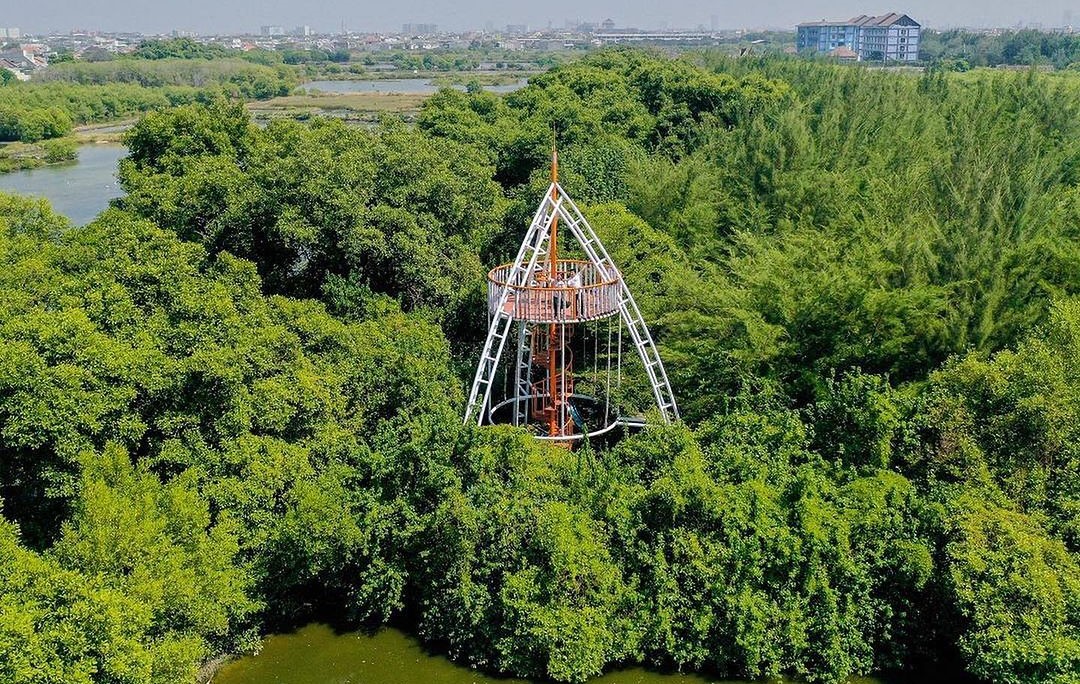
The National Research and Innovation Agency (BRIN) together with the Surabaya City Government, East Java have built an integrated mangrove conservation center for research and education purposes in a total area of 27 hectares.
Based on the National Mangrove Map released by the Ministry of Environment and Forestry in 2021, Indonesia has mangrove forests covering an area of 3,364,076 hectares. In the National Mangrove Map, there are three classifications of mangrove forests referring to the condition and percentage of canopy cover.
First, dense mangroves, namely the condition of mangroves with canopy cover above 70 percent and the number reaches 3,121,239 ha (93 percent). Then, medium mangroves have canopy cover between 30 percent and 70 percent and an area of 188,363 ha (5 percent) in the country. Lastly, mangroves are rare with canopy cover of less than 30 percent and their number in Indonesia is 54,474 ha (2 percent).
The government is currently focusing on rehabilitating mangrove areas in sparse cover and identifying their distribution, such as within forest areas or outside forests. The largest distribution of rare mangroves is in areas outside the forest, namely 29,910 ha.
In fact, mangroves are one of the best natural coastal fortifications because they are located in tidal areas. Generally, mangrove forests develop well on protected beaches, river estuaries, or lagoons.
There are two functions of mangrove forests as potential marine resources in Indonesia, namely ecological and economic functions. The ecological function is as a habitat for marine animals to shelter, find food and reproduce, as well as preventing sea water abrasion, minimizing the impact of tsunamis, reducing pollution, and increasing oxygen levels.
Meanwhile, its economic function is the use of tree wood as fuel wood or charcoal making material and can also be used as paper making material. Apart from wood, mangrove forests are also inhabited by various types of fauna that have economic value, for example shrimp and other types of fish.
Mangrove Botanical Garden
The mangrove forest conservation center is located on the coast or protected area of the East Coast, Gunung Anyar District, Surabaya City, East Java. This is the first botanical garden in Indonesia and the largest in Southeast Asia devoted to mangrove conservation.
The presence of the Surabaya Mangrove Botanical Gardens increases the number of botanical gardens in Indonesia to 46 locations, both managed by BRIN, provincial governments and district/city governments.
The Surabaya Mangrove Botanical Garden, which is not far from the government center of the capital city of East Java, covers a total area of 27 ha including three locations, namely Wonorejo Mangrove, Medokan Sawah Mangrove, and Gunung Anyar Mangrove.
Construction of the Surabaya Mangrove Botanical Gardens began on April 29 2018 as a result of collaboration between the Surabaya City Government, the Ministry of Public Works and Public Housing, BRIN, and the Indonesian Botanical Gardens Foundation (YKRI).
The Surabaya Mangrove Botanical Garden was inaugurated to coincide with the commemoration of World Mangrove Day on Wednesday, July 26 2023. The inauguration was carried out by Megawati Soekarnoputri as Chair of the Indonesian Botanical Garden Foundation and Chair of the BRIN Steering Committee. The Fifth President of Indonesia emphasized the importance of the country maintaining biodiversity and preserving germplasm.
This is in accordance with the mandate of Presidential Regulation number 93 of 2019 which states that botanical gardens are centers for ex-situ conservation or preservation outside their natural habitat. Apart from that, it also serves as in-situ conservation for various biodiversity. However, on the other hand, he reminded that establishing botanical gardens in a number of regions in Indonesia is not easy.
Every botanical garden must meet the criteria and standards, namely as a center for conservation, research, education, tourism and environmental services. Moreover, the operational management and maintenance of botanical gardens is also very high. This is what the managers of botanical gardens have had to think about and strive for so that they are directed to become tourist attractions, thereby providing income for maintenance.
57 Types of Mangroves
Currently, 57 types of mangroves have been planted in the Surabaya Mangrove Botanical Gardens. The plant collection includes api-api (Avicennia lannata), black mangrove (Rhizophora mucronata), and red mangrove (Rhizophora mangle). Then the oil mangrove (Rhizophora apiculata), bintaro (Cerbera manghas), and gedang-gedangan (Heliconia rostrata).
There are also black jeruju (Acanthus ebracteatus), ketower (Derris trifoliata), swamp date palm (Phoenix paludosa), and sea fern (Acrostichum aureum). Next there are red pidada/bogem (Sonneratia caseolaris), waru (Hibiscus tiliaceus), and sea waru (Thespesia populnea).
BRIN is not just carrying out detailed conservation and recording to make it easier for the public to research this place, even though currently only 17 of the 57 types of mangroves in the Surabaya Mangrove Botanical Garden’s collection have been registered. More than that, it also helps prepare the use of biodiversity as medicinal plants and food products based on advanced technology.
They have done this in the Cibinong Botanical Gardens, West Java which is managed by BRIN.
“This is one of the botanical gardens that is managed well and consistently among the 46 botanical gardens in Indonesia,” said Head of BRIN Laksana Tri Handoko, as reported by Antara.
As a tourist attraction, the city government has equipped the Surabaya Mangrove Botanical Gardens with mangrove educational tours. Among other things, a 1 meter wide canopy or road made of planks and bamboo in the form of a stilt that is 630 meters long divides the mangrove forest. There is also a 12 meter high viewing tower, boat dock and picnic area.
Visitors can also take a boat tour along the 5.4 kilometer river while enjoying the charm of the mangrove forest and the 28 species of birds that inhabit it. A suspension bridge made of wood and bamboo about 30 meters long has stood firmly to connect the Gunung Anyar Mangrove area and the Medokan Sawah Mangrove area.
Other facilities at the Surabaya Mangrove Botanical Gardens are a prayer room, meeting room, gallery and toilets. For the time being, there is no charge for visitors unless they want to try some of the rides in the Surabaya Mangrove Botanical Gardens, such as river crossings. (AT Network)
Check out other news and articles at Google News