
ASIATODAY.ID, JAKARTA – Climate disasters are the biggest threat to island countries.
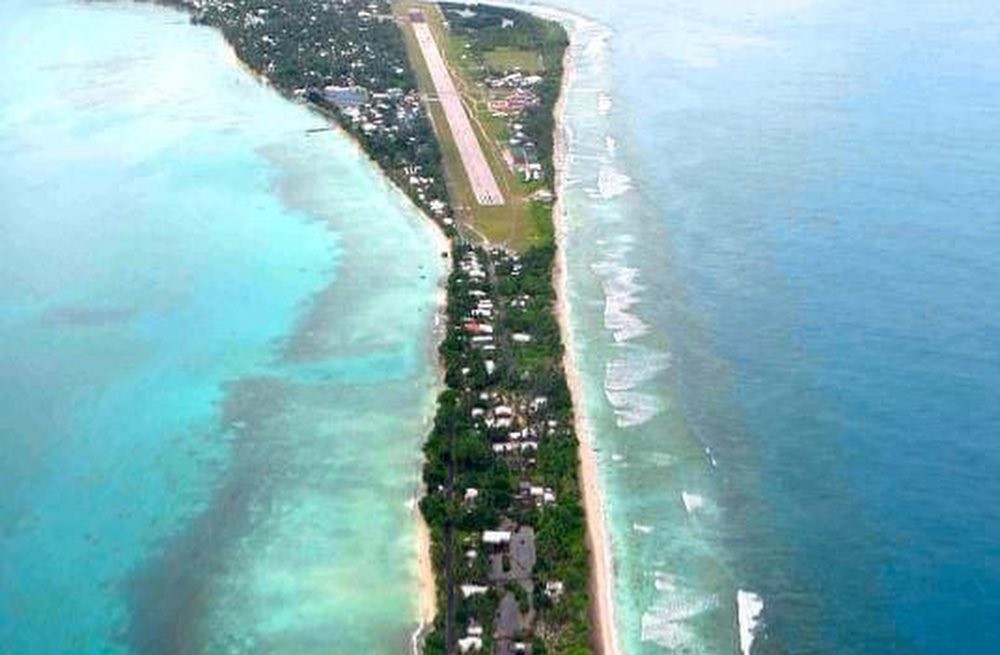
Tuvalu, a ring-shaped island country surrounding a lagoon (atoll) in the South Pacific, is predicted to be the first country to sink due to rising sea levels in the world due to climate change.
Based on a global emissions scenario assuming that global greenhouse gas emissions continue to increase at current rates and taking into account Tuvalu’s existing infrastructure, as much as 95 percent of the capital Funafuti is expected to be submerged in daily seawater flooding by the end of this century. The city will be uninhabitable by 2050.
Just a few years ago, Tuvalu’s then foreign minister Simon Kofe, stood at a dais knee-deep in water at the northern tip of Fongafale, and delivered a passionate speech about the impact of climate change on his country and the wider world.
“We cannot wait for speeches while sea levels around us continue to rise. We are sinking, but so is everyone else,” he said at the United Nations Climate Change Conference (COP26) in Glasgow in 2022.
Two years on from that speech, Tuvalu is still living on the edge, trying to survive in the face of destruction. Sea water regularly flows into the homes and businesses of residents on the main island of Fongafale, which is only 12 km long.
The Tuvaluan government has taken proactive steps to protect the nation’s sovereignty and ensure its survival into the future, regardless of what the future holds.
In September last year, the country’s constitution was amended to state that Tuvalu’s statehood would remain eternal, regardless of whether its physical territory was lost or not.
It was a move that theoretically strengthened Tuvalu’s existence as a country, but gave rise to other discussions about the worst-case scenario of moving the entire country to a new location. But for now, the Tuvaluan government insists that relocation is not on the agenda.
“Our government continues to insist that migration is a definite no-no. However, this is a matter of choice for our people. People have the freedom to leave if they are willing,” said Tuvalu Climate Change Minister Maina Talia.
He explained that the government would help facilitate processes and pathways for Tuvaluans to consider their future options, while prioritizing the protection of their homes.
“Our role as a government is to ensure that Tuvalu survives because if we move to another part of the world, one day, my children will ask, where is Tuvalu? Where do we come from? And Tuvalu has disappeared from the face of the earth,” he said.
Tuvalu currently has a partnership with Australia. With this security partnership agreement, hundreds of Tuvaluans can move abroad every year. The Falepili Union Agreement was agreed in November 2023 between the two respective governments to facilitate 280 long-term visas annually for Tuvaluans. This agreement provides special mobility pathways for individuals and families in Tuvalu to live, work and study in Australia.
“For a country with a population of around 12,000 people, this is a large number,” said Paulson Panapa, Tuvalu’s Minister of Foreign Affairs, Labor and Trade.
“This is an important opportunity for many people. This is completely optional. “It’s up to each person whether they want to go and live in Australia,” Panapa said.
“However, I think as a government, it is our duty to provide a pathway so that our citizens can start a new life in Australia. That doesn’t mean it’s not good here, but job opportunities are difficult,” he explained.
He hopes that young people studying abroad can help Tuvalu develop further in the years to come. (ATN)
Follow Us at Google News and WA Channel