
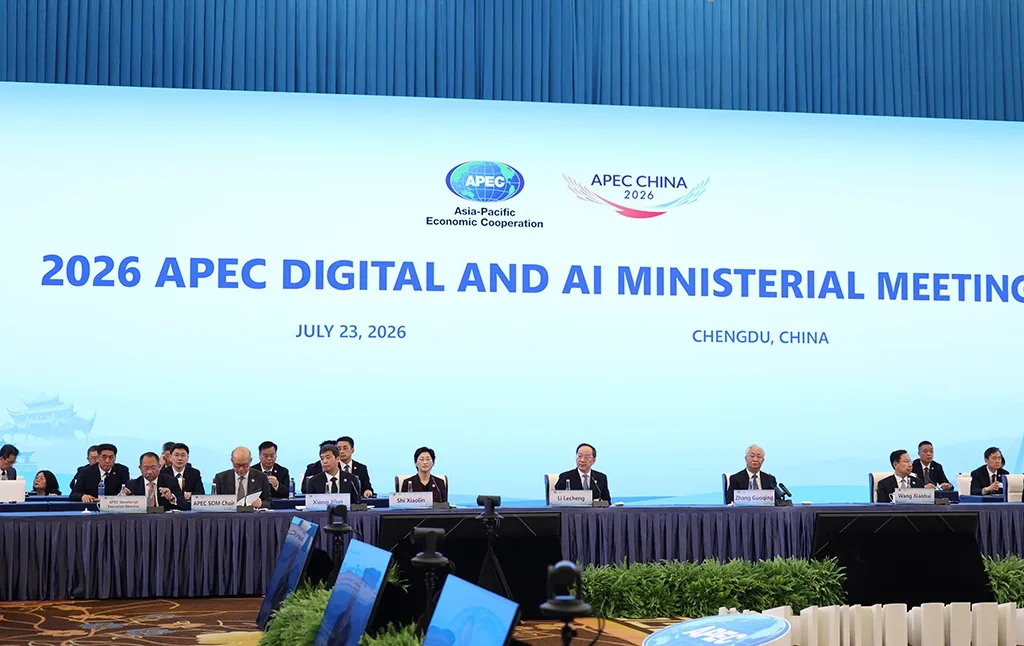
ASIATODAY.ID, CHENGDU — Asia-Pacific economies are accelerating cooperation on artificial intelligence (AI) and digital technologies as governments seek to harness innovation, boost economic growth and ensure that the benefits of the digital revolution are shared more widely across society.
The commitment emerged at the 2026 APEC Digital and AI Ministerial Meeting in Chengdu, China, where ministers responsible for telecommunications, information and communication technologies (ICTs) and digital policy agreed to strengthen regional collaboration in building a secure, trusted and inclusive digital future.
The meeting comes as AI rapidly transforms industries, reshapes business models and creates new opportunities for productivity and innovation across the Asia-Pacific and beyond.

China’s Vice Premier Zhang Guoqing, who opened the meeting, described AI as a strategic technology driving a new era of scientific advancement and industrial transformation.
“As a strategic technology leading the new wave of scientific and technological revolution and industrial transformation, AI is profoundly changing the way we produce and live,” Zhang said.
He emphasized China’s readiness to work with APEC economies to deepen practical cooperation in digital technologies and AI, supporting the development of a more connected and prosperous Asia-Pacific community.
The meeting was chaired by China’s Minister of Industry and Information Technology Li Lecheng, who called for collective action to maximize AI opportunities while managing emerging risks.
“We can seize the new opportunities arising from digital and AI development and address risk challenges only if we uphold innovation-driven growth, pursue inclusiveness, and advance openness and connectivity,” Li said.
Five Pillars of Asia-Pacific’s Digital Transformation
The meeting produced the 2026 APEC Digital and AI Ministerial Statement, which outlines five strategic priorities to guide regional cooperation in the digital era.
1. Expanding Digital Connectivity for All
APEC members reaffirmed the importance of universal and meaningful digital connectivity by improving access to reliable, affordable and secure digital infrastructure.
The ministers highlighted the need to close the digital divide, particularly in rural and remote areas, while encouraging investment in next-generation connectivity technologies, including advanced communication networks and satellite-based solutions.
2. Accelerating AI Adoption for Economic Growth
APEC economies recognized AI as a key driver of productivity, competitiveness and economic resilience.
The ministers encouraged responsible AI adoption across major sectors, including manufacturing, agriculture and services, while supporting digital transformation among micro, small and medium enterprises (MSMEs).
AI-powered public services were also identified as an opportunity to improve government efficiency and deliver greater benefits to communities.
3. Developing Digital and AI Talent
As AI adoption expands, APEC economies stressed the importance of strengthening digital literacy and workforce skills.
Governments were encouraged to expand education, vocational training and capacity-building programs to help citizens understand, use and benefit from emerging technologies.
4. Strengthening Digital Trust and Security
The ministers acknowledged growing challenges linked to cyber threats, data breaches, online scams and the misuse of AI.
They called for stronger cooperation between governments, businesses, academia and technology communities to enhance cybersecurity, protect data and build public confidence in digital systems.
5. Encouraging Investment and Open Innovation
APEC members emphasized the importance of investment in digital infrastructure, AI ecosystems and technology-driven businesses.
The statement also highlighted the role of secure open-source innovation in supporting technological development while maintaining data protection, cybersecurity and intellectual property standards.
Indonesia and ASEAN Eye Greater Role in AI Economy
The regional push for AI cooperation comes as Southeast Asian economies, including Indonesia, accelerate their digital transformation strategies.
As ASEAN’s largest economy, Indonesia has been strengthening its digital ecosystem through technology development, innovation partnerships and efforts to expand digital inclusion.
The growing regional commitment on AI aligns with Indonesia’s ambition to build a more competitive digital economy, develop technological capabilities and ensure that artificial intelligence supports sustainable and inclusive economic growth.
For ASEAN, closer cooperation on AI governance, digital infrastructure and talent development is increasingly important as the region positions itself as a major hub for innovation, investment and technology-driven growth.
Toward a Trusted AI Future in Asia-Pacific
The APEC agreement builds on the APEC Internet and Digital Economy Roadmap and the APEC Artificial Intelligence Initiative (2026–2030), which promote responsible AI development and cross-border cooperation.
During the APEC High-Level Forum on AI, held as part of APEC Digital Weeks 2026, ministers, business leaders, researchers and international organizations further called for AI development that is secure, responsible and accessible.
The forum identified four key priorities: promoting secure AI development, accelerating responsible AI applications, creating an enabling environment for innovation, and ensuring broader participation in the benefits of AI.
With the Asia-Pacific home to some of the world’s most dynamic digital economies, the region is entering a new phase of technological competition and collaboration.
The Chengdu consensus reflects a shared vision among APEC economies: building an AI-powered future where innovation drives economic progress while trust, security and inclusion remain at the center of digital transformation. (Midwan)
Follow Us at Google News, Instagram and LinkedIn