
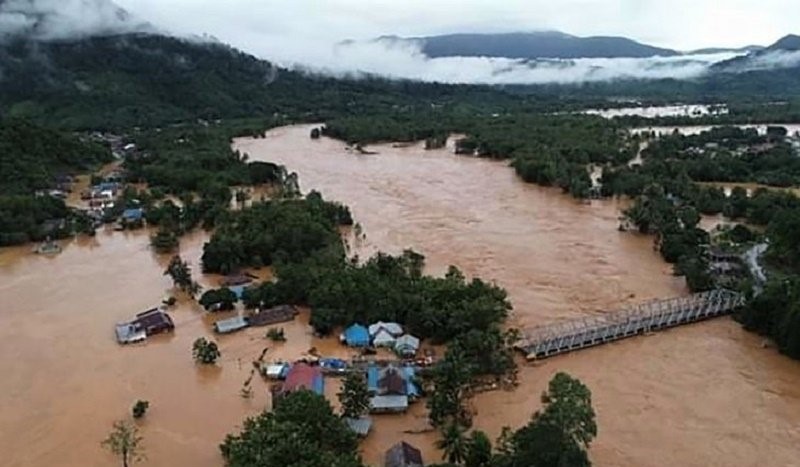
ASIATODAY.ID, JAKARTA – Researchers from a number of vocational universities in Indonesia are optimistic that the country will be able to become a center for global disaster studies before it is one hundred years old or its golden age in 2045.
“The success of Indonesian academics, researchers and engineers in creating and developing innovative disaster early warning technology is one indicator of that trust,” said the Remote Sensing Committee, Association of Centers for Technology and Innovation Studies (CTIS), Dr. Agustan in a statement received in Jakarta, Monday, July 22 2024.
CTIS exemplifies innovative technologies created by the nation’s children, including water level monitoring sensor devices, Landslide Detection Tools (ADeL), SIJAMPANG, Rapid Timer, earthquake-resistant house innovations, and Deniji from Gadjah Mada University, Yogyakarta.
According to him, these innovative products are some of those that have been developed by Indonesian engineers and researchers and are used to detect hydrometeorological and seismotectonic natural phenomena in the country.
These various innovations are also ready to be mass produced or widely developed so that they can be utilized domestically through the National Disaster Management Agency (BNPB) as the implementer and even by the global community.
Including this, the product will also be introduced at the ADEXCO exhibition (Asian Disaster Management and Civil Protection Expo and Conference) and the GFSR (Global Forum for Sustainable Resilience) conference which will be held at JIEXPO Kemayoran, Jakarta, on 11-14 September 2024.
“It is hoped that this event will become a meeting place for domestic and foreign industry players, so that the nation’s capable technology can get the opportunity to enter the industrial world and export abroad,” he said.
Gadjah Mada University (UGM) Natural Disaster Study Center (PSBA) Engineering Researcher Winaryo added that such support is really needed to make Indonesia a center of excellence for disasters and also a center for global disaster studies.
Based on the World Risk Report (WRR) in 2023, Indonesia is in second place as the country with the highest natural disaster risk index after the Philippines with a score of 43.5.
This risk has been responded to as a study material modality to innovation and technology in reducing disaster risk by Indonesian researchers, including UGM which developed a tool called Deniji.
Deniji is a disaster early warning tool specifically designed with sensor technology to detect water level levels in river flows developed by PSBA UGM.
He explained that the Deniji tool is equipped with sensors that are integrated with the Regional Disaster Management Agency (BPBD) information system to then convey river flow conditions to the local community. The data recorded by the sensors can be monitored in real time via the government’s internet page so that it can be accessed by the general public.
“Another important thing is that the sensors on the device also record daily data which is ready to be used for research in accordance with the principles of risk reduction and sustainable resilience which encourage science, engineering, technology and innovation in elements of development planning towards a golden Indonesia 2045,” he said. (ATN)
Follow Us at Google News and WA Channel