
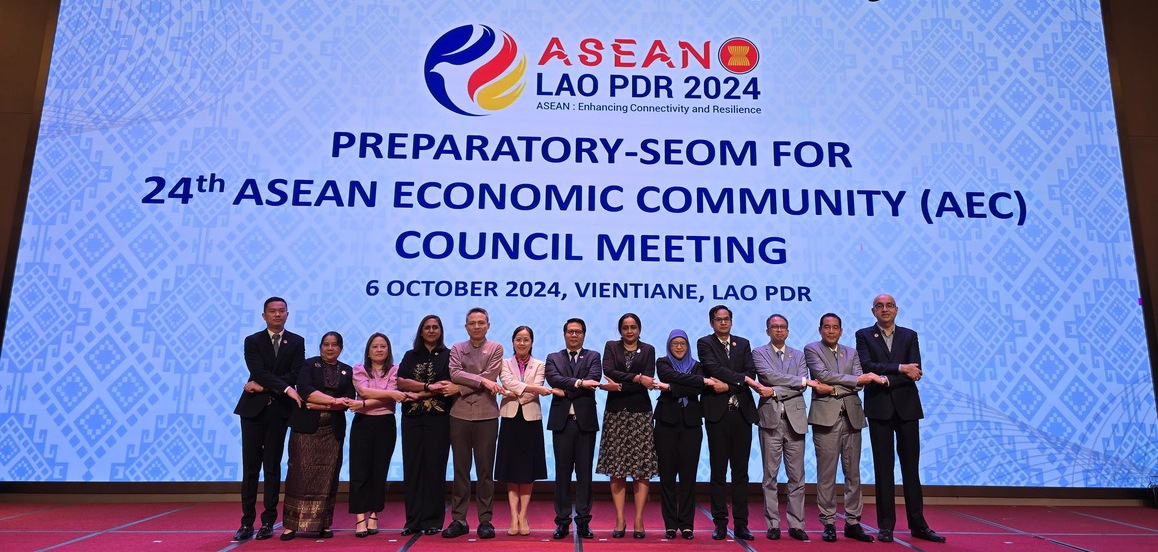
ASIATODAY.ID, VIENTIANE – The series of 44th and 45th ASEAN Summits will begin to be held on 6-11 October 2024 in Vientiane, Laos.
As initial preparations for economic issues, a Senior Officials’ Meeting for Economic Affairs (SEOM) was held on Sunday, October 6 in Vientiane, Laos. Deputy for International Economic Cooperation Coordination, Coordinating Ministry for the Economy, Edi Prio Pambudi led the Indonesian delegation at the meeting.
The economic issues discussed include the regional economic landscape, achievements of ASEAN economic priorities, achievements in implementing the ASEAN Blueprint 2025, sustainability issues, digital transformation issues, preparation of the AEC Strategic Plan 2026-2030, membership of Timor Leste, as well as documents that will be agreed at the Ministerial level and Head of State.
“I congratulate Laos on its Chairmanship in ASEAN 2024. There have been many positive achievements, but there are several initiatives that need attention in the future, namely strengthening tourism infrastructure, emphasizing geopolitical and geoeconomic issues, identifying potential cooperation with ASEAN partners including the Gulf Cooperation Council ( GCC),” said Deputy Edi.
Laos’ chairmanship of ASEAN in 2024 carries the theme “Enhancing Connectivity and Resilience”. Through this theme, Laos has the main mission to promote infrastructure connectivity, narrow development gaps, promote economic integration, encourage relations between people, and strengthen ASEAN relations with external partners.
To support this, Laos’ economic priorities focus on three main strategies, namely integration and connectivity, inclusiveness and sustainability. ASEAN currently has several initiatives related to sustainability issues such as carbon neutrality, blue economy, circular economy and so on.
“We have many initiatives for the sustainability agenda, but what is more important is how we formulate strategic action plans to carry out these various initiatives,” said Deputy Edi.
During the meeting, senior officials also discussed documents that required adoption, endorsement or notation from the MEA Council. The documents consist of four documents for adoption, five documents for ratification, and six documents for MEA Council notation.
These documents will then become the basis for the framework and implementation of regional cooperation in the economic sector, including those related to inclusive economics, sustainable agriculture, ecotourism, and artificial intelligence. (AT Network)
Follow Us at Google News and WA Channel