
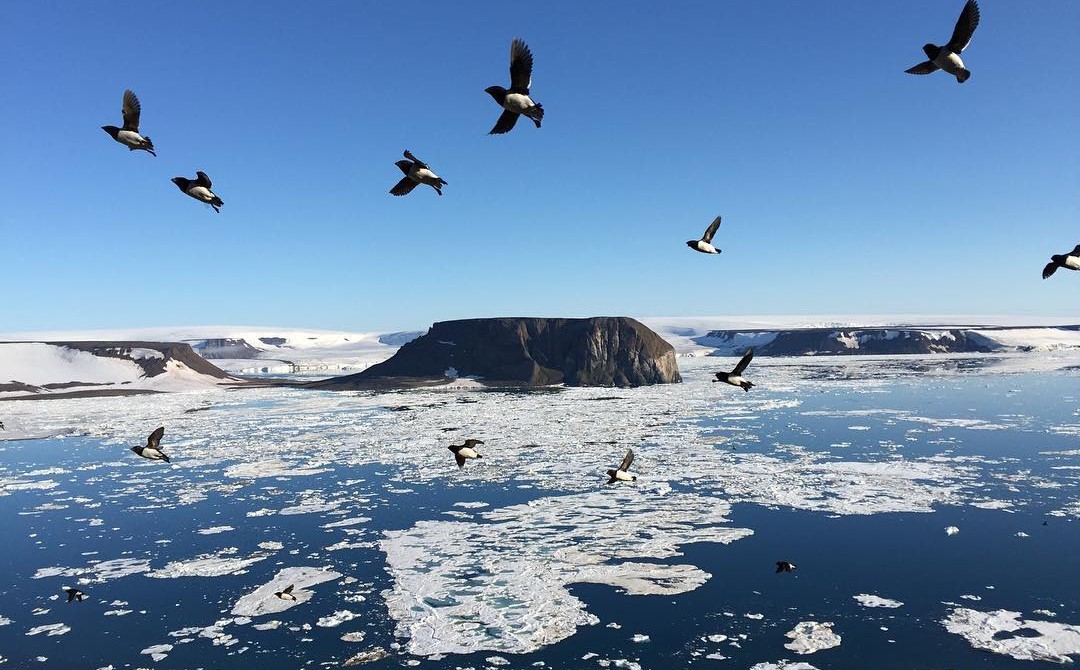
ASIATODAY.ID, MOSCOW – A large glacier near Russia’s Franz Josef Land archipelago in the Arctic Ocean, described as an ‘island’ by observers, has completely disappeared, the Russian Geographical Society has reported. Researchers have tentatively attributed the development to global warming.
On Thursday, the Society issued an article, citing observations made by its young volunteers after analyzing satellite images of the area. The group’s head, Aleksey Kucheyko, said that “near Eva-Liv Island in Franz Josef Land archipelago in the Arctic, an ice formation which was previously called Mesyatsev Island has disappeared.” The discovery warrants an update to maritime maps, he added.
According to the piece, the ‘island’ had formed by at least 1995, separating from the ice cap on Eva-Liv Island as it progressively melted away. The Society reported that while as of August 2015 it measured approximately 53 hectares (0.2 square mile), the island had shrunk to just 3 hectares by earlier this year. When the researchers analyzed satellite imagery this September, even that tiny remainder was gone.
The article noted that additional probes would have to be carried out in the area to confirm the conclusion.
The researchers theorized that global warming, which is leading to a sea level rise and particularly noticeable in the Arctic, was to blame for the demise of the ice island.
Earlier this year, the Institute of Economic Forecasting of the Russian Academy of Sciences issued a report, suggesting that Russia’s GDP could grow by “approximately 0.6 trillion rubles ($6.5 billion) every ten years” should the current climate trends continue.
The researchers estimated that on average, the temperature in Russia grows by 0.5 degrees Celsius every ten years.
According to the paper, the agriculture and forestry sectors in particular could stand to benefit from rising average temperatures. Additionally, global warming could foster the development of the Northern Sea Route (NSR) – the shipping waterline running along the Russian Arctic coast that connects Europe to such Far Eastern economic powerhouses as South Korea, Japan and China. (RT/AT Network)
Follow Us at Google News and WA Channel