
ASIATODAY.ID, WASHINGTON – U.S. President Donald Trump has hailed the country’s aggressive tariff policies as a major economic success, claiming they are boosting national revenue and driving down prices, even as global markets react negatively and tensions with China intensify.
Taking to Truth Social on Monday, Trump asserted that tariffs are delivering billions in revenue, reducing inflationary pressures, and prompting foreign powers to reconsider their trade stances.
“Oil prices are down, interest rates are down (the slow-moving Fed should cut rates!), food prices are down, there is NO INFLATION, and the long-time abused USA is bringing in Billions of Dollars a week from the abusing countries on tariffs that are already in place,” Trump wrote.
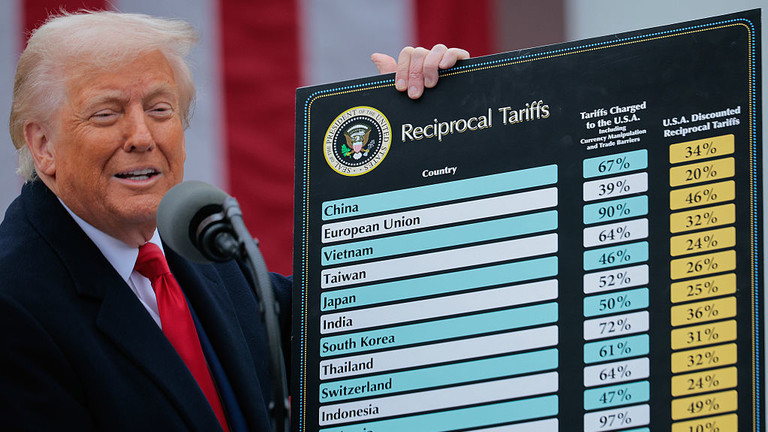
The president’s remarks come in the wake of a sweeping new wave of U.S. tariffs, ranging from 10% to 50%, on imports from countries accused of unfair trade practices. The European Union is now facing a blanket 20% tariff, while Chinese goods are being hit with duties totaling 34%.
China responded swiftly. On Friday, Beijing announced a reciprocal 34% tariff on all U.S. imports, effective April 10, and filed a formal complaint with the World Trade Organization (WTO). The Chinese government condemned the U.S. measures as unilateral and destabilizing.
“These actions represent unilateralism, protectionism, and economic bullying,” said Chinese Foreign Ministry spokesperson Lin Jian during a press conference. “They seriously impact the stability of the global economic order.”
Global Markets React to Tariff Escalation
The growing trade conflict is rattling global markets. Brent crude, the international oil benchmark, fell by around 14% over the past five days to just above $64 per barrel. Russia’s Urals crude has also dropped, nearing $50 per barrel, its lowest point in nearly two years.
Major stock indexes in Asia, Europe, and the U.S. tumbled following the latest announcements, as investors grow increasingly anxious about the potential for a global recession. Investment bank Goldman Sachs has raised its estimate for a U.S. recession in the next 12 months to 45%.
The Federal Reserve Board, tasked with setting U.S. monetary policy, is holding a closed-door meeting Monday. The current federal funds rate stands at 4.25% to 4.50%, having been cut in the last three consecutive policy meetings, with the most recent in December 2024.
Trump has urged the Fed to take more aggressive action to cut rates, aligning with his narrative that the tariffs are strengthening the economy despite signs of market strain.
In a scathing editorial published Monday, China’s Global Times accused the U.S. of “shifting blame” for its economic shortcomings. The article argued that rather than fixing issues like declining manufacturing competitiveness, Washington is instead targeting foreign economies through punitive tariffs.
The editorial stated that Beijing’s countermeasures are meant to “demonstrate its firm resolve” in defending fair trade principles and international norms.
As tit-for-tat tariffs escalate, analysts warn of significant global fallout—including disrupted supply chains, rising consumer prices, and slowed economic growth. With trade tensions mounting and diplomacy strained, both Washington and Beijing are under increasing pressure to de-escalate before more damage is done to the fragile global economy. (RT)
Follow Us at Google News and WA Channel