
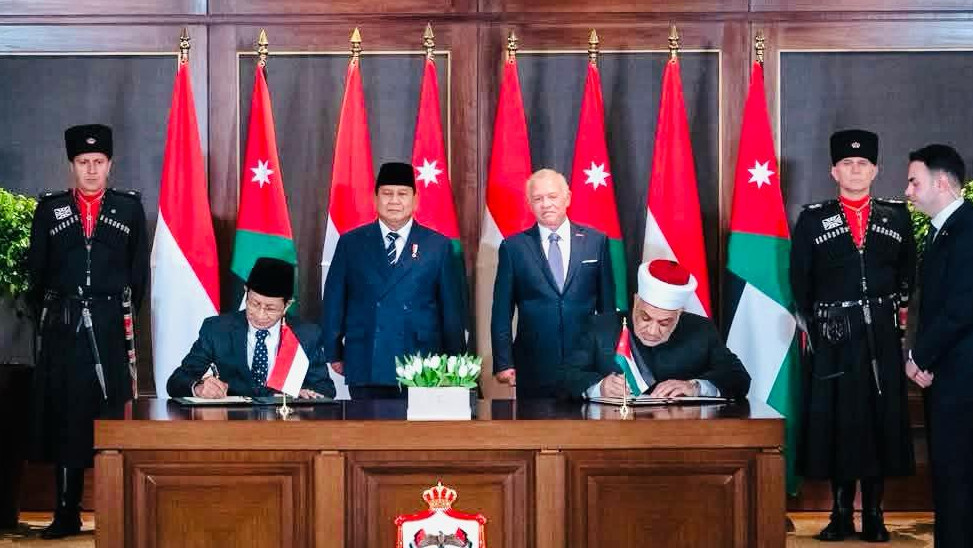
ASIATODAY.ID, AMMAN – In a significant move to deepen bilateral relations, the Ministry of Religious Affairs of the Republic of Indonesia has signed two landmark Memorandums of Understanding (MoUs) with the Hashemite Kingdom of Jordan. The agreements were made with Jordan’s Ministry of Higher Education and Scientific Research, and the Ministry of Awqaf, Islamic Affairs, and Holy Places.
The MoUs, centered on enhancing educational collaboration and strengthening waqf (Islamic endowment) and religious affairs, were officially signed during a high-level visit attended by President of Indonesia, Prabowo Subianto, and King Abdullah II of Jordan.
Minister of Religious Affairs of Indonesia, Nasaruddin Umar, and Jordan’s Minister of Higher Education and Scientific Research, Azmi Mahafzah, signed the education MoU, while the MoU on religious and waqf affairs was inked by Minister Umar and Mohammad Al-Khalaileh, Jordan’s Minister of Awqaf.
“This agreement opens up broad opportunities for cooperation between our nations, especially in undergraduate and postgraduate studies, double degree programs, and short courses,” stated Minister Umar on Monday, April 14, 2025.
Further collaboration will extend to research initiatives, community service, institutional development, and mutual recognition of academic credentials. The partnership will also involve faculty exchanges, mobility programs for lecturers, educational staff, students, and santri (Islamic boarding school students).
Short-term training programs focused on Arabic language proficiency and Islamic studies will be offered to Indonesian educators and academic personnel, along with scholarship exchanges at all educational levels.
“A joint committee will be established soon to regularly meet and ensure the technical implementation of these initiatives,” added Minister Umar.
Strengthening Religious and Waqf Collaboration
The agreement on religious and waqf affairs outlines nine key areas of cooperation:
- Exchange of best practices in religious moderation and preventing religious extremism.
- Sharing experiences and expertise in preserving Islamic cultural heritage and religious manuscripts.
- Collaboration in mosque management and community empowerment.
- Exchange of religious leaders, scholars, preachers, and mosque imams.
- Promotion of interfaith and intercultural dialogue.
- Enhanced participation of Qur’an reciters (qari) and judges in international Qur’an and Sunnah competitions.
- Sharing of expertise in zakat and waqf administration.
- Offering educational scholarships and training for ulama (Islamic scholars), da’i (preachers), and nadhir (waqf managers).
- Promotion of the Amman Message and Istiqlal Declaration through international forums held in Amman and Jakarta respectively.
Minister Umar emphasized, “Both ministries have committed to forming a joint committee that will convene regularly to follow up on the implementation of this MoU.” (AT Network)
Follow Us at Google News and WA Channel