
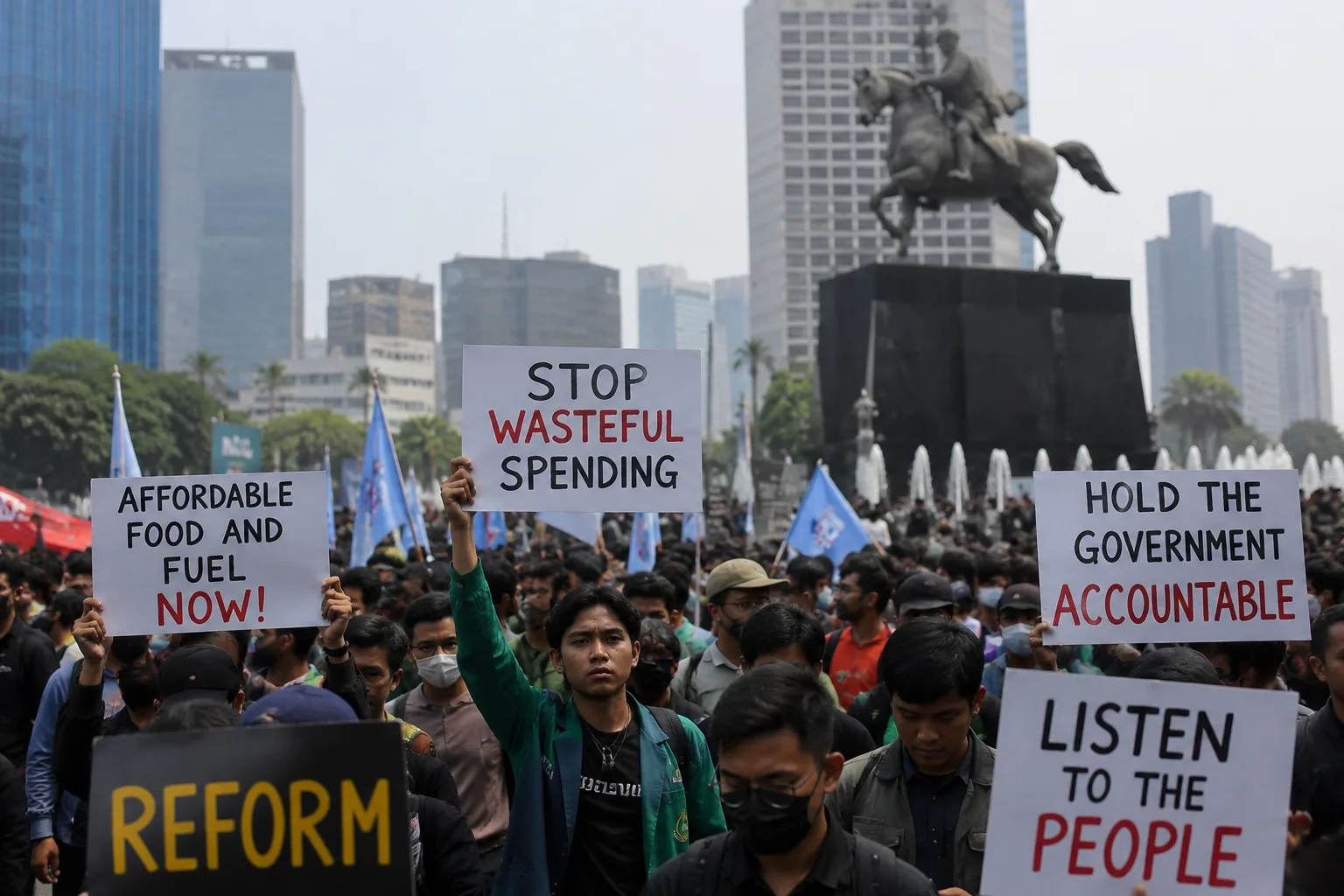
ASIATODAY.ID, JAKARTA — Student groups from several major universities across Indonesia’s Greater Jakarta region are preparing to stage a mass demonstration in the capital on Friday, signaling a renewed wave of campus-led activism reminiscent of the country’s Reformasi era.
The protest, scheduled to take place at Jakarta’s iconic Horse Statue (Patung Kuda) near the presidential palace complex, is expected to bring together student representatives from multiple universities, including the University of Indonesia (UI), Bogor Agricultural University (IPB), Pancasila University, and Gunadarma University.
Anandaku Dimas Rumi, Chairman of the University of Indonesia Student Executive Board (BEM UI), said all faculty-level student councils at the university would participate in the rally. Additional student organizations and activist networks are also expected to join following a national consolidation meeting held on the UI campus.
The demonstration is set to begin at 10:00 a.m. local time and will focus on five key demands directed at the administration of President Prabowo Subianto.
Student leaders are calling on the government to halt what they describe as wasteful state spending, lower prices of essential goods and fuel, discontinue the Free Nutritious Meals (MBG) program and the Merah Putih Village Cooperative initiative, end what they characterize as the militarization of civilian institutions, and acknowledge policy failures affecting the public.
According to Dimas, organizers are continuing discussions and preparations ahead of the rally, while estimating the number of participants expected to attend.
The planned protest comes amid growing public debate over economic pressures, government spending priorities, and broader governance issues under the Prabowo administration. Student activists argue that these concerns warrant stronger public accountability and policy evaluation.
While some observers have compared the mobilization to a potential “Reformasi 2.0” movement—a reference to the mass student protests that helped end Indonesia’s authoritarian era in 1998—organizers stopped short of formally adopting that label.
“Whether this becomes Reformasi 2.0 is a question for all of us,” Dimas said.
“The real issue is whether those currently holding public office still deserve the trust of the people and whether they continue to represent the public interest.”
The demonstration marks one of the most visible student-led political actions in recent months and will be closely watched as a gauge of public sentiment toward government policies and Indonesia’s evolving political landscape.
With university students once again taking to the streets, the protest is expected to reignite discussions about accountability, democratic participation, and the role of youth movements in shaping Indonesia’s future. (AT Network)
Follow Us at Google News and WA Channel