
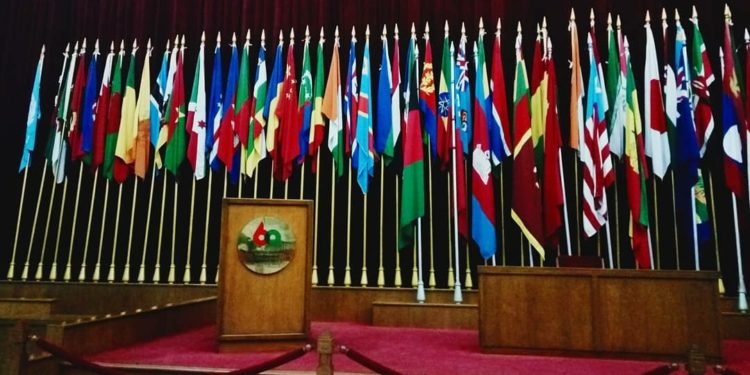
ASIATODAY.ID, BANDUNG – Seventy years have passed since the Asian-African Conference (AAC), yet the Bandung Principles and the Bandung Spirit remain increasingly relevant in addressing today’s global challenges and conflicts.
“The Bandung Spirit is more relevant than ever. It is crucial for us to revisit the Bandung Principles,” said Dino Patti Djalal, founder of the Foreign Policy Community of Indonesia (FPCI), during the opening of the “Global History and Politics Dialogue” event commemorating the 70th anniversary of the Asian-African Conference in Bandung on Tuesday evening, April 15.
The Bandung Spirit refers to a concept inspired by the principles of the Asian-African Conference held in Bandung, particularly the idea of “live and let live” and a commitment to global engagement based on equality and interdependence.
Meanwhile, the Bandung Principles refer to the core tenets of the AAC, including self-determination, mutual respect for sovereignty, non-aggression, and non-intervention.
According to Dino, the Spirit and Principles of Bandung are increasingly relevant today due to the growing number of violations of international laws and norms.
“I believe the Bandung Principles are more relevant now because many of these principles are no longer being observed and have been violated in today’s international landscape,” he explained.
“What we are experiencing now is a world facing a crisis of trust in the rules-based international system,” he added.
He highlighted the growing disregard for the United Nations Charter, one of whose main tenets is the respect for national sovereignty and territorial integrity—values that align with the Bandung Principles.
“For example, one country—the United States—says, ‘I want to claim Greenland,’ and ‘I want Canada to become the 51st state of the US,'” Dino said, referring to statements made by former US President Donald Trump.
“But that doesn’t mean we should act the same way. On the contrary, we must encourage other nations to act in accordance with the UN Charter. We must step up and become defenders of a rules-based global order,” he continued.
He also pointed to the presence of double standards in the current global system, where rules are applied to certain countries but not to others.
“There’s a system where the rules apply to you but not to us. Double standards and hypocrisy have become commonplace. This is the greatest threat to the international system,” said Dino.
Therefore, he believes the most important takeaway from the 70th anniversary of the AAC is the need to continually voice the Bandung Spirit and uphold the principles embedded in the Bandung Declaration.
“In today’s international context, we need to reflect on the principles of the Bandung Declaration, and work to apply and revive them within the global system,” he said.
The first Asian-African Conference was held on April 18, 1955, in Bandung, West Java. This year marks the 70th anniversary of that historic event.
The 1955 AAC resulted in ten foundational principles, known as the Bandung Principles, which inspired Asian and African nations in their struggle against colonialism.
The Bandung Principles are as follows:
– Respect for fundamental human rights and the purposes and principles of the Charter of the United Nations
– Respect for the sovereignty and territorial integrity of all nations
– Recognition of the equality of all races and the equality of all nations, large and small
– Non-intervention and non-interference in the internal affairs of other countries
– Respect for the right of each nation to defend itself, individually or collectively, in conformity with the UN Charter
– Refraining from the use of collective defense arrangements to serve the particular interests of any of the big powers, and refraining from exerting pressure on other countries
– Refraining from acts or threats of aggression or the use of force against the territorial integrity or political independence of any country
– Settlement of all international disputes by peaceful means such as negotiation, conciliation, arbitration, or judicial settlement, as well as other peaceful means of the parties’ own choice, in conformity with the UN Charter
– Promotion of mutual interests and cooperation
– Respect for justice and international obligations. (AT Network)