
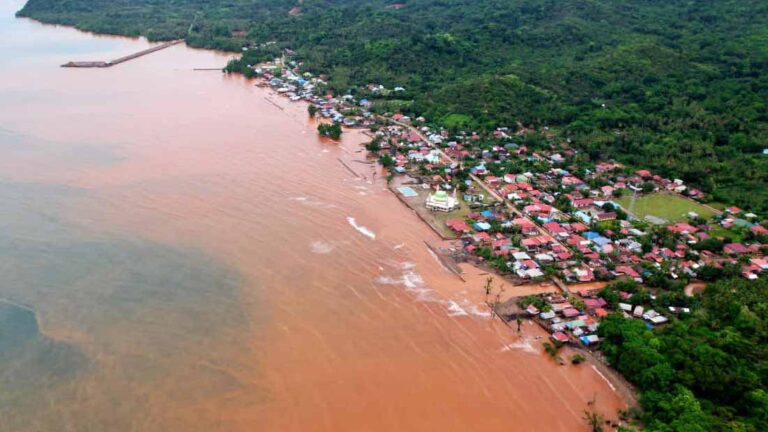
ASIATODAY.ID, PARIS – Kabaena Island, a small island in Southeast Sulawesi, Indonesia, has captured international attention once again.
At the OECD Forum on Responsible Mineral Supply Chains, held from May 5–7, 2025, in Paris, the severe impacts of nickel exploitation in Kabaena were brought to the global stage by Satya Bumi, in collaboration with local NGO Sagori, Fern, and the Rainforest Foundation Norway (RFN).
Representing the voices of Kabaena communities, Satya Bumi participated in the session titled “EU Electric Vehicle Targets: Assessing Human Rights Implications, Deforestation Risks, and Industry Readiness,” exposing the harsh realities of environmental destruction and human rights violations linked to the booming nickel industry.
Kabaena, a compact island of only 891 km², is currently burdened with 15 mining permits (IUPs), covering a total concession area of 655 km². Between 2001 and 2022, the island lost 3,374 hectares of forest cover, including 24 hectares of protected forest, due to massive deforestation driven by nickel mining operations.
“Can we truly say that our nickel and stainless steel are used for a just energy transition? Not for war, occupation, or genocide?” questioned Hayaa, a representative from Satya Bumi, during the forum.
Hayaa emphasized the lack of transparency in global supply chains and the weak legal protections in Indonesia.
Heavy Metal Contamination Threatens Ecosystems and Health
Satya Bumi presented recent research findings that reveal severe contamination of Kabaena’s marine ecosystem. High levels of nickel, cadmium, arsenic, mercury, and lead were detected in both seawater and shellfish, posing serious health risks.
– Nickel levels in residents’ urine: 4.77–36.07 µg/L (5–30 times higher than normal)
– Heavy metal levels in seawater: 200% to 7000% above WHO and EPA safety thresholds
These exposures have been linked to rising cases of cancer, acute respiratory issues, and partial blindness among local populations.
In front of global electric vehicle industry representatives, Satya Bumi laid out three urgent demands:
1. Legal reform in Indonesia: The international community must pressure the Indonesian government to strengthen legal protections from project planning to grievance mechanisms.
2. Robust environmental restoration: Immediate ecological recovery is needed, especially for coastal and small island regions like Sulawesi, Halmahera, and Papua.
3. End nickel exploitation under the guise of a “just transition”: A true energy transition should not come at the expense of local communities and ecosystems.
“A just energy transition must not be paid for with the suffering of people and the destruction of nature,” Hayaa stated.
Hayaa urged all stakeholders to apply international standards, especially in extractive zones across Indonesia where oversight and accountability remain severely lacking. (AT Network)
Source: mediasultra.com
Follow Us at Google News and WA Channel