
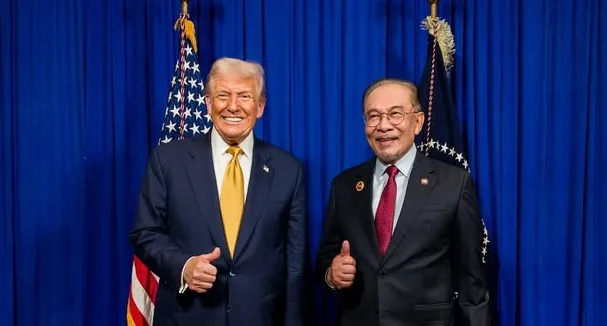
ASIATODAY.ID, KUALA LUMPUR — The United States has achieved a major strategic and geopolitical victory in Southeast Asia after securing a series of trade and critical mineral cooperation agreements with Malaysia, Thailand, Cambodia, and Vietnam — effectively giving Washington direct control over a key part of the world’s rare earth supply chain.
The landmark deals signal a new phase in the global competition for critical minerals, which are essential to semiconductors, electric vehicles, renewable energy systems, and advanced defense technologies. Analysts see the move as a direct challenge to China’s long-standing dominance over the world’s rare earth industry.
Trump Reasserts US Economic Influence in the Indo-Pacific
During his visit to Kuala Lumpur for the 47th ASEAN Summit, October 26, 2025, President Donald Trump finalized several trade and energy-related agreements that mark a significant expansion of US influence in the Indo-Pacific.
Trump signed reciprocal trade agreements with Malaysia and Cambodia, as well as a framework memorandum of understanding (MoU) with Thailand designed to remove tariff and non-tariff barriers while promoting open, fair trade among regional partners.
Under these arrangements, the United States will maintain a 19% tariff on certain exports, while reducing tariffs to zero for a range of strategic and high-value goods, particularly those related to technology and clean energy.
A separate framework agreement with Vietnam will also see the country increase imports of American products to help narrow its US$123 billion trade surplus with the US recorded last year.
Malaysia and Thailand at the Center of the New Supply Chain
The most consequential aspect of Trump’s Southeast Asian diplomacy comes from two bilateral agreements with Malaysia and Thailand focusing on critical mineral cooperation and supply chain diversification.
Malaysia’s sovereign wealth fund, Khazanah Nasional, had previously engaged in talks with Chinese companies over a potential rare earth processing plant.
However, the new deal with the US represents a policy realignment, with Malaysia committing not to impose export bans or quotas on critical minerals shipped to the United States.
While details on whether this applies to raw or processed materials remain unclear, Malaysia — which holds an estimated 16.1 million tons of rare earth reserves — is now positioned as one of Washington’s most important regional partners in the race for mineral independence.
The country’s previous ban on raw mineral exports was aimed at developing domestic downstream industries, a strategy that now aligns with US efforts to build resilient, non-Chinese supply chains for vital materials.
A Direct Challenge to China’s Resource Dominance
China remains the world’s largest producer and processor of rare earth elements, but its recent tightening of export controls and refining technologies has fueled global anxiety over potential supply disruptions.
By securing these new partnerships across Southeast Asia, the US has effectively expanded its influence deep into China’s economic backyard and strengthened its ability to control global mineral flows critical to next-generation technologies.
“Southeast Asia is the heart of the global supply chain,” President Trump said in a statement.
“The United States is building partnerships based on openness, fairness, and mutual prosperity.”
The agreements mark a pivotal moment in global trade geopolitics, as the United States not only restores its leadership role in the Indo-Pacific but also gains unprecedented leverage over the world’s most strategic mineral resources amid escalating economic rivalry with Beijing.
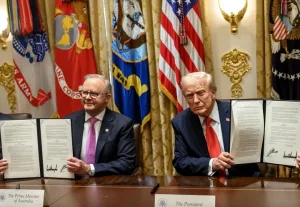
US and Australia Unite to Build a Critical Minerals Superpower
In a parallel development, the United States and Australia announced a major rare earths and critical minerals deal designed to counter China’s market control.
Australian Prime Minister Anthony Albanese confirmed that the agreement would support a US$8.5 billion (A$13 billion) pipeline of “ready-to-go” projects aimed at boosting Australia’s mining and refining capacity.
Under the framework, both countries will jointly invest US$1 billion in projects across the US and Australia within the next six months. The US Export-Import Bank will also allocate US$2.2 billion in financing for critical minerals ventures, including the construction of a 100-ton-per-year advanced gallium refinery in Western Australia.
“This partnership takes our cooperation to the next level,” Albanese said, describing the deal as a key step toward mineral independence and economic resilience for both nations.
Shares of Australian rare earth producers surged following the announcement — Arafura Rare Earths rose 7.7%, Iluka Resources gained over 3%, and Lynas Rare Earths rallied on expectations of increased US investment.
The agreement also commits both countries to collaborate on pricing, permitting, and government oversight of corporate takeovers in the critical minerals sector — ensuring that Western control of key resources remains secure.
A Coordinated Push Against China’s Rare Earth Monopoly
China currently controls around 70% of global rare earth mining and 90% of processing capacity, giving Beijing outsized leverage over global supply chains. Recent export restrictions on refining technologies have intensified global concern about supply security.
The US–Australia–ASEAN alliance represents a strategic shift in global resource politics, creating a Western-led network for critical mineral exploration, extraction, and refining that bypasses Chinese control.
Trump reaffirmed that the AUKUS partnership — the trilateral security pact between the US, UK, and Australia — remains “full steam ahead,” describing it as part of a broader strategy to ensure Indo-Pacific security and resource stability.
“This is about building resilience and independence,” Trump said. “The United States and its allies will never again be held hostage by resource dependency.” (AT Network)
Follow Us at Google News and WA Channel