
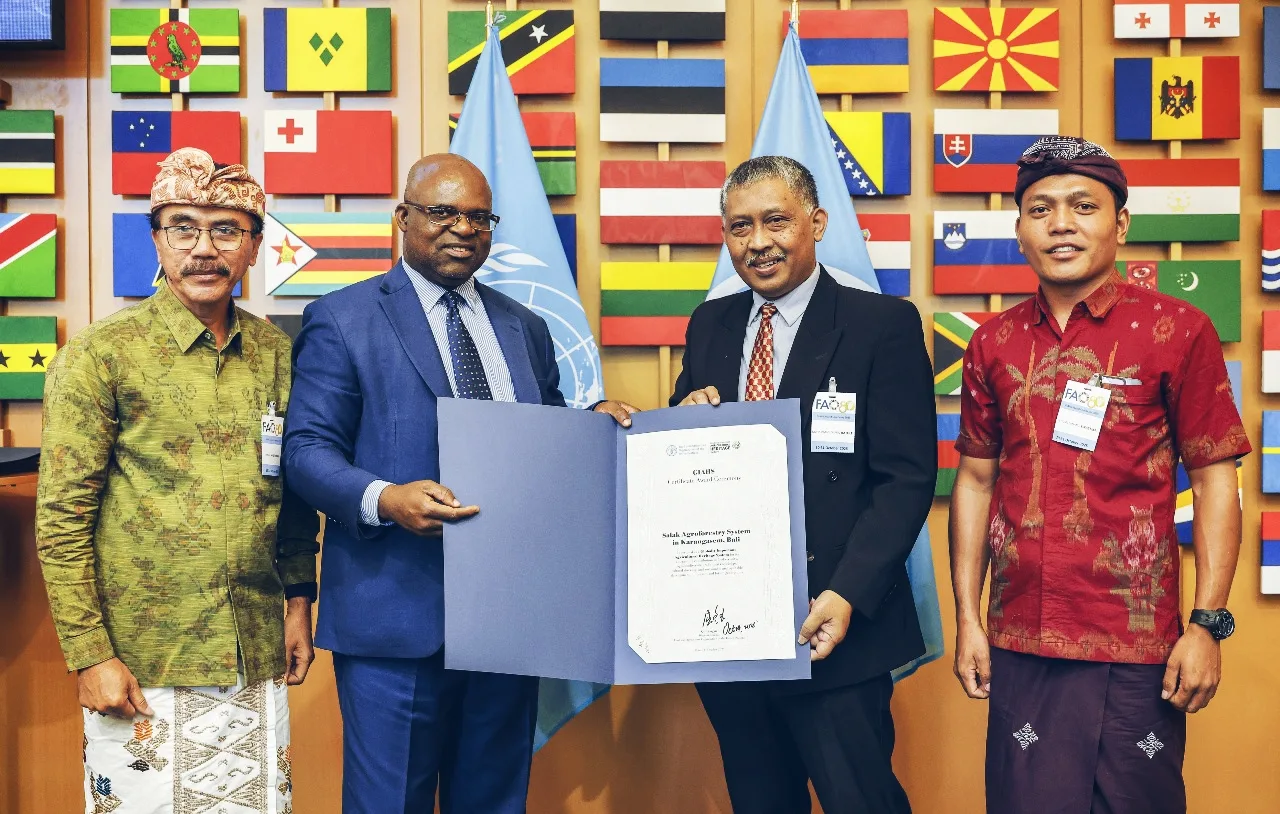
ASIATODAY.ID, JAKARTA – Food and Agriculture Organization (FAO) of the United Nations awarded Indonesia its first Globally Important Heritage Systems (GIAHS) certificate today at FAO Headquarters in Rome, Italy.
The 2025 GIAHS Award Ceremony celebrated the country’s Karangasem Salak (snake fruit) Agroforestry System in Bali as one of 28 newly agricultural heritage designations across 14 countries.
Under the FAO’s flagship programme, a total of 102 sites globally have been selected for safeguarding food and livelihood security, agro-biodiversity, sustainable knowledge systems and practices, cultural and social values, and outstanding landscapes.
Indonesia’s Karangasem Salak Agroforestry System, officially designated in September 2024, showcases exemplary integration of traditional philosophy, ecological wisdom, and community-based stewardship to advance food security, sustainable livelihoods, and ecosystem conservation.
During the biennial Ceremony, FAO Deputy Director-General Godfrey Magwenzi presented the GIAHS certificate to Executive Secretary of the Directorate General of Horticulture, Ministry of Agriculture (MoA), Muhammad Taufiq Ratule, accompanied by Secretary of Sibetan Customary Village I Made Mastiawan.
“This recognition marks a historic milestone for Indonesia,” said Muhammad Taufiq Ratule, DG of Horticulture, MoA on October 31, 2025.
“The Karangasem Salak Agroforestry System reflects the collective dedication of farmers, customary institutions, researchers, local and national governments, and FAO. The Government of Indonesia remains committed to preserving and strengthening this heritage landscape so that it continues to benefit local communities, enhance food system resilience, and serve as a living classroom for sustainable agriculture rooted in local wisdom. We welcome further international cooperation, knowledge exchange, and technical partnerships to support community-based agriculture and nurture more GIAHS sites across Indonesia.”
Karangasem Regency is Bali’s biggest salak producing region, recording 24.972 metric tons in 2024. The system employs about 2,800 farmers around the Sibetan Customary Village, who have developed and preserved over 12 local salak varieties. Local customary village regulations, known as awig-awig, protect agricultural land, prohibiting conversion for other purposes and restricting land sales to non-locals.
Karangasem Regional Secretary I Ketut Sedana Merta said the GIAHS recognition is an honour to the local community and their generational knowledge that has for long conserved biodiversity and sustained their land, which have grown ever more relevant in today’s climate.
”Amid the challenges of land use change, lack of youth’s participation in farming, and climate change, the GIAHS recognition is a call for further investments into our farmers and their sustainable practices to ensure food security, local livelihoods, biodiversity preservation, and environment stewardship in the long-term,” I Ketut Sedana Merta said.
“We are hopeful the recognition will raise global awareness of the salak agroforestry system, open international opportunities and collaboration establish of public-private-community partnerships in various areas, such as agrotourism, exports of derivative products, agricultural research, and biodiversity conservation, including to attract youth into the sector,” he added.
FAO Representative in Indonesia and Timor Leste Rajendra Aryal concurred that with the right support, GIAHS can evolve from a ecosystem conservation effort into a working model for climate resilience and resilient food systems proving that tradition must be preserved for a more sustainable future.
“Beyond Bali, local communities around Indonesia have developed similar systems and innovations that stand the test of time and offer applicable climate solutions. FAO stands ready to support Indonesia in sustaining its first GIAHS site, and in identifying and adding more of such agricultural heritage practices into the list,” Rajendra said.
Indonesia joins Brazil, China, Ecuador, Iran, Italy, Japan, Korea, Mexico, Morocco, Spain, Thailand, and Tunisia in this year’s GIAHS Award Ceremony. Beyond celebrating agricultural heritage, the event fosters international knowledge sharing, ecological practice exchange and cultural cooperation.
About Karangasem Salak Agroforestry System
The Karangasem agroforestry system integrates the cultivation of salak with diverse crops in Bali’s driest region, ensuring year-round harvests and creating a rich biodiverse agricultural landscape. It was developed by the Indigenous Balinese People using the traditional five-strata integrated cultivation system. Every part of the salak palm is utilized, making it a zero-waste crop.
Rooted in traditional Balinese philosophies of “Tri Hita Karana” and “Tri Mandala”, which have also been listed as UNESCO Cultural Landscapes, this system reflects a harmonious relationship between humans, nature, and spirituality.
Through this sustainable system, local farmers have helped enhance biodiversity, conserve water, sequester carbon, support food security, and contribute to multiple global environmental benefits, while preserving cultural heritage and sustaining local livelihoods.
About GIAHS
Launched by FAO at the 2002 World Summit on Sustainable Development and formally endorsed as a FAO corporate programme in 2015, the GIAHS initiative identifies and safeguards remarkable agricultural systems where communities maintain an intricate relationship with their territories.
Evolving and resilient, they are characterized by agrobiodiversity, traditional knowledge, invaluable cultures, and unique landscapes, sustainably managed by farmers, herders, fisherfolk, and forest people in ways that support livelihoods, adaptive management, and knowledge exchange. (AT Network)
Follow Us at Google News and WA Channel