
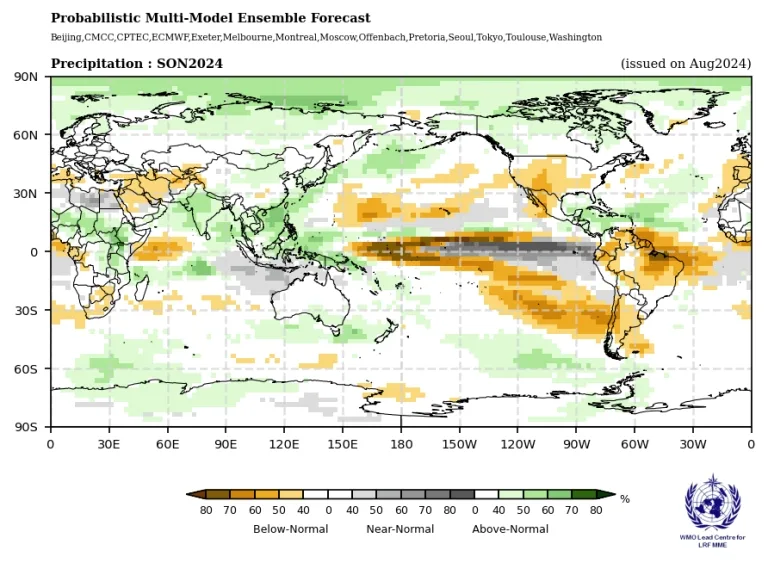
ASIATODAY.ID, GENEVA — The World Meteorological Organization (WMO) on December 4, 2025 has issued a sharp climate alert, revealing a 55% chance that a weak La Niña will develop over the next three months, potentially disrupting global weather patterns despite its “weak” classification.
Experts warn that even a mild La Niña can intensify extreme weather events across multiple regions.
La Niña refers to the cooling of sea-surface temperatures in the central and eastern equatorial Pacific, combined with shifts in tropical atmospheric circulation, wind patterns, pressure systems, and rainfall distribution. These changes often trigger cascading impacts across continents, from destructive floods to severe droughts.
A Weak La Niña — But Still Capable of Severe Impacts
According to the WMO Global Producing Centres for Seasonal Prediction, oceanic and atmospheric indicators as of mid-November 2025 reveal borderline La Niña conditions. Forecast models now show a 55% probability of meeting La Niña thresholds during the December–February 2025–2026 period.
Strikingly, although La Niña typically causes temporary cooling in global average temperatures, many regions are still projected to face above-normal heat, highlighting how climate change is overpowering natural cooling cycles.
Potential Global Consequences
A weak La Niña may still produce substantial disruptions, including:
Heavier-than-usual rainfall and flooding in parts of the tropics and subtropics
Increased tropical cyclone activity in the western Pacific
Heightened drought risk in western South America
Shifts in monsoon patterns across Asia and the Pacific
Scientists stress that the combination of La Niña variability and long-term global warming may lead to more unpredictable and more extreme outcomes than historical patterns suggest.
WMO Urges Global Preparedness
The WMO calls on governments, climate agencies, and disaster-response authorities to strengthen early-warning systems and risk-reduction measures, particularly in regions historically vulnerable to La Niña impacts. (AT Network)
Follow Us at Google News and WA Channel