
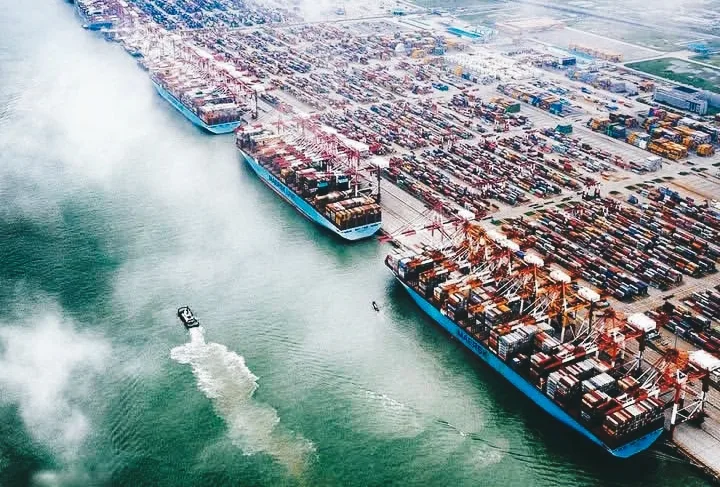
ASIATODAY.ID, JAKARTA — Amid renewed global trade uncertainty and the return of aggressive tariff rhetoric under Trump 2.0, economic ties between ASEAN and China continue to strengthen.
Bilateral trade reached USD 984 billion in 2024 and is projected to surpass USD 1 trillion in 2025, cementing ASEAN’s position as China’s largest trading partner for the fifth consecutive year.
Rather than becoming collateral damage in the global trade war, Southeast Asia has emerged as a key beneficiary, transforming geopolitical disruption into deeper supply-chain integration—particularly in electronics, electric vehicles, and high value-added manufacturing.
“Despite global trade uncertainty and the evolving tariff dynamics under Trump 2.0, trade and investment flows between ASEAN and China continue to strengthen. What we are witnessing is not merely supply-chain relocation, but a deeper integration of production networks,” said Yun Liu, ASEAN Economist at The Hongkong and Shanghai Banking Corporation (HSBC) on Monday, January 12, 2026.
Supply-Chain Integration, Not Just a Trade Deficit
HSBC notes that ASEAN’s widening trade deficit with China should not be interpreted as a sign of structural weakness. Instead, it reflects intensifying supply-chain connectivity, particularly in the electronics and electrical machinery (E&E) sector.
Around 30% of ASEAN’s exports to China consist of E&E products, while roughly the same share of imports from China falls within the same category.
Economies such as Malaysia, Vietnam, and Singapore play critical roles in the global semiconductor and technology supply chain, while Indonesia remains heavily exposed to commodity exports, including nickel, ferro-alloys, and coal.
This two-way flow underscores ASEAN’s role as both a manufacturing base and an export platform for global markets.
FDI Accelerates as China+1 Strategy Endures
On the investment front, ASEAN now captures 14.5% of global foreign direct investment (FDI)—nearly double China’s share. While Singapore accounts for roughly 65% of inflows, other ASEAN economies are gaining traction as companies diversify production bases under the China+1 strategy.
“ASEAN is not a casualty of the trade war—it is a beneficiary. The data clearly show that the region has successfully converted global tensions into stronger trade and investment inflows,” Yun Liu added.
Chinese investment has expanded rapidly across ASEAN’s manufacturing landscape:
– Indonesia and Thailand have benefited from EV and battery-related investments,
– Malaysia and Vietnam have outperformed in electronics and technology manufacturing, while digital infrastructure and data centers have emerged as new investment themes in 2025.
Trump 2.0 Fails to Disrupt ASEAN’s Momentum
A key question for investors has been whether renewed tariff escalation under Trump 2.0 could derail the China+1 strategy. High-frequency data suggest otherwise. Trade volumes continue to rise, and FDI approvals—particularly from Chinese firms—have surged across Malaysia, Thailand, and Vietnam.
For ASEAN, the challenge now lies not in attracting investment, but in scaling up market share globally, upgrading skills, and sustaining policy certainty.
ASEAN’s Strategic Moment
HSBC concludes that the ASEAN–China economic corridor has evolved beyond cyclical trade dynamics into a structural, long-term partnership. With trade approaching USD 1 trillion and FDI inflows accelerating, Southeast Asia is consolidating its role as a central pillar of the global economy.
For global investors and policymakers alike, the message is increasingly clear: ASEAN is no longer an alternative—it is a core engine of global growth. (Silvia Andriani)
Follow Us at Google News and WA Channel