
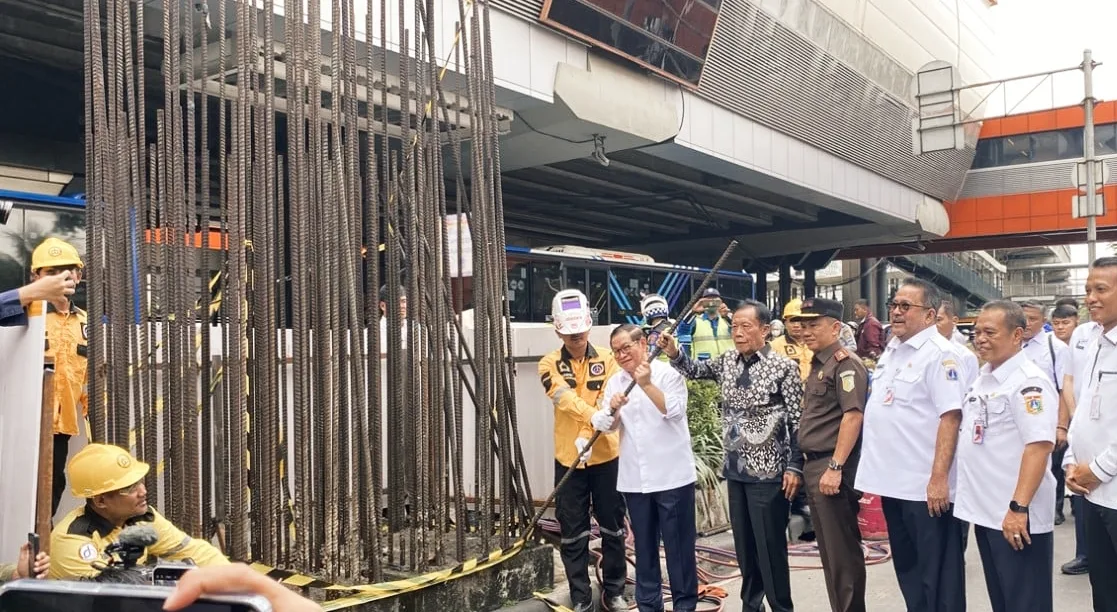
ASIATODAY.ID, JAKARTA — The Jakarta Monorail project has officially gone down as a total failure in urban infrastructure investment.
After nearly two decades of abandonment and never once becoming operational, the city began dismantling the monorail’s concrete pillars on January 14, 2026, bringing a definitive end to a project that absorbed trillions of rupiah in investment without delivering any public benefit.
Once promoted as a modern solution to Jakarta’s chronic congestion, the monorail has instead become a graveyard of failed capital in the heart of the city, leaving behind idle assets, prolonged legal disputes, and new public costs to erase the remnants of a collapsed megaproject.
Capital Spent, Trains Never Ran
First proposed in 2004, the Jakarta Monorail was marketed as the future of mass transportation in Indonesia’s capital. The investment scheme involved PT Jakarta Monorail (PT JM) as project developer, with state-owned construction giant PT Adhi Karya (Persero) Tbk responsible for building the initial structures.
The outcome, however, was stark:
– Not a single kilometer of track ever became operational
– No return on investment was generated
– No clear accountability for financial losses emerged
Initial investment estimates placed the project’s value at around US$1.5 billion (approximately IDR 17.3 trillion at 2013 exchange rates). That enormous figure never translated into a functioning transit system—only into unused concrete pillars now being torn down.
State-Owned Assets Turned Non-Performing
As the project stalled indefinitely, the monorail pillars became non-performing assets on Adhi Karya’s balance sheet, with their book value continuing to depreciate over time. With no technical or commercial viability remaining, the structures lost all economic function.
In effect, trillions of rupiah were sunk into a project that never produced economic returns, underscoring the risks of infrastructure investment without regulatory certainty, financial feasibility, and sound governance.
Contract Expired, Legal Basis Lost
On September 21, 2011, the cooperation agreement between the Jakarta provincial government and PT Jakarta Monorail officially expired. From that point forward, the project lost its legal foundation, yet the concrete pillars remained standing along Jakarta’s main thoroughfares for more than a decade.
During that time, the abandoned monorail became a symbol of policy failure, contributing to visual blight, traffic disruption, and public safety risks in Jakarta’s central business and diplomatic districts.
Demolition Begins, Investment Dispute Remains
The decision by the Jakarta Provincial Government to dismantle the monorail does not automatically resolve the underlying investment dispute. PT Adhi Karya maintains that the pillars remain legally recognized company assets, despite the project’s termination.
Corporate Secretary Rozi Sparta stated that no final agreement has yet been reached regarding demolition procedures or asset compensation.
“The monorail pillars are assets of Adhi Karya, as confirmed by court rulings and legal opinions from the State Attorney. Any action must comply with principles of good corporate governance,” Rozi said on January 13, 2026.
The situation illustrates how failed infrastructure investments can continue generating liabilities, even long after construction stops.
IDR 100 Billion to Clean Up a Failed Project
The Jakarta administration has allocated approximately IDR 100 billion (around US$6.4 million) in the 2026 regional budget, not only for dismantling the pillars but also for traffic management, site restoration, and urban reconfiguration, particularly in the Kuningan area.
This means the failure of the monorail project has resulted not only in trillions of rupiah in sunk investment, but also in additional public spending to remove its physical legacy.
IDR 58 Trillion and the Irony of a New Monorail Proposal
Ironically, as the old monorail is being dismantled, talk of reviving the Jakarta Monorail has resurfaced.
In July 2025, PT Jakarta Monorail announced a new proposal to rebuild the system with a projected investment value of IDR 58 trillion (approximately US$3.55 billion).
The company’s majority ownership—around 90 percent—is now held by Ortus Infrastructure Capital Limited, part of the Ortus Group, following a series of acquisitions since 2013.
The new proposal claims it would use Alstom monorail technology from France, under a 40-year Build–Operate–Transfer (BOT) scheme.
The plan includes: a 30-kilometer Green Line, a 14-kilometer Blue Line, projected ridership of 280,000 passengers per day, and foreign financing support.
Yet the demolition of the old monorail sends a clear warning: Jakarta’s transport future cannot be built on the unresolved failures of past governance. Without legal clarity, policy consistency, and transparent feasibility, a new multibillion-dollar project risks repeating the same mistakes.
Five Governors, One Failed Investment
The Jakarta Monorail project spanned five gubernatorial administrations: Sutiyoso, Fauzi Bowo, Joko Widodo, Basuki Tjahaja Purnama, and Anies Baswedan.
Despite multiple leadership changes, none succeeded in salvaging the investment. The project was halted, revived in discourse, then abandoned again—without a stable financing model, economic viability, or long-term legal certainty.
For investors, the monorail stands as a case study in regulatory and policy risk. For the state, it represents a costly lesson in inconsistent infrastructure planning.
A Graveyard of Investment in the City Center
As Jakarta dismantles the last concrete pillars, the city is not merely reclaiming public space—it is symbolically burying a failed trillion-rupiah investment. What began as a flagship transport project has become a cautionary tale about the true cost of weak governance and fragmented policy.
The demolition closes a dark chapter in Jakarta’s transport history.
But one critical question remains unanswered:
who bears responsibility for the trillions of rupiah that vanished—and how can Indonesia ensure such failures are never repeated? (AT Network)
Follow Us at Google News and WA Channel