
ASIATODAY.ID, JAKARTA — Indonesia has once again reshaped global understanding of early human civilization.
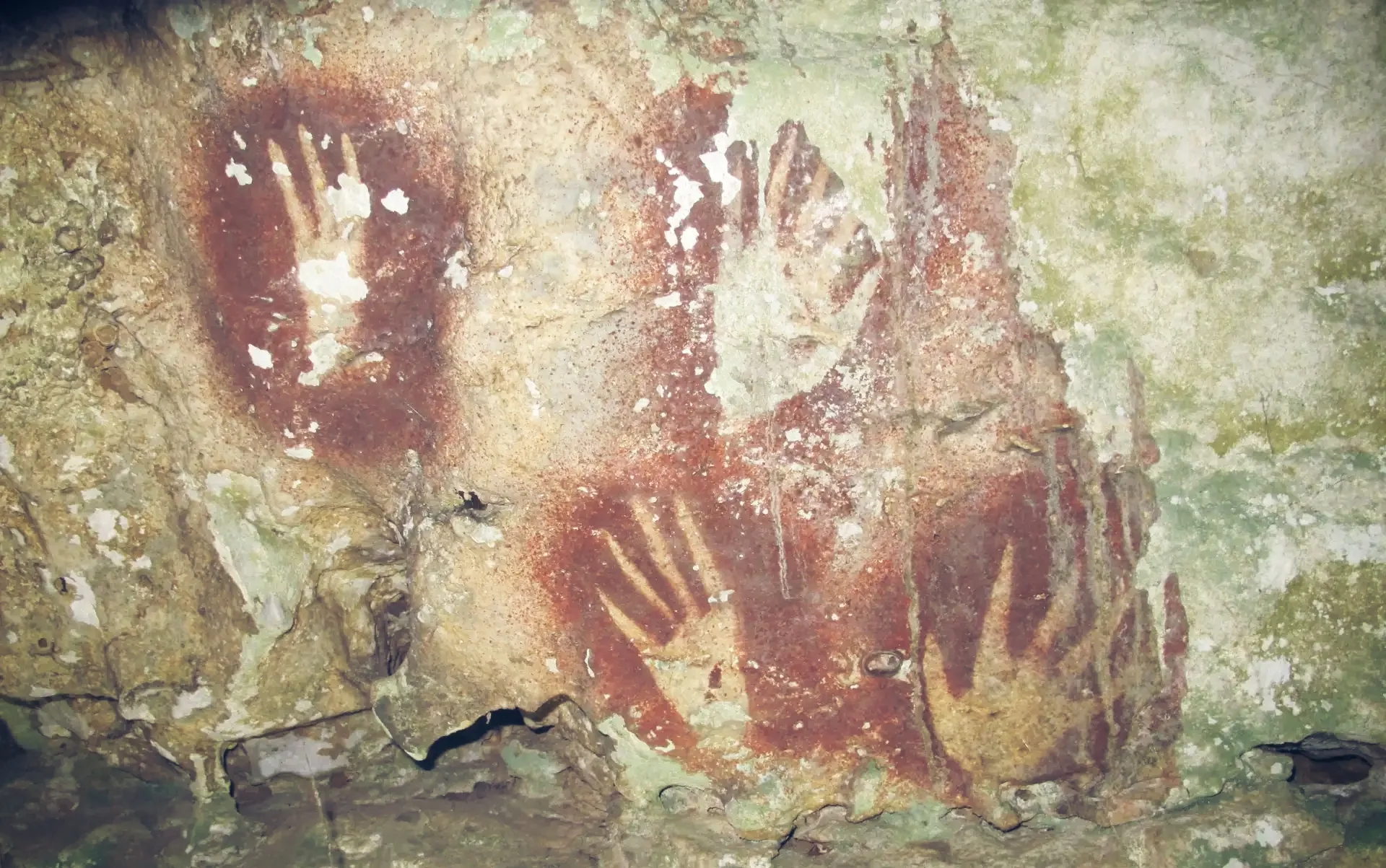
The National Research and Innovation Agency of Indonesia (BRIN) has officially unveiled the oldest known rock art in the world, a human hand stencil dated to at least 67,800 years ago, discovered at Leang Metanduno Cave on Muna Island, Southeast Sulawesi.
The groundbreaking discovery, published in the prestigious scientific journal Nature, establishes Indonesia as one of the most critical centers in the study of early symbolic expression, cognitive development, and maritime expansion of modern humans.
A Landmark Discovery Published in Nature
The study, titled “Rock Art from at Least 67,800 Years Ago in Sulawesi,” confirms that the hand stencil predates all previously known cave art, surpassing famous Paleolithic artworks in Europe and other regions.
According to BRIN, the discovery represents a major turning point in archaeology, challenging long-standing Eurocentric narratives about the origins of art and symbolic thinking.
Long-Term International Scientific Collaboration
Head of BRIN’s Research Center for Environmental, Maritime, and Sustainable Cultural Archaeology, Marlon Nicolay Ramon Ririmasse, explained that the publication is the result of a multi-year international research collaboration between BRIN and Griffith University and Southern Cross University in Australia.
“This Nature publication is the outcome of long-term collaborative research. To date, the partnership has produced at least 12 international peer-reviewed publications, including several in top-tier journals,” Marlon said during a press conference at the BJ Habibie Building in Jakarta quoted on Friday, January 23, 2026.
Beyond academic output, the research has contributed to global cultural dissemination. One of the Sulawesi rock art findings has been featured in exhibitions associated with the George Lucas Narrative Art Museum in the United States, in collaboration with Google Arts & Culture.
Investing in Scientific Capacity and Human Capital
Marlon emphasized that the project goes beyond scientific discovery.
BRIN has also used the research program to strengthen Indonesia’s scientific human resources, including funding doctoral education for Indonesian researchers involved in the study.
Looking ahead, BRIN plans to expand archaeological research across Sulawesi, Maluku, and Papua, in partnership with international institutions and local governments, to further reconstruct the deep history of human migration and culture in the Asia–Pacific region.
Redefining the Origins of Symbolic Art
Head of BRIN’s Organization for Archaeology, Language, and Literature Research (OR Arbastra), Herry Yogaswara, highlighted the global significance of the findings.
“Publication in Nature confirms the robustness of the scientific process. But this discovery is not an endpoint—it marks the beginning of a shared responsibility to protect an irreplaceable cultural heritage,” Herry said.
He noted that BRIN operates at the upstream level of research, while long-term preservation and site management fall under the authority of Indonesia’s Ministry of Culture and regional governments. Effective protection, he stressed, requires cross-institutional and cross-sector collaboration.
More Than Hand Stencils: A Narrative of Human Life
The Leang Metanduno site offers far more than the world’s oldest hand stencil.
Adhi Agus Octavian, a researcher at BRIN’s Center for Archaeometry Research, explained that the cave contains a rich visual narrative of human life, technology, and environment.
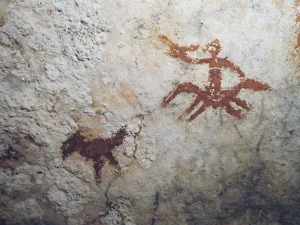
“At Metanduno, we don’t only see hand stencils. There are human figures, large animals resembling horses or cattle, depictions of boats, hunting scenes, and evidence of domestication,” Adhi said.
Researchers have created a 3D digital model of the cave, allowing a comprehensive analysis of the rock art panels. The imagery reflects a later cultural phase when humans had developed maritime technology, organized hunting, and complex social structures.
“This is not merely art—it is a social archive documenting how early humans interacted with animals, nature, technology, and one another,” he added.
A Unique Artistic Style Found Only in Sulawesi
One of the most intriguing aspects of the discovery was explained by Professor Maxime Aubert, an international collaborator on the project.
He noted that the hand stencil represents a distinct artistic style unique to Sulawesi, known as the ‘narrow-finger stencil’.
“The fingers appear elongated and pointed. This is not a typical hand stencil,” Aubert explained.
The technique used to produce the image remains unknown. Researchers speculate that early humans may have deliberately altered finger positions or movement while blowing pigment, possibly drawing inspiration from animal claws.
Remarkably, similar visual styles appear in Sulawesi rock art dated to around 20,000 years ago, indicating an artistic tradition spanning tens of thousands of years.
Local Pride and Global Responsibility
From the regional perspective, Hadi Wahyudi, Head of Culture at the Muna Regency’s Education and Culture Office, expressed deep pride in the discovery.
“This is a source of immense pride for the Muna people. It is an ancestral legacy that we are committed to protecting,” he said.
The Leang Metanduno site has already been designated a provincial-level cultural heritage site.
Local authorities hope it will eventually gain national heritage status and, in the long term, recognition as a UNESCO World Heritage Site. Protective measures have been strengthened, particularly in anticipation of increased international attention following the Nature publication.
Indonesia at the Center of Human Prehistory
The discovery of the world’s oldest rock art in Southeast Sulawesi is more than a scientific milestone—it fundamentally reshapes global narratives about where, when, and how modern humans first developed symbolic thought and artistic expression.
With this publication in Nature, Indonesia not only sets a new chronological benchmark for ancient art but also asserts its place as a central cradle of early human culture, creativity, and maritime civilization—a heritage that now demands protection, continued research, and global recognition. (AT Network)
Follow Us at Google News and WA Channel