
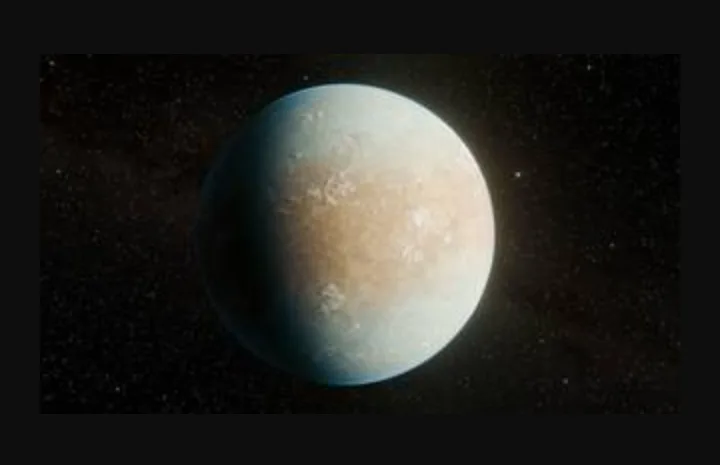
ASIATODAY.ID, JAKARTA – Scientists have identified a distant, Earth-sized planet that could potentially support life, according to NASA, raising fresh excitement in the search for worlds beyond our solar system.
The planet candidate, named HD 137010 b, orbits a Sun-like star located about 146 light-years from Earth. While it may have cold, Mars-like conditions, researchers say it lies near the outer edge of its star’s habitable zone — the region where liquid water could exist under the right atmospheric conditions.
The discovery was reported this week in The Astrophysical Journal Letters by an international research team from Australia, the United Kingdom, the United States, and Denmark. The planet was detected using data collected in 2017 by NASA’s Kepler Space Telescope during its extended K2 mission.
HD 137010 b was observed during a rare and brief transit, when it passed in front of its host star and caused a slight dip in brightness.
According to co-author Chelsea Huang of the University of Southern Queensland, the planet completes an orbit in roughly 355 days, closely resembling Earth’s year.
“This is the first planet candidate with an Earth-like radius and orbital period transiting a Sun-like star bright enough for meaningful follow-up observations,” the researchers noted quoted on Friday January, 30, 2026.
Most previously identified Earth-sized exoplanets around Sun-like stars are significantly farther away and much dimmer, making HD 137010 b a particularly valuable target for future study.
Because it receives less than one-third of the heat and light Earth gets from the Sun, the planet’s surface temperature could drop as low as minus 68 degrees Celsius, similar to conditions on Mars.
However, scientists suggest that a dense, carbon dioxide-rich atmosphere could trap heat, potentially increasing the planet’s chances of being habitable to between 40 and 51 percent.
For now, HD 137010 b remains a planet candidate, as only one transit has been observed. Its long orbital period makes repeated detections challenging.
Confirmation may come from NASA’s TESS satellite or Europe’s CHEOPS mission, though definitive observations could require next-generation telescopes.
Researchers emphasize that the planet’s Earth-like size, orbit, and bright host star make it one of the most promising candidates yet for understanding how common potentially habitable worlds may be in our galaxy. (AT Network)
Follow Us at Google News and WA Channel