
ASIATODAY.ID, RIYADH — The International Monetary Fund (IMF), the Arab Monetary Fund (AMF), and Saudi Arabia have reinforced their strategic roles in the global financial system by locking in a long-term partnership that will run through 2036.
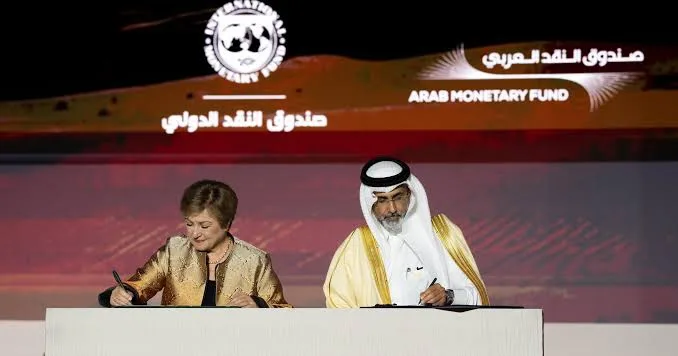
The renewed alliance was formalized through an updated Memorandum of Understanding (MoU) between the IMF and AMF, announced at the close of the Second Annual AlUla Conference for Emerging Market Economies, held on February 8–9, 2026.
As the global economy faces persistent uncertainty driven by geopolitical tensions, shifting trade patterns, and rapid technological disruption, the agreement signals a growing ambition by the Arab region to emerge not merely as a participant—but as a pillar of global economic stability.
IMF–AMF MoU Through 2036 Strengthens Regional Financial Stability
The updated MoU was signed by IMF Managing Director Kristalina Georgieva and AMF Director General and Chairman Fahad M. Alturki on the sidelines of the AlUla Conference, co-organized by the Saudi Ministry of Finance and the IMF.
Georgieva emphasized that deeper cooperation between global and regional financial institutions is essential in an increasingly volatile global environment.
“Our shared purpose is clear: to strengthen macroeconomic and financial stability and promote inclusive growth across the Arab region. By combining our strengths and deepening our partnership, we can better support our members during a period of high global uncertainty and rapid economic transformation,” Georgieva said.
Alturki underscored that reinforcing the regional financial safety net remains central to the AMF’s mandate.
“Ensuring regional financial stability for Arab countries is a core pillar of the AMF’s work. This renewed MoU will further strengthen our longstanding partnership with the IMF—particularly in surveillance, lending programs, data sharing, and analytical work—allowing us to respond more effectively to evolving member needs,” Alturki stated.
Expanded IMF–AMF Cooperation: Surveillance, Lending, and Data Integration
Under the updated MoU, the IMF and AMF agreed to significantly expand cooperation across key areas, including:
– Closer alignment on economic surveillance and lending frameworks
– Deeper collaboration on training and technical assistance
– Enhanced exchange of macroeconomic and financial data
– Strengthening regional statistical systems
– Joint analytical work and co-hosting high-level policy forums
The agreement builds on recent milestones, including the establishment of the IMF Regional Office in Riyadh and the approval of the AMF’s medium-term strategy in 2024, positioning the region to better navigate future economic shocks.
AlUla Conference: Emerging Markets Face a Shock-Prone Global Economy
The strengthened IMF–AMF alliance was reinforced by a joint statement issued by Saudi Finance Minister Mohammed Aljadaan and IMF Managing Director Kristalina Georgieva at the conclusion of the AlUla Conference.
The statement highlighted that emerging market economies are operating in a global environment marked by persistent uncertainty, geopolitical realignment, evolving trade dynamics, and accelerating technological change.
Discussions during the conference reaffirmed the importance of sound macroeconomic and financial policies, supported by strong institutions and effective governance, as the foundation for resilience in an increasingly shock-prone world.
From Stability to Growth: The Next Reform Challenge for Emerging Markets
While many emerging markets have succeeded in strengthening macroeconomic stability, conference participants emphasized that the next phase of reform must focus on delivering higher, more sustained, and more job-rich growth.
Key priorities identified at the conference include:
– Unleashing private sector dynamism
– Deepening financial markets
– Reducing barriers to entrepreneurship and investment
– Harnessing artificial intelligence (AI) through investment in digital infrastructure
Equipping young people with future-ready skills to compete in a rapidly evolving global labor market
Regional and Cross-Regional Integration Gains Strategic Importance
In a world of shifting trade and investment patterns, the AlUla Conference underscored that deeper intra-regional and inter-regional integration offers critical opportunities for emerging market economies.
Strengthening trade links and regional cooperation was widely seen as essential for adapting to a rapidly changing global economic landscape and maintaining long-term growth momentum.
Saudi Arabia Emerges as a Global Hub for Economic Dialogue
The renewed IMF–AMF agreement through 2036 further cements Saudi Arabia’s role as a global hub for economic dialogue, policy coordination, and financial cooperation, particularly for emerging and developing economies.
With global, regional, and national institutions aligning more closely than ever, the Arab region is no longer just adjusting to global economic shifts—it is increasingly helping to shape the direction of the global economy itself. (AT Network)
Follow Us at Google News and WA Channel