
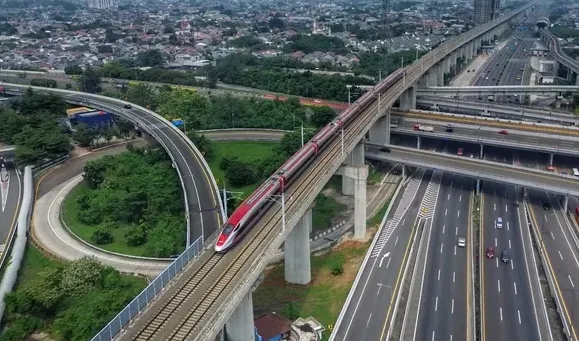
ASIATODAY.ID, JAKARTA – Indonesia has confirmed that it will use its state budget (APBN) to service debt linked to the Jakarta–Bandung High-Speed Railway (HSR), known as Whoosh, marking a pivotal moment in the country’s infrastructure financing strategy and its engagement with China under the Belt and Road Initiative (BRI).
The project, valued at approximately US$7.2 billion, including a US$1.21 billion cost overrun, is financed roughly 75 percent by loans from China Development Bank (CDB). The remainder was funded through equity contributions from the Indonesian-Chinese consortium behind PT Kereta Cepat Indonesia China (KCIC).
Initially structured as a business-to-business (B2B) venture without explicit state guarantees, the project has now shifted into direct fiscal responsibility, with Indonesia’s government stepping in to ensure long-term financial stability.
From Commercial Venture to Sovereign Responsibility
For years, Indonesian officials emphasized that the high-speed rail project would not burden the state budget.
However, mounting financial pressures and restructuring negotiations have led to a different outcome.
Minister of State Secretary Prasetyo Hadi confirmed that the repayment obligations—estimated at around IDR 116 trillion (approximately US$7.2 billion equivalent)—will be covered through the national budget.
The statement followed remarks by PT Kereta Api Indonesia (KAI) President Director Bobby Rasyidin, who said the debt issue had been resolved with direct assurances from President Prabowo Subianto.
President Prabowo has publicly defended the move, arguing that the railway generates broad public benefits, including congestion reduction, lower emissions, and technology transfer. According to him, such strategic infrastructure should not be assessed purely on short-term profitability.
Indonesia is reportedly committed to annual payments of around IDR 1.2 trillion, reinforcing the government’s willingness to safeguard the project’s continuity.
BRI Context: Partnership or Pressure?
The Jakarta–Bandung line is widely seen as a flagship BRI project in Southeast Asia. As China’s global infrastructure initiative continues to evolve, cases like Indonesia’s are closely watched by policymakers and investors alike.
While critics globally often raise concerns about “debt trap diplomacy,” Indonesia’s situation appears more nuanced. China Development Bank has reportedly indicated flexibility regarding the identity of the paying entity, provided repayment terms remain clear and consistent.
Rather than a scenario of asset seizure or geopolitical coercion, Indonesia’s case reflects a sovereign decision to protect fiscal credibility and preserve bilateral economic relations.
Nonetheless, the development underscores key geopolitical realities:
– Southeast Asian economies remain deeply engaged with Chinese infrastructure financing.
– Cost overruns and traffic projections can alter risk calculations significantly.
– Sovereign backstopping of BRI-linked projects may become more common than initially projected.
Domestic Fiscal Debate
Notably, Indonesia’s Finance Minister Purbaya Yudhi Sadewa had earlier expressed reluctance to use public funds to settle the railway’s debt.
“If it were up to me, I wouldn’t use the state budget,” he told reporters, while acknowledging that final decisions rest with the President.
He suggested a division of responsibility:
– The government would handle infrastructure-related obligations.
– Danantara, Indonesia’s sovereign investment body, would manage operational and rolling stock components.
However, the final political decision appears to consolidate repayment under state oversight, signaling a prioritization of macroeconomic stability and international credibility.
Implications for Indonesia and the Region
Indonesia’s move may shape future BRI negotiations across Southeast Asia. The country remains one of China’s most significant economic partners in the region, and Jakarta’s approach suggests a recalibration rather than disengagement.
Key questions now arise:
– Will Indonesia renegotiate interest rates or loan tenors with CDB?
– How will the repayment affect fiscal space and deficit management?
– Does this set a precedent for future public-private infrastructure projects?
Despite controversy, the Whoosh railway is operational and has reported increasing passenger numbers.
For Jakarta, the strategic calculus appears to favor long-term infrastructure positioning over short-term fiscal discomfort.
A Strategic Balancing Act
Indonesia’s decision illustrates the balancing act faced by emerging economies participating in the Belt and Road Initiative. Infrastructure ambition, geopolitical alignment, domestic politics, and fiscal prudence intersect in complex ways.
Rather than a simple narrative of dependency, the Whoosh case reveals a pragmatic recalibration: Indonesia is choosing to honor financial commitments, preserve strategic partnerships, and maintain investor confidence—while absorbing the fiscal cost.
As global infrastructure financing models evolve, Jakarta’s handling of the Whoosh debt may become a case study in how middle powers navigate the intersection of national interest and great-power economic diplomacy. (AT Network)
Follow Us at Google News and WA Channel