
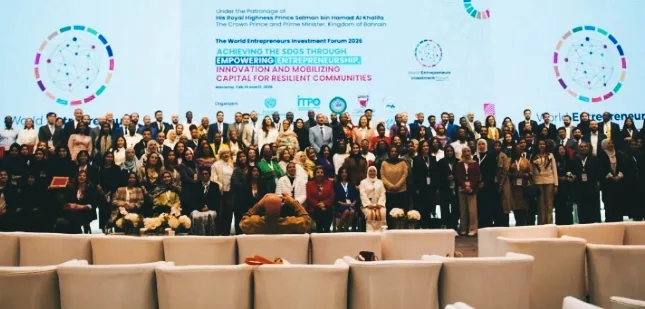
ASIATODAY.ID, MANAMA — A powerful message echoed across the halls of the World Entrepreneurs and Investment Forum (WEIF) 2026: women are not beneficiaries of economic development — they are its architects.
The Manama Declaration, issued at the close of the forum, firmly places women at the heart of global economic transformation. It stresses that empowering women within business and innovation ecosystems is not optional, but essential to achieving inclusive and sustainable growth.
Organized by the Investment and Technology Promotion Office in Bahrain of the United Nations Industrial Development Organization (UNIDO), the forum convened global leaders, investors and entrepreneurs to shape a more resilient world economy and unlock new opportunities for women-led enterprises.
Women at the Core of Green, Blue and Orange Economies
The declaration calls for strengthening women’s presence across emerging sectors — including the green economy (environmentally responsible growth), the blue economy (sustainable ocean-based industries), and the orange economy (creative and cultural industries).
These sectors are increasingly viewed as strategic pillars for advancing the Sustainable Development Goals (SDGs), the global blueprint adopted in 2015 to promote prosperity, equality and environmental protection.
UNIDO Director-General Gerd Müller described women’s entrepreneurship as “a driving force for sustainable development, global innovation and economic inclusion.”
“We must ensure that women everywhere have a level playing field and are given the opportunity to unlock their full potential,” he emphasized.
He also highlighted UNIDO’s expanding recovery programmes in crisis-affected countries such as Syria, Sudan and Palestine, where women are among the most impacted by economic instability.
From Networking to Real Investment Impact
Beyond declarations, WEIF 2026 delivered tangible results.
Through structured business-to-business (B2B) sessions, participants secured cross-border partnerships and market access opportunities.
Entrepreneurs reported collaborations spanning the Middle East, Africa, Europe and beyond — demonstrating that women-led businesses are increasingly integrated into global value chains.
The forum followed the annual conference of the International Women Entrepreneurial Challenge (IWEC), a New York-based NGO that has recognised 575 distinguished women entrepreneurs worldwide. Collectively, IWEC awardees represent businesses with investments exceeding US$6 billion.
Inclusive Entrepreneurship: Creativity Without Barriers
A distinctive feature of WEIF 2026 was its spotlight on inclusive entrepreneurship through exhibitions such as “Determined Creative Entrepreneur.”
Among the exhibitors was Bahrain’s Micro Art Center, led by Nisreen Samour, which trains artists with disabilities and supports orphans in developing professional artistic skills.
The initiative demonstrates that economic transformation is not solely about capital flows — it is equally about access, dignity and social inclusion.
Universities as Launchpads for Women Entrepreneurs
Higher education institutions were also identified as critical actors in shaping the next generation of women leaders.
Dr. Nihal Al-Najjar of the Royal University for Women in Bahrain stressed that entrepreneurship must be embedded not merely as an academic subject, but as a methodology that encourages innovation, problem-solving and real-world application.
Universities, she argued, must connect students with mentors, funding pathways and professional networks to ensure ideas evolve into viable enterprises.
Success Stories from Bahrain to Africa
Among IWEC’s newly recognised awardees was Sonia Mohamed Janahi, founder of Maya La Chocolaterie. With UNIDO’s support, she expanded her Bahraini chocolate brand into Africa by establishing a cocoa processing facility in Côte d’Ivoire — creating jobs, promoting ethical supply chains and strengthening African value addition.
From Nigeria, entrepreneur Oluwakelemi shared how her lifestyle retail business has empowered more than 5,000 people while preparing for international expansion.
IWEC Chair Ibukun Awosika underscored the transformative potential of women in leadership:
“Every nation wise enough to invest in the talent of 50 per cent of its population is a country positioned to win.”
Women as Strategy, Not Symbolism
WEIF 2026 marked a clear shift in global economic discourse: women’s empowerment is no longer framed as a complementary social agenda — it is a strategic economic imperative.
In an era defined by climate disruption, technological transformation and widening inequality, women are emerging not as supporting actors, but as central drivers of innovation, resilience and sustainable growth.
The future of the global economy, it seems, has a clearer face than ever — and that face is female. (AT Network)
Follow Us at Google News and WA Channel