
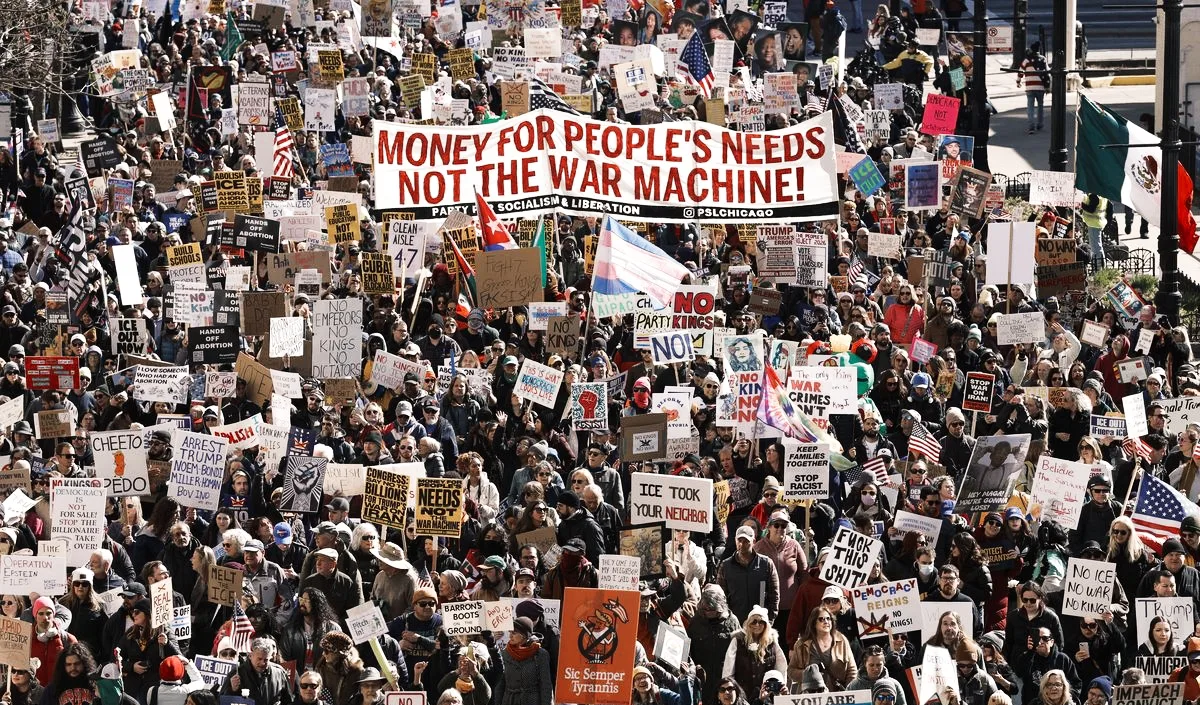
ASIATODAY.ID, WASHINGTON – The United States is facing mounting unrest.
A wave of demonstrations under the banner “No Kings” has spread across the country, marking one of the largest mass mobilizations in recent years.
In its third round of protests last weekend, more than 3,200 demonstrations took place across all 50 states. The movement is no longer confined to major urban centers—it is rapidly expanding into smaller, non-metropolitan communities, signaling a deepening grassroots uprising.
Major rallies were reported in New York, Dallas, Philadelphia, and Washington, D.C. Notably, around two-thirds of the protests are now occurring outside major cities, a nearly 40% increase compared to the initial wave in June 2025.
A Stand Against Authoritarianism
Minnesota Governor Tim Walz framed the movement as a moral and democratic resistance.
“They call us radical. Yes—we are radicalized by compassion, decency, and democracy,” he said.
U.S. Senator Bernie Sanders echoed the sentiment, warning that the country must not fall into authoritarianism or oligarchy.
In New York, actor Robert De Niro went further, calling President Donald Trump an existential threat to national freedom and security.
Tensions Escalate Into Clashes
While many demonstrations remained peaceful, tensions escalated in several cities. In Dallas, clashes broke out between protesters and counter-groups led by Enrique Tarrio, prompting police arrests following street fights and road blockades.
In Los Angeles, authorities detained several demonstrators after unrest near a federal building. The Department of Homeland Security reported that officers were injured by thrown objects.
Immigration and Iran Conflict Fuel Anger
The protests are driven by growing public anger over policies under Donald Trump, particularly aggressive immigration deportations and U.S. military involvement in the ongoing Iran conflict, now entering its fourth week.
Anti-war sentiment is becoming a key element of the movement, with many questioning the necessity of U.S. intervention abroad.
“No one attacked us. We don’t need to be there,” said a protester in Washington, reflecting a broader public mood.
Midterm Elections Add Political Pressure
The “No Kings” wave comes at a critical moment ahead of the November midterm elections, which will determine control of Congress.
According to a Ipsos poll, President Donald Trump’s approval rating has fallen to 36%, its lowest level since returning to office.
Significantly, protests have also spread into Republican strongholds such as Idaho, Wyoming, Montana, and Utah—suggesting that dissatisfaction is no longer limited to traditionally liberal regions.
A Movement or the Beginning of Political Change?
Since its launch on June 14, 2025, the “No Kings” movement has grown into a nationwide force, drawing millions of participants in successive waves.
Now, with its scale expanding rapidly, the movement could reshape the U.S. political landscape.
The question remains: is this merely a protest wave a major political shift?
One thing is clear: the United States is under intense social and political strain—and the pressure is far from easing. (AT Network)
Follow Us at Google News and WA Channel