
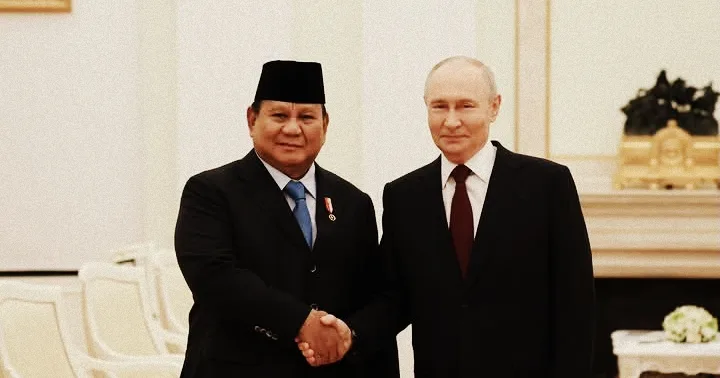
ASIATODAY.ID, MOSCOW – A five-hour meeting between Prabowo Subianto and Vladimir Putin at the Kremlin on Monday, April 13, 2026 has sent a strong signal of a shifting trajectory in Indonesia–Russia strategic cooperation amid growing global geopolitical uncertainty.
The meeting went far beyond symbolic diplomacy. Behind closed doors, both leaders finalized a series of key agreements, particularly in the energy and mineral resources sectors—two pillars now central to Indonesia’s economic transformation.
Cabinet Secretary Teddy Indra Wijaya revealed that discussions were intensive, comprising two hours of bilateral talks followed by three hours of one-on-one dialogue.
The outcome: a mutual commitment to strengthen long-term cooperation in energy, including oil and gas resilience and downstream industrial development.
“Long-term cooperation in energy and mineral resources has been agreed upon, including strengthening energy security and downstreaming,” Teddy stated.
Energy and Downstreaming Take Center Stage
The agreements underscore Indonesia’s ambition to accelerate resource-based industrialization. Russia, home to some of the world’s largest energy reserves, is seen as a strategic partner to support this agenda.
Beyond energy, both nations also agreed to expand cooperation in education, technological research, agriculture, and industrial investment. The objective is clear: to build a stronger, globally competitive national industry.
In this context, partnership with Russia is increasingly relevant. In addition to being a global power, Russia holds strategic influence as a permanent member of the UN Security Council and a key member of BRICS—an economic bloc that Indonesia is now actively engaging with.
Strong Signals of Geopolitical Support
During the meeting, President Prabowo highlighted Russia’s support for Indonesia’s strategic interests, including its bid to join BRICS.
“I am very grateful. Our discussions have been highly productive, and Russia supports Indonesia’s key interests,” Prabowo said.
He emphasized that nearly all previously agreed bilateral initiatives have shown significant progress, with remaining areas set to be accelerated under his direct supervision.
Prabowo also noted that his visit to Moscow aimed to conduct strategic consultations amid rapidly evolving global geopolitical dynamics. Indonesia views Russia as a crucial partner in maintaining global stability.
Intensifying Diplomacy, Deepening Ties
The meeting also reflects the increasingly close personal rapport between the two leaders. Over the past year, Prabowo and Putin have met five times, including their previous encounter in Moscow last December.
The atmosphere at the Kremlin was described as warm and cordial. Putin expressed appreciation for Prabowo’s visit, while Prabowo conveyed gratitude for the hospitality extended despite the Russian leader’s busy schedule.
Indonesia and Russia have maintained diplomatic relations for over seven decades since 1950.
However, this latest meeting marks a pivotal moment—transforming the relationship from traditional bilateral ties into a more concrete and impactful strategic partnership.
A New Direction: Economy, Energy, and Industry
The Kremlin agreements highlight three key pillars for future cooperation: Strengthening national energy security, Accelerating downstreaming and industrialization, Expanding investment and technological collaboration.
Amid global uncertainty, this move reflects Indonesia’s strategy to diversify partnerships and reinforce its position on the international stage.
Ultimately, the five-hour meeting at the Kremlin was not merely about diplomacy—it signaled how Indonesia is actively redesigning its future, with energy, industry, and geopolitics at its core. (AT Network)
Follow Us at Google News and WA Channel