
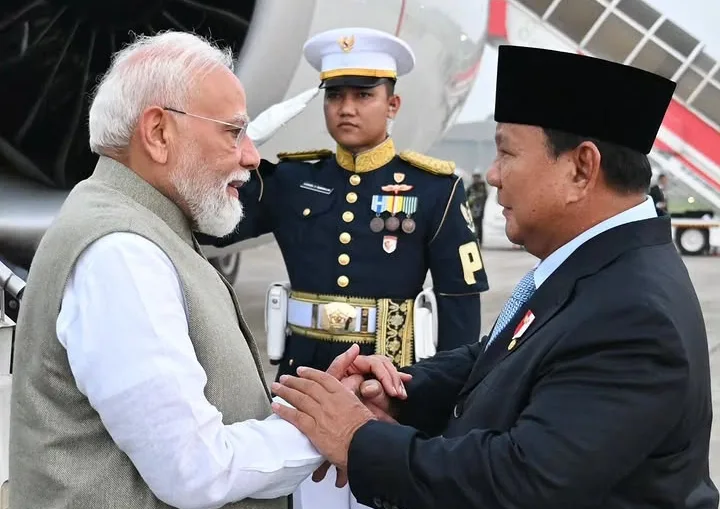
ASIATODAY.ID, JAKARTA — President Prabowo Subianto and Indian Prime Minister Narendra Modi on Tuesday elevated Indonesia–India relations by signing 16 landmark agreements covering defense, critical minerals, energy, digital technology, maritime connectivity, healthcare, education, scientific research, and industrial cooperation.
Announced after bilateral talks at Jakarta’s Merdeka Palace, the agreements represent one of the broadest expansions of cooperation between the two countries in decades. They reflect a shared commitment to strengthening economic resilience, enhancing regional security, accelerating industrial transformation, and expanding collaboration in sectors expected to drive Asia’s long-term growth.
India is one of the world’s fastest-growing major economies, while Indonesia is Southeast Asia’s largest economy and one of the world’s leading producers of nickel and other critical minerals essential for electric vehicles, batteries, and clean-energy technologies. Against the backdrop of intensifying geopolitical competition and shifting global supply chains, closer cooperation between Jakarta and New Delhi is expected to carry growing economic and strategic significance across the Indo-Pacific.
Shared Vision for Peace and a Rules-Based Indo-Pacific
During a joint press statement, Prabowo said Indonesia and India share common views on promoting global peace, strengthening diplomacy, and ensuring developing countries have a stronger voice in international affairs.
“We exchanged views on regional and global issues. Indonesia and India remain committed to advancing global peace and stability while ensuring the voices of the Global South are heard,” Prabowo said.
Both leaders reaffirmed their commitment to a free, open, inclusive, transparent, and rules-based Indo-Pacific, while emphasizing ASEAN centrality as a key pillar of regional stability.
The two governments also reiterated their support for resolving international conflicts—including those in the Middle East—through dialogue, diplomacy, and full respect for international law.
Strategic Cooperation Extends Beyond Traditional Diplomacy
The centrepiece of Modi’s state visit was the announcement of 16 strategic agreements involving government agencies, research institutions, state-owned enterprises, and private-sector companies.
Rather than focusing on a single sector, the agreements establish a broad framework for long-term cooperation in defense, maritime security, space exploration, disaster management, telecommunications, pharmaceuticals, agriculture, scientific research, education, election technology, innovation, and cultural heritage conservation.
Defense cooperation advanced through agreements covering Indonesia’s procurement of India’s BrahMos supersonic cruise missile system and additional defense technologies, underscoring expanding security cooperation between the two countries.
Critical Minerals and Industrial Transformation
Critical minerals emerged as one of the summit’s most strategically important areas of cooperation.
New partnerships involving Indonesian and Indian institutions and companies will focus on downstream processing, stainless steel, advanced materials, rare earth refining, and magnet manufacturing—industries expected to play an increasingly important role in the global energy transition.
For Indonesia, the cooperation supports its ambition to move further up the global value chain by expanding domestic processing and advanced manufacturing. For India, it strengthens access to strategic raw materials needed for electric vehicles, renewable energy, electronics, and other high-technology industries.
Clean Energy, Artificial Intelligence and Digital Economy
Energy security and technological innovation formed another major pillar of the strengthened partnership.
The two countries agreed to expand cooperation in solar energy development, energy-transition initiatives, nuclear technology, artificial intelligence, telecommunications, Digital Public Infrastructure (DPI), startup ecosystems, and scientific research.
Indonesia and India also committed to strengthening collaboration in space technology through joint research, technology transfer, and capacity building, building on decades of cooperation between their respective space agencies.
Maritime Connectivity and Trade Integration
Recognizing the strategic importance of the eastern Indian Ocean, Jakarta and New Delhi agreed to enhance maritime connectivity by supporting the development of Sabang Port in Aceh and India’s Andaman and Nicobar Islands, strengthening links between Southeast Asia and South Asia.
The initiative is expected to facilitate trade, logistics, tourism, and maritime cooperation along one of the world’s busiest shipping routes.
Both governments also pledged to accelerate negotiations on an Indonesia–India Preferential Trade Agreement (PTA) and support the modernization of the ASEAN–India Trade in Goods Agreement (AITIGA).
In another significant step, the two countries agreed to implement cross-border QR payment connectivity, which is expected to improve transaction efficiency, facilitate tourism, and deepen regional financial integration.
Investing in People and Innovation
Beyond economic and strategic cooperation, Indonesia and India expanded collaboration in healthcare, higher education, scientific research, professional training, and cultural heritage preservation.
The agreements include expanded opportunities for medical training, stronger partnerships between universities and research institutions, and joint conservation efforts for the UNESCO World Heritage-listed Prambanan Temple Compounds, reinforcing long-term people-to-people ties.
A Partnership with Regional and Global Significance
Together, Indonesia and India represent nearly 1.7 billion people, making their expanding partnership increasingly important to the future of the Indo-Pacific and the wider Global South.
As governments and businesses seek more resilient supply chains, stronger energy security, and accelerated technological innovation, the agreements reached in Jakarta mark a significant step toward a broader and more diversified strategic partnership between two of Asia’s leading democracies.
While rooted in bilateral cooperation, the outcomes of the summit are expected to influence regional trade, industrial development, investment, maritime connectivity, and economic integration across the Indo-Pacific in the years ahead. (Midwan)
Follow Us at Google News, WA Channel, and LinkedIn