
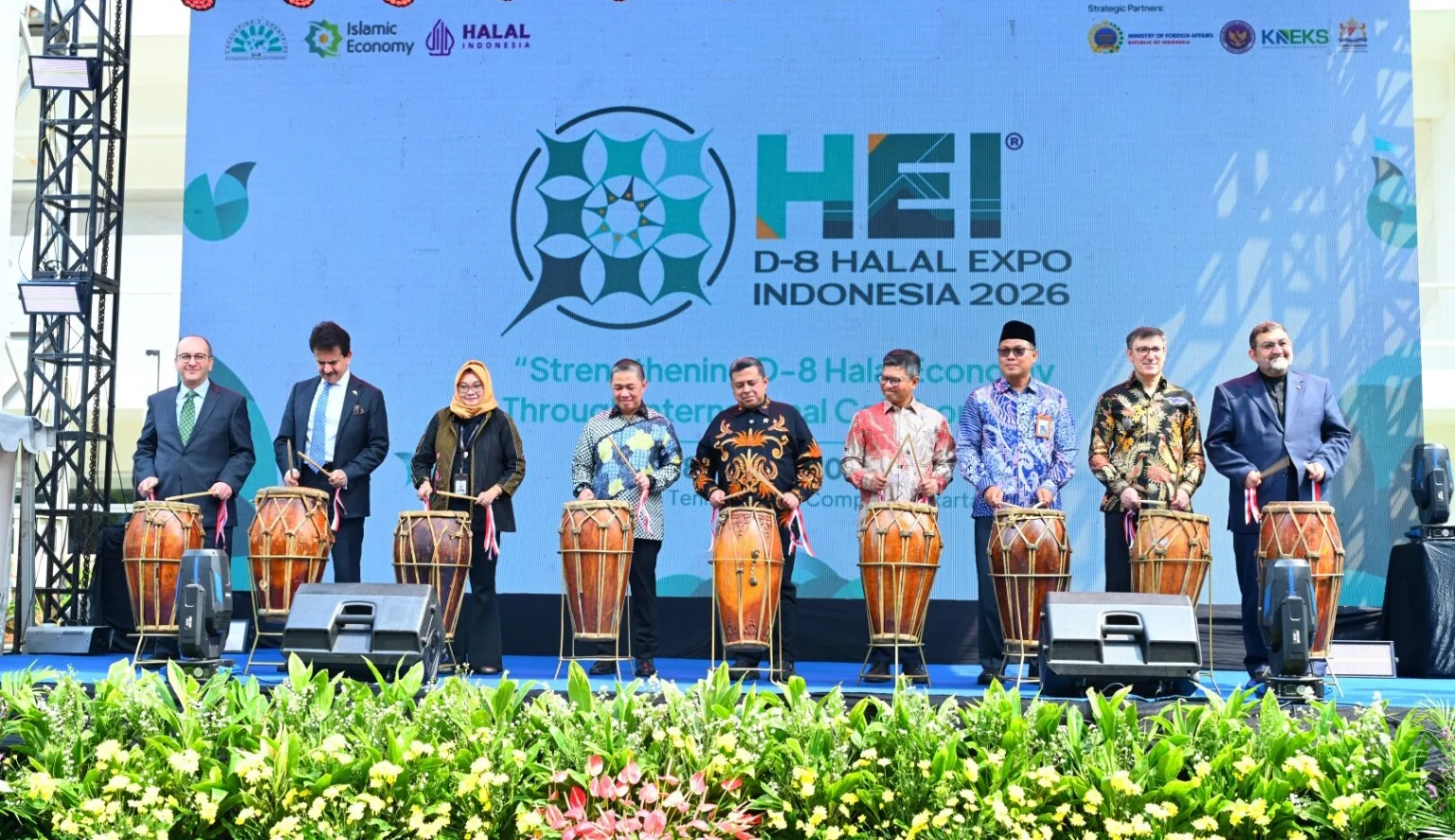
ASIATODAY.ID, JAKARTA — Indonesia has launched the inaugural D-8 Halal Expo Indonesia (HEI) 2026, using its chairmanship of the Developing Eight (D-8) to accelerate the bloc’s emergence as a major player in the rapidly expanding global halal economy.
Held from July 8 to 12 at Jakarta’s Senayan Tennis Indoor Stadium, the expo brings together policymakers, investors, exporters, entrepreneurs, and industry leaders from D-8 member states and partner countries to deepen economic cooperation, strengthen halal value chains, and unlock new cross-border investment opportunities.
The initiative forms a key pillar of Indonesia’s D-8 Chairmanship for 2026–2027 and reflects Jakarta’s broader strategy to position itself as one of the world’s leading halal economy hubs.
The D-8 comprises Azerbaijan, Bangladesh, Egypt, Indonesia, Iran, Malaysia, Nigeria, Pakistan, and Türkiye. Together, the bloc represents approximately 1.3 billion people—around 16 percent of the global population—and a combined gross domestic product of about US$5.1 trillion, giving it significant potential to influence the future of global halal trade.
Opening the event, Indonesia’s Deputy Foreign Minister Anis Matta said the halal economy has become a strategic pillar of the country’s international economic engagement, particularly as global markets adjust to geopolitical uncertainty and shifting supply chains.
According to Anis, expanding Indonesia’s integration with the wider Muslim world through the halal economy will help create new engines of growth while strengthening the country’s international economic competitiveness.
Held under the theme “Strengthening D-8 Halal Economy Through International Collaboration,” the expo serves as a platform to connect businesses across sectors including halal food and beverages, pharmaceuticals, cosmetics, modest fashion, tourism, Islamic finance, and digital services.
A major objective is to support the D-8’s target of increasing intra-bloc trade to US$500 billion by 2030, while encouraging greater private-sector investment, industrial collaboration, and innovation across member countries.
Throughout the five-day programme, participants are taking part in trade exhibitions, business matching sessions, investment meetings, and policy discussions under the D-8 HEI Talks. The event has also attracted buyers and exhibitors from outside the D-8, including the Netherlands, Djibouti, India, Palestine, France, Uzbekistan, and Jordan, highlighting growing international interest in the bloc’s halal market.
The D-8 Secretary-General praised Indonesia for hosting the organization’s first halal expo, describing it as an important platform for expanding intra-D-8 trade, investment, research collaboration, capacity building, and private-sector partnerships.
Meanwhile, the Executive Director of Indonesia’s National Committee for Islamic Economy and Finance (KNEKS) said the expo was designed to generate tangible commercial outcomes through structured business matching between exporters and importers, while facilitating long-term partnerships and knowledge exchange.
The event also advances President Prabowo Subianto’s commitment, announced during the 11th D-8 Summit in Cairo in December 2024, to strengthen global halal value chains and establish Indonesia as one of the world’s principal halal economy centres.
Jointly organised by Indonesia’s Ministry of Foreign Affairs, KNEKS, the Halal Product Assurance Agency (BPJPH), and the Indonesian Chamber of Commerce and Industry (Kadin Indonesia), the inaugural D-8 Halal Expo marks an important step in Indonesia’s effort to translate diplomatic leadership into stronger trade, investment, and industrial cooperation.
As demand for halal products and services continues to expand worldwide, Indonesia is positioning the D-8 not merely as a forum for economic cooperation, but as an emerging geopolitical and commercial force capable of shaping the next phase of the global halal economy. (AT Network)
Follow Us at Google News, Instagram, WA Channel, and LinkedIn