
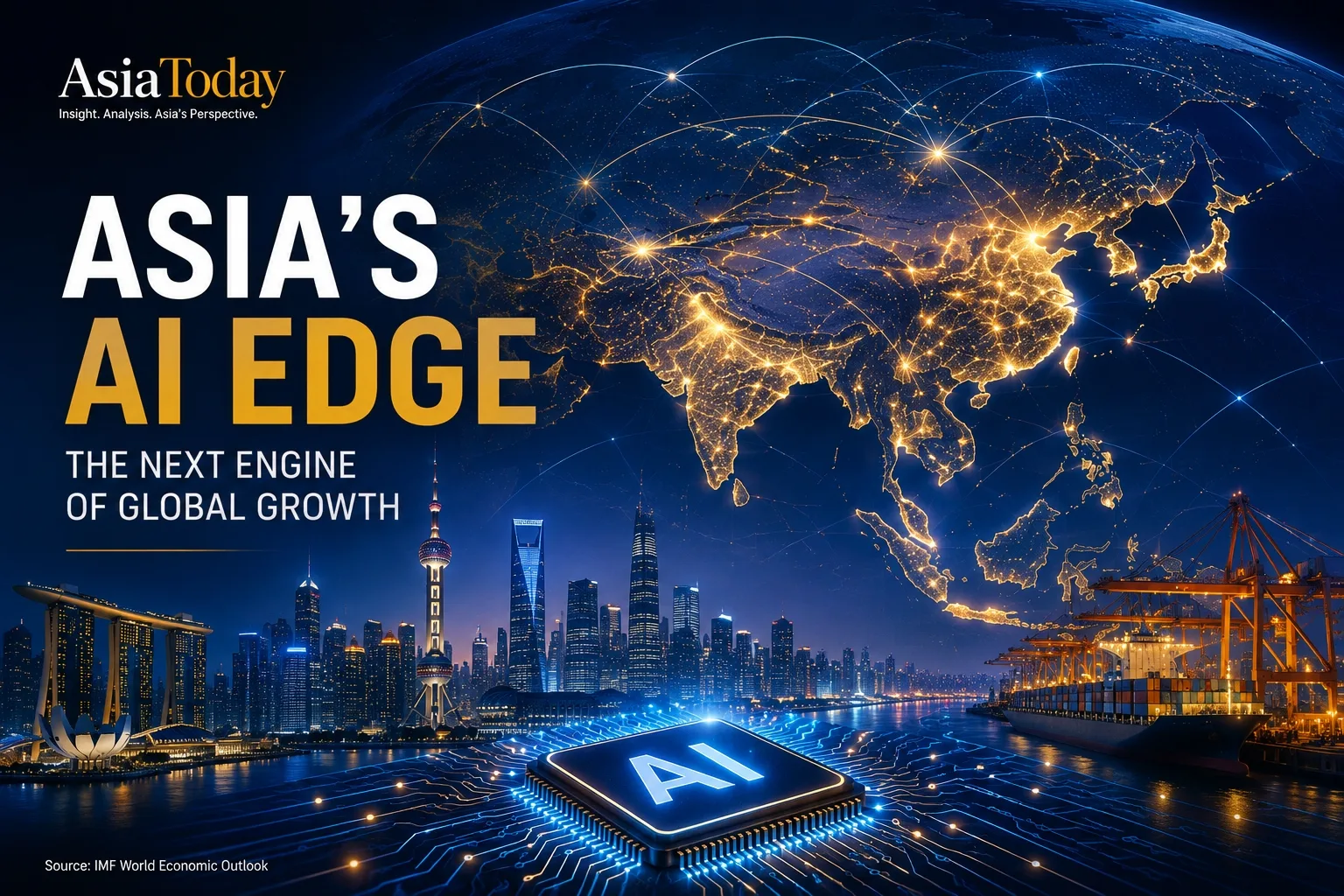
ASIATODAY.ID, WASHINGTON — As war in the Middle East disrupts energy markets and inflation continues to challenge policymakers worldwide, a different story is unfolding across Asia. Backed by accelerating investment in artificial intelligence (AI), semiconductors, and advanced manufacturing, several Asian economies are emerging as the strongest performers in an increasingly fragmented global economy.
The latest World Economic Outlook (WEO) Update released by the International Monetary Fund (IMF) projects global economic growth of 3.0 percent in 2026 and 3.4 percent in 2027, broadly unchanged from its April forecast. Yet behind those headline figures lies a widening divergence between economies benefiting from the AI investment boom and those still weighed down by geopolitical shocks and rising energy costs.
“The global outlook is being shaped by two powerful forces pulling in opposite directions: the lingering effects of the energy shock from the war in the Middle East and a technology-driven investment boom,” Petya Koeva Brooks, Deputy Director of the IMF’s Research Department, said during the release of the report.
According to the IMF, the world economy has so far absorbed the initial impact of the conflict better than expected, thanks to improved energy resilience, expanded oil production outside the Gulf region, strategic inventory releases, and a growing share of renewable energy. Even so, the recovery remains fragile as geopolitical uncertainty continues to cloud the outlook.
Asia Emerges as a Technology Powerhouse
The IMF’s latest projections highlight Asia’s expanding role in industries expected to define the next era of global growth.
South Korea received one of the largest upward revisions after stronger-than-expected exports of AI-related semiconductors and advanced technology products boosted economic activity.
China’s growth forecast for 2026 was revised upward to 4.6 percent, supported by stronger first-quarter performance despite higher global energy prices and softer external demand.
India is expected to grow 6.4 percent this year, maintaining its position among the world’s fastest-growing major economies as resilient domestic demand offsets higher oil import costs.
The IMF also cited Thailand among economies benefiting from stronger technology investment linked to the expanding global AI supply chain.
Taken together, these revisions underscore Asia’s growing importance in advanced manufacturing, digital infrastructure, and the semiconductor ecosystem that increasingly underpins global productivity.
A World Divided by Technology
While Asia strengthens its position in the AI-driven economy, other regions face a more difficult recovery.
Oil-exporting countries directly affected by conflict in the Middle East continue to experience disruptions in production and transport, while many low-income and energy-importing economies remain under pressure from elevated fuel prices and inflation.
The IMF warns that these contrasting trends are creating a more uneven global recovery, with technology-intensive economies advancing faster than countries that remain heavily exposed to commodity shocks.
At the same time, the Fund cautions that excessive optimism surrounding AI investment could eventually trigger financial market corrections if commercial returns fail to meet investor expectations.
Inflation and Geopolitical Risks Persist
Despite stable global growth projections, inflation remains a major concern.
The IMF raised its global headline inflation forecast to 4.7 percent for 2026, noting that the disinflation trend that began in early 2024 has largely stalled.
The Fund’s baseline scenario assumes shipping through the Strait of Hormuz gradually resumes from mid-July, with trade and energy flows returning to pre-war conditions by early 2027.
However, a renewed escalation in the conflict could push oil prices higher, tighten global financial conditions, disrupt supply chains, and deepen food insecurity in vulnerable economies.
Central banks, the IMF said, should remain focused on preserving price stability while governments gradually rebuild fiscal buffers as temporary energy-related support measures are phased out.
Why Asia Matters More Than Ever
Beyond the short-term forecasts, the IMF’s latest assessment points to a deeper structural transformation in the global economy.
Competitive advantage is increasingly determined by leadership in artificial intelligence, advanced manufacturing, semiconductor production, digital infrastructure, and resilient supply chains rather than by market size alone.
Several Asian economies have already established themselves at the center of these strategic industries, positioning the region to capture a growing share of future investment, innovation, and productivity gains.
While geopolitical risks remain elevated and downside risks continue to dominate the global outlook, the IMF’s latest projections suggest that Asia is entering the next phase of economic transformation from a position of relative strength.
For governments, businesses, and investors alike, the implications are increasingly clear: understanding the future direction of the global economy means paying closer attention to Asia. As artificial intelligence reshapes industries and geopolitical tensions redefine trade and investment flows, Asia is becoming one of the principal drivers of the world’s next chapter of economic growth. (AT Network)
Follow Us at Google News, Instagram, WA Channel, and LinkedIn