
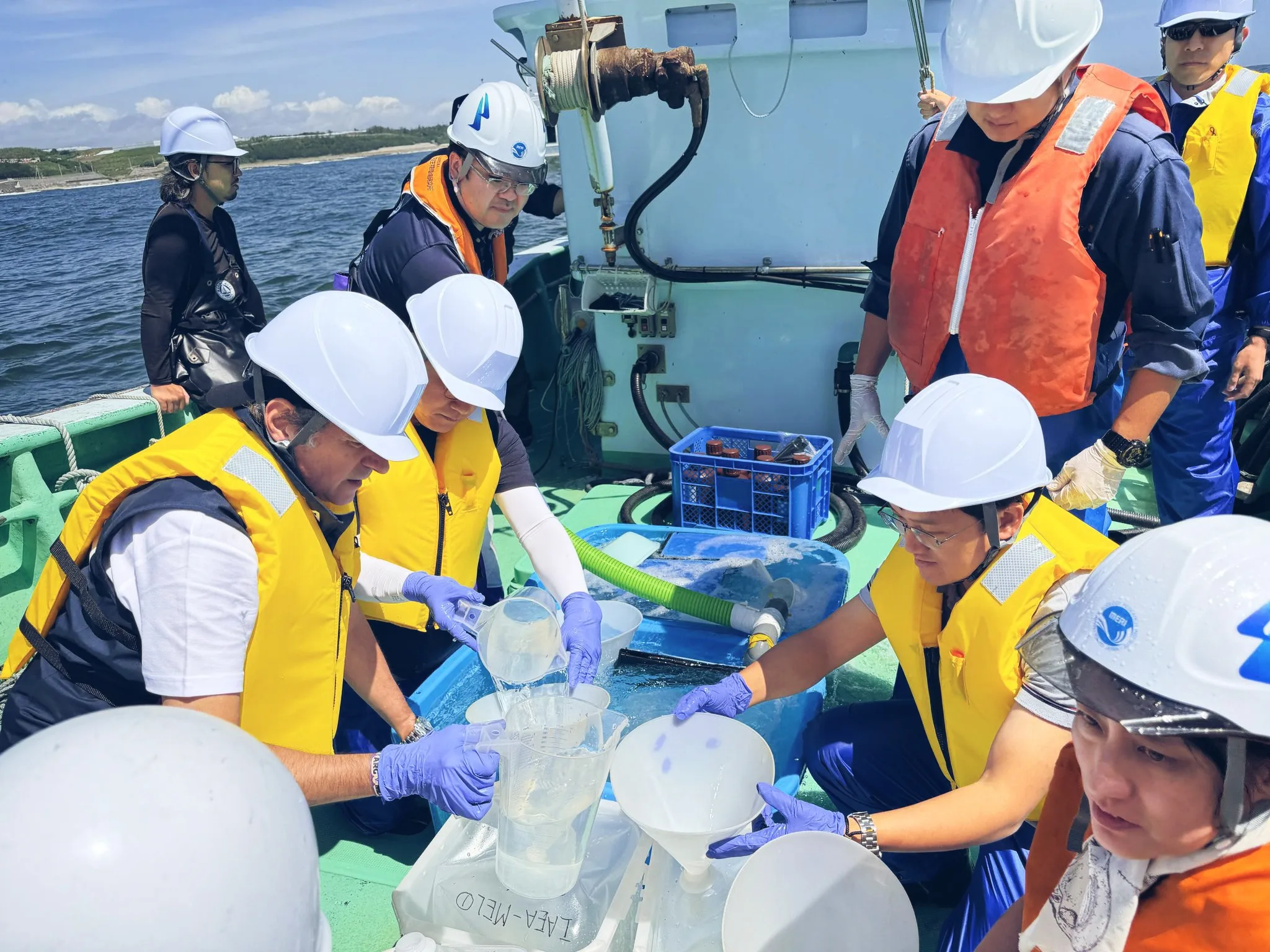
ASIATODAY.ID, FUKUSHIMA — The International Atomic Energy Agency (IAEA) has intensified international monitoring of Japan’s Fukushima Daiichi Nuclear Power Station by leading an independent sampling mission to verify the safety of the 21st batch of water treated through the Advanced Liquid Processing System (ALPS).
Conducted on 8–9 July 2026 in Fukushima Prefecture, the mission marks the tenth operation under the IAEA’s Additional Measures framework, designed to expand international participation, enhance transparency, and provide independent verification of radionuclide levels before the treated water is discharged into the Pacific Ocean.
The latest samples were collected after the ALPS-treated water was diluted with seawater and immediately before its release through the Fukushima Daiichi discharge facilities.
The IAEA previously confirmed that tritium concentrations in the 21st batch were significantly below Japan’s operational limit, indicating that the discharge process remains consistent with international safety standards.
Experts from China, South Korea, Russia and Switzerland, together with IAEA specialists, collected samples directly from the discharge vertical shaft and seawater pipe header operated by Tokyo Electric Power Company Holdings (TEPCO), the operator of the Fukushima Daiichi Nuclear Power Station.
The samples will undergo independent analysis at several internationally recognized laboratories, including the China Institute for Radiation Protection, the Korea Institute of Nuclear Safety, Russia’s Institute for Problems of Environmental Monitoring of the Research and Production Association “Typhoon,” Switzerland’s Spiez Laboratory, the IAEA Fukushima Laboratory, and TEPCO facilities in Japan.
All participating international laboratories are members of the IAEA’s Analytical Laboratories for the Measurement of Environmental Radioactivity (ALMERA) network, a global network selected for its technical expertise and high standards in environmental radioactivity analysis.
IAEA Director General Rafael Mariano Grossi previously highlighted the importance of allowing international experts to directly collect and analyze samples as a way to strengthen transparency, shared understanding, and confidence, particularly among Japan’s neighboring countries.
“By welcoming countries to collect and analyse samples directly, Japan is helping to increase transparency, shared understanding and confidence,” Grossi said.
The Additional Measures, launched by the IAEA in October 2024, cover critical stages of the Fukushima discharge process, including testing ALPS-treated water before dilution, analyzing diluted water mixed with seawater, and monitoring seawater and marine life near the Fukushima Daiichi facility.
The initiative forms part of the IAEA’s ongoing independent, impartial and technical safety review to ensure that the release of treated water from Fukushima Daiichi continues to meet international safety requirements and remains subject to rigorous global oversight. (AT Network)
Follow Us at Google News, Instagram, WA Channel, and LinkedIn